Zum Hauptinhalt springen
Nicht aus der Schweiz? Besuchen Sie lehmanns.de
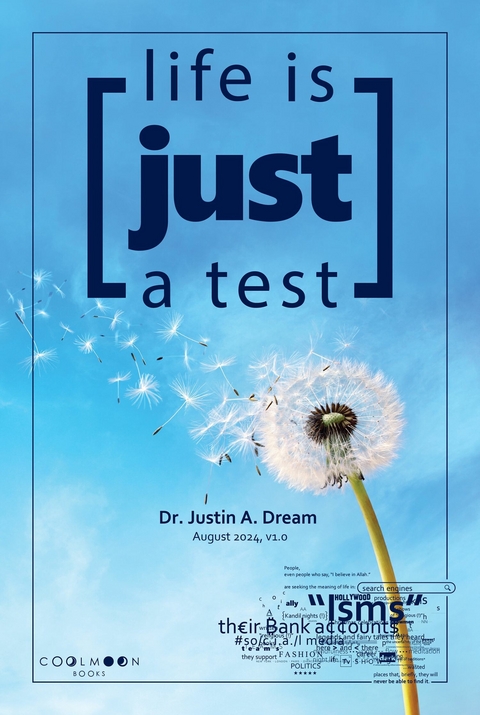
Life Is Just A Test -  Dr. Justin A. Dream

Life Is Just A Test (eBook)

eBook Download: EPUB
2025 | 1. Auflage
272 Seiten
Bookbaby (Verlag)
979-8-3509-7536-9 (ISBN)
Systemvoraussetzungen
3,56 inkl. MwSt
(CHF 3,45)
Der eBook-Verkauf erfolgt durch die Lehmanns Media GmbH (Berlin) zum Preis in Euro inkl. MwSt.
  • Download sofort lieferbar
  • Zahlungsarten anzeigen
Being tested in the post-modern era is not easy. Maybe it is not as difficult as being a Muslim in the Meccan era, but the era we live in has its own unique challenges. Muslims of this era are probably accepting that Allah (swt) is an Ilah (-Deity/God) more easily. But they are experiencing great difficulty in accepting that Allah (swt) is the One and the Only Ilah, and to reject Ilahs other than him. People, even people who say, 'I believe in Allah.' are seeking the meaning of life in search engines, social media, TV shows, Hollywood productions, their bank accounts, career paths, teams they support, music they listen to, getting wasted, nightlife, shopping malls, fashion, politics, 'Isms,' mindfulness, yoga, flow, meditation sessions, chasing power, chasing love, chasing their desires, the darkness of traditions, the uncertainty of the future, sufi monasteries, the doorsteps of their sheikhs, kandil nights, Christmas celebrations, TV shows of religious (!) showmen, chaotically written religious (!) books, legends and fairy tales they heard here and there, in places that, briefly, they will never be able to find. People are bringing the Qur'an into their homes and hanging it in the highest place possible, so that it is hard to reach, hard to read... Is it because Islam is not enough for Muslims? Is it because there is a lack of knowledge about Islam? Perhaps it is a psychological reflection of the complex mixed with admiration in Islamic lands for the centers of 'Isms'. Maybe it is an emotional result of our inability to fill the great void we feel inside with Islam. Life is Just a Test is challenging contemporary Muslims to ask the right questions that shape their faith before it is too late, drawing a roadmap to embrace and live true Islam. Written with sincere love for my brothers and sisters, it is not an easy book. Because true love is not entertaining our loved ones with the easy lie but warning them with the hard truth.

Who I am is of little consequence, but I pray that what I write, Insha Allah, might have meaning and some impact. I am an emerging writer who recently published my first book, Life is Just a Test. I hold a Ph.D. in Culture and Literature, with a particular focus on the Meccan era of Islam and its contemporary reflections. With over 20 years of professional experience in various roles that I've been fortunate to enjoy, I've had the opportunity to turn this experience into comparative studies. I believe that this life, which we experience only in limited dimensions through our senses, is a test, nothing but a test and just a test. My purpose in this temporary existence is to observe, comprehend and write about this reality, with the hope of revealing the true essence of Islam in the process. Yet, Allah (swt) knows best, and we know nothing at all. 'We will surely test you with something of fear and hunger and a loss of wealth and lives and crops, but give good tidings to the patient.' -Al-Baqarah, 155
Being tested in the post-modern era is not easy. Maybe it is not as difficult as being a Muslim in the Meccan era, but the era we live in has its own unique challenges. Muslims of this era are probably accepting that Allah (swt) is an Ilah (~Deity/God) more easily. But they are experiencing great difficulty in accepting that Allah (swt) is the One and the Only Ilah, and to reject Ilahs other than him. For many believers although they do not express it this way or desire it this way Prophet Muhammad (saw) has become a regular human being. The Qur'an has become an ordinary book. Islam has become just a religion. Today, many Muslims, moreover, many Muslims born and raised in Islamic lands, are chasing their salvation not in Islam but in "e;Isms"e;. Unable to create their own agendas free from "e;Isms,"e; they engage with the post-modern agendas imposed on them. They are finding ways of stopping, waiting and postponing change, each more enjoyable, more ambitious, and more creative than the other. They are distracting themselves with the excuse of seeking the truth when the truth is just before their eyes. People, even people who say, "e;I believe in Allah."e; are seeking the meaning of life in search engines, social media, TV shows, Hollywood productions, their bank accounts, career paths, teams they support, music they listen to, getting wasted, nightlife, shopping malls, fashion, politics, "e;Isms,"e; mindfulness, yoga, flow, meditation sessions, chasing power, chasing love, chasing their desires, the darkness of traditions, the uncertainty of the future, sufi monasteries, the doorsteps of their sheikhs, kandil nights, Christmas celebrations, TV shows of religious (!) showmen, chaotically written religious (!) books, legends and fairy tales they heard here and there, in places that, briefly, they will never be able to find. People are bringing the Qur'an into their homes and hanging it in the highest place possible, so that it is hard to reach, hard to read Is it because Islam is not enough for Muslims? Is it because there is a lack of knowledge about Islam? Perhaps it is a psychological reflection of the complex mixed with admiration in Islamic lands for the centers of "e;Isms"e;. Maybe it is an emotional result of our inability to fill the great void we feel inside with Islam. As Muslims, it is possible that we might have been caught unprepared for the social media era. It is possible that we have lost ourselves to the social bondage and media popularity of "e;Isms"e; in an age where truth is no longer important. Young people, in particular, may be reacting to the wrongs that the society they live in, which they try to impose on them under the guise of Islam, with "e;Isms"e;. They may be looking for salvation not in Islam but in post-modern "e;Isms"e; due to their resistance to change, loneliness, pretentiousness or lack of self-confidence. Or maybe we are just at the beginning of the road: we haven't defeated our egos yet. The love of Allah (swt) has not fully prevailed in our hearts over other loves. We have not succeeded in isolating ourselves from the "e;Isms"e; of the post-modern society that surrounds us. Life is Just a Test is challenging contemporary Muslims to ask the right questions that shape their faith before it is too late, drawing a roadmap to embrace and live true Islam. Written with sincere love for my brothers and sisters, it is not an easy book. Because true love is not entertaining our loved ones with the easy lie but warning them with the hard truth.

1.
The Village We Don’t Go, The Road We Don’t Know.
There is a village out there,
That village is our village,
Even if we don’t go there,
Even if we don’t know where,
That village is our village.
There is a house out there,
That house is our house,
Even if we don’t sleep under its roof,
Even if we stand aloof,
That house is our house.
There is a voice out there,
That voice is our voice,
Even if no one hears,
Even if we close our ears,
That voice is our voice.
There is a mountain out there,
That mountain is our mountain,
Even if we don’t ascend,
Even if we don’t descend,
That mountain is our mountain.
There is a road out there,
That road is our road,
Even if we don’t know it,
Even if we ignore it,
That road is our road.
In the first year of middle school, our literature teacher asked us to write an essay about a poem. We were going to write about a village we had never been to. About a village, the house in the village, the voices heard at the village, the mountain seen from the village, the road to the village. A village that somehow belonged to us, although we had never visited, stayed, seen or heard of it. Which we didn’t know for sure if it existed, and, in case it did, we had no accurate information about its whereabouts.
I was 13 years old. With my childish mind and soul, I wrote an essay about why this poem was totally wrong. “A village we have no intention of visiting cannot belong to us.” I began. “To call a village our own, we must go there. We have to stay there. We should build a school in that village and make sure everyone in the village is happy.”
I would like to emphasize the phrase “with my childish mind and soul.” I don’t want to act as a cheap hero as if I deliberately wrote my essay with an opposing view, especially at a time when the effects of the military coup were felt heavily. In those years, our families sent us off to school every morning by handing us our lunch boxes, kissing us and warning us: “Don’t interfere with anyone at school. If anyone asks something, shut up. Say, I don’t know!”. Every morning. “Don’t interfere. Keep silent! Say, I don’t know!”. Each and every single morning!
Before I could read half of my writing, my childish mind left my soul with my teacher’s slap. “It” was crying. The reason it was crying was not the slap that exploded in its face. It wasn’t because of the pain it felt. Its friends were laughing at its front. The laughter of its friends was too hard for it to process.
The first slap had only hurt the pride of my childish mind and soul. Seeing that the entire class was laughing, the woman threw a second slap with the power of the support of the young crowd behind her: that was the slap that penetrated the depths of my existence. My feet were off the ground. I had felt down.
As I fell to the ground, the laughter suddenly stopped. The class understood the severity of my pain. At first, the teacher had slapped my childish mind and soul on her own. But by encouraging her for the second slap, my friends had become partners in her mistake. They were blaming themselves. Everyone had lost their joy.
I wish I could write this was what had happened.
As I fell to the ground, the laughter burst into tears.
My childish mind was wishing to escape childhood entirely, while my childish soul was resisting to remain a child forever. I had no bad intentions. I hadn’t written anything wrong. I wasn’t disrespectful towards my teacher. I hadn’t laughed at my friends when they got beaten up before. Why was I on the ground? For what was I beaten? Why was everyone laughing at me?
***
We may throw the responsibility off our shoulders to an imposing system dictating a meaningless poem for years by saying, “It is every nation-state’s official ideology to claim ownership of the villages they have not gone, the roads they have not used.” We may also blame our distorted education system, which has failed to kill the author since Barthes’ La mort de l’auteur (Barthes 1967). In summary, we can find numerous ways – each more creative and intellectual than the other – to delegate our responsibility to someone else. With the self-confidence of not being held responsible, we may indeed rant over this issue on the internet…
However, that ownership attributed to the nation-state is a highly inclusive emotion with a broad spectrum that all segments of society have accepted.
People who call distant villages “home,” villages they haven’t visited maybe since they were kids, villages they don’t intend to go to and know nothing about, are members of our own society. The irregularity of the cities we live in, the time we lose in traffic and the devastating effects of earthquakes and epidemics are caused by our friends, relatives and acquaintances who try to turn their residences into the villages they have not been to, instead of adapting to them.
On the other hand, another group of our friends, relatives and acquaintances embrace the villages of other countries of which they know nothing, neither of their language nor culture and where they haven’t traveled even once. They compare their lives to those in houses where they have never been, in which they have never slept. They describe the mountains they have never climbed, at most shared on social media, as if they were their own. The distortion of our laws, the inferiority complex we are forced to feel towards The Occident and the destructive effects of our cultural confusion stem from our friends, relatives and acquaintances who try to turn their residencies into villages, houses and mountains they have never visited, instead of developing their own ideas.
Our childish minds and souls oscillate between these two villages. We experience a childish polarization between the two villages devoid of minds and souls. We are forced to choose between the two. One village does not understand, the other misunderstands. One removes, the other adds. One destroys, we’re unable to find. The other multiplies, we get lost in the multitude. We are stuck in between: either in emptiness or in darkness.
***
But then, we also have friends, relatives and acquaintances who say “our way” to a distant road, who embrace a road they don’t go or don’t know as if it were their own…
Some express that they are true believers, yet they don’t go to prayers or don’t know when to go. Some of them pray five times a day, but they don’t go back from the wrong paths they stray or don’t know that they have fallen into sin up to their necks.
It is unclear where they got the idea; most commonly believe that “because they are believers, they will eventually be accepted to The Guaranteed Paradise set for them after they spend in hell for a few numbered days.” They deceive themselves with this thought. Some of them try to deceive others. They commit all kinds of immorality, theft and injustice under the guise of true believers.
However, Allah’s (subhanahu wa-ta ‘ala) answer to those who claim that the fire of hell will touch them except for numbered days is very clear. His answer is truly uncomplicated. On the other hand, the good news that He gives, that those who believe and do righteous deeds are the companions of eternal Paradise, is an indescribable source of happiness…
And they say, “Never will the Fire touch us, except for (a few) numbered days.” Say, “Have you taken a covenant with Allah? For Allah will never break His covenant. Or do you say about Allah that which you do not know?”
Yes, (on the contrary), whoever earns evil and his sin has encompassed him – those are the companions of the Fire; they will abide therein eternally.
But they who believe and do righteous deeds – those are the companions of Paradise; they will abide therein eternally.
Al-Baqarah, 80, 81, 82
We know that an unreachable road won’t lead a person to heaven, yet anywhere. Then why do our friends, relatives and acquaintances persistently embrace roads that lead them nowhere?
Believing in The Guaranteed Paradise is an ideal fuse box to suppress the fear of death. This fuse cuts the current when the severity of fear of death becomes unsettling. It prevents the overcurrent of theory without practice, faith without action and religion without prayer from threatening consciousness. It offers a practical, cheap and comfortable faith experience that makes people forget the fear of death without the need for prayer, without giving up their current wrongs and sins, and without requiring to change.
Systems know very well that this fuse box used to suppress the fear of death can also be used to suppress people should they ever become conscious and begin to threaten themselves. Therefore, they ideologically embrace and systematically support moderate doses of cheap, easy and comfortable faith experiences. This support is sometimes in the form of direct encouragement, sometimes in the form of opposing society, ensuring that the society...

Erscheint lt. Verlag 3.1.2025
Sprache englisch
Themenwelt Geisteswissenschaften Religion / Theologie Islam
ISBN-13 979-8-3509-7536-9 / 9798350975369
Informationen gemäß Produktsicherheitsverordnung (GPSR)
Haben Sie eine Frage zum Produkt?
EPUBEPUB (Ohne DRM)
Größe: 4,1 MB

Digital Rights Management: ohne DRM
Dieses eBook enthält kein DRM oder Kopier­schutz. Eine Weiter­gabe an Dritte ist jedoch rechtlich nicht zulässig, weil Sie beim Kauf nur die Rechte an der persön­lichen Nutzung erwerben.

Dateiformat: EPUB (Electronic Publication)
EPUB ist ein offener Standard für eBooks und eignet sich besonders zur Darstellung von Belle­tristik und Sach­büchern. Der Fließ­text wird dynamisch an die Display- und Schrift­größe ange­passt. Auch für mobile Lese­geräte ist EPUB daher gut geeignet.

Systemvoraussetzungen:
PC/Mac: Mit einem PC oder Mac können Sie dieses eBook lesen. Sie benötigen dafür die kostenlose Software Adobe Digital Editions.
eReader: Dieses eBook kann mit (fast) allen eBook-Readern gelesen werden. Mit dem amazon-Kindle ist es aber nicht kompatibel.
Smartphone/Tablet: Egal ob Apple oder Android, dieses eBook können Sie lesen. Sie benötigen dafür eine kostenlose App.
Geräteliste und zusätzliche Hinweise

Buying eBooks from abroad
For tax law reasons we can sell eBooks just within Germany and Switzerland. Regrettably we cannot fulfill eBook-orders from other countries.

Mehr entdecken
aus dem Bereich