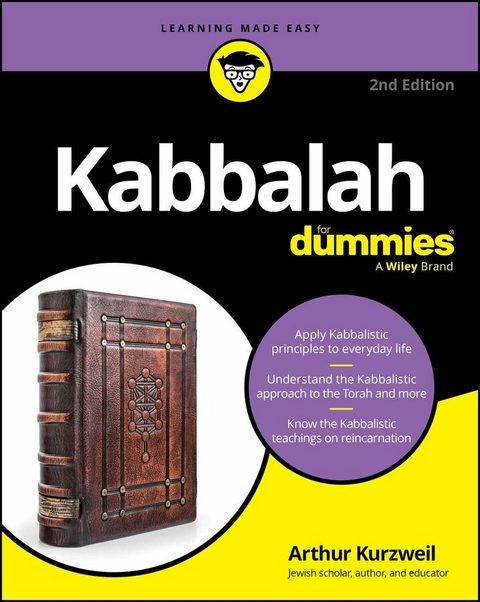
Kabbalah For Dummies (eBook)
508 Seiten
For Dummies (Verlag)
978-1-394-31514-7 (ISBN)
A trustworthy, easy-to-read guide to an integral part of Judaism
Kabbalah For Dummies, 2nd Edition is your factual and objective guide to understanding Kabbalah-a spiritual practice, also known as the 'received tradition,' that's connected to Judaism. This easy-to-follow resource walks you through how to connect to and better understand the Kabbalistic way of life, through explaining what Kabbalah is and isn't and detailing the Kabbalistic approach to the Torah, the Talmud, the Mishnah, and more Jewish texts. You'll also discover how to practice common rituals, worship, and pray as a practitioner of Kabbalah with this informative resource.
- Understand the foundations of Kabbalah (including core ideas)
- Know what Kabbalistic practice and study entails
- Discover key Kabbalah resources
Perfect for practicing Kabbalists who want to brush up on the basics and for the Kabbalah-curious-Kabbalah For Dummies, 2nd Edition is a must-read resource for anyone who wants to understand the fundamentals of one of the world's great spiritual practices.
Arthur Kurzweil teaches Talmud and Kabbalah across the United States. Arthur is the author of several books, including The Torah For Dummies, On the Road with Rabbi Steinsaltz and The Persistence of Memory. He received the Distinguished Humanitarian Award from the Melton Center For Jewish Studies at The Ohio State University for his contributions to Jewish education.
A trustworthy, easy-to-read guide to an integral part of Judaism Kabbalah For Dummies, 2nd Edition is your factual and objective guide to understanding Kabbalah a spiritual practice, also known as the received tradition, that's connected to Judaism. This easy-to-follow resource walks you through how to connect to and better understand the Kabbalistic way of life, through explaining what Kabbalah is and isn't and detailing the Kabbalistic approach to the Torah, the Talmud, the Mishnah, and more Jewish texts. You'll also discover how to practice common rituals, worship, and pray as a practitioner of Kabbalah with this informative resource. Understand the foundations of Kabbalah (including core ideas) Know what Kabbalistic practice and study entails Discover key Kabbalah resources Perfect for practicing Kabbalists who want to brush up on the basics and for the Kabbalah-curious Kabbalah For Dummies, 2nd Edition is a must-read resource for anyone who wants to understand the fundamentals of one of the world's great spiritual practices.
Introduction
Kabbalah is the theology of the Jewish people; it is the way Judaism understands God and the relationship between God and the world. For Kabbalists, all the laws, customs, practices, holidays, and rituals of Judaism are best understood in light of the Kabbalistic teachings about God and of what it is that God wants from humans.
Over the centuries, Kabbalah has become more and more systematized. Brilliant Jewish sages have explored, developed, and refined its insights to the point at which, in the last six centuries, Kabbalah has become a distinct system of ideas, beliefs, technical terminology, and values with its own history, great personalities, controversies, and vocabulary. But Kabbalah, which means “the received tradition,” has always been an integral part of Jewish religious and spiritual life.
Like other studies of divinity and spirituality, Kabbalah deals with ultimate questions: Who are we? Where do we come from? Where are we going? What for? Why?
About This Book
Kabbalah is often thought to be a secret study occupying the minds of elite students throughout the ages. But the “secrets” of Kabbalah aren’t the typical kind in which information is revealed to the few.
There are two kinds of secrets:
- Secrets that are kept from the public: When revealed, these secrets are recognized for what they are: clever illusions that, once revealed, can never fool again. Whatever “mysteries” the illusions once held disappear.
- Real secrets that are available for all to see: When real secrets are explored, they become deeper and more profound. They become richer and give birth to even greater secrets while their revelations illuminate the world. Such are the so-called “secrets” of Kabbalah.
My goal in writing this book is to help set the record straight and to inform the general public about what Kabbalah is — and also what Kabbalah isn’t.
In recent years Kabbalah has become a pop culture phenomenon, a development that’s resulted in the spread of tremendous inaccuracies and misinformation about the subject. This book is for those who are curious about the subject as well as for those who sincerely want to begin to grasp some of the profound teachings of Kabbalah and to integrate Kabbalistic wisdom into their daily lives.
Unfortunately, some books represent Kabbalah as a New Age, mystical practice dealing with amulets, obscure forms of meditation, superstition, and occult practices. Some books on Kabbalah separate Kabbalah from Judaism, misinforming well-meaning students and encouraging them to think of Kabbalah as a general philosophy of life rather than as a spiritual practice inextricably integrated into Jewish law, ritual, prayer, and study.
Kabbalah For Dummies explains in plain English both the major abstract ideas of Kabbalah as well as the Kabbalistic practices that are part of daily Jewish life. Although the study of Kabbalah can be a major commitment that influences a practitioner’s entire life, a person can pick up on many profound approaches to life just by considering the ideas and perspectives of Kabbalah.
Conventions Used in This Book
Because Kabbalah is a complex and often controversial topic, I had to establish a few conventions while writing to keep things as fair and simple as possible. As you’re reading Kabbalah For Dummies, please keep in mind my conventions regarding the following:
- References to God: Kabbalistic notions about God include the fundamental belief that the Almighty doesn’t have a gender, so whenever possible, I refrain from referring to God using masculine pronouns. However, the primary language of Judaism, Hebrew, doesn’t have a neutral gender, so most Hebrew nouns are masculine. In addition, although there’s a female term that indicates God’s indwelling presence in the world, the male forms of God’s names have their own spiritual significance (Kabbalistic tradition has many names for God, as I explain in Chapter 16). In Jewish prayers, for example, God is referred to as “He.” This isn’t sexism; God is neither He nor She, so please don’t be offended when God is referred to as “He.” You will also notice that words that take the place of the word God are capitalized. These words include Infinite, Divine, Divine Light, Heaven, and Almighty.
-
The word “Kabbalist”: Throughout this book, I refer to things that Kabbalists do or believe. In reality, none of the great (or even not-so-great) Kabbalists ever referred to themselves as Kabbalists. All the great Kabbalists throughout history have been Jews, more specifically, traditional, observant Jews. In today’s terms, they’d probably be called Orthodox Jews.
I use the term “Kabbalist” through this book to refer to those people, great sages, or everyday people like me who integrate into their lives the beautiful Jewish practices and profound ideas that are part of Jewish tradition and have an explicit connection to Jewish theological — and therefore Kabbalistic — ideas.
A great sage is referred to as a Kabbalist because he wrote about or taught the theology of Judaism and was specifically interested in using the vocabulary and essential ideas contained in the theological, esoteric explorations of Judaism. Even today, teachers who are considered masters of Kabbalah aren’t generally known as Kabbalists; instead, the term mekubal (meh-koo-bahl) indicates that a certain teacher is a qualified teacher of Kabbalah and is known for their Kabbalistic teachings.
-
Hasidism: In recent centuries, there have been two streams of Kabbalah study.
- One is represented by the great rabbi born in the year 1720, known as Rabbi Elijah (also known as the Vilna Gaon). He saw Kabbalah as a subject reserved for study only by the best students.
- The other is represented by the great rabbi born around the same time, in 1698, known as Rabbi Israel (also known as the Baal Shem Tov). The thrust of his teaching was to bring the wisdom and practice of Kabbalah to the average person, not just to the elite scholar. This effort is called Hasidism.
In this book, many of the sages that I quote and many of the Kabbalistic practices that I address come from Hasidism, which is basically the effort during the last few centuries within Judaism to bring Kabbalah to the masses. Because Kabbalah For Dummies is an effort to explain Kabbalah to as many people as possible, it’s filled with teachings from Hasidism, which is Kabbalah for everyone.
- Dates: I don’t use the abbreviations BC and AD to indicate dates in this book because these designations measure time in relation to Christian history. Rather, I use BCE, which means “Before the Common Era” and CE, which means “Common Era.” For example, the year that Columbus discovered America would be indicated as 1492 CE.
- Gender equality: Religious groups throughout history have defined participatory roles for men and women in a number of ways. Throughout this book, I’ve tried to approach subjects from a starting point that assumes that both men and women can participate in almost all Jewish rituals. However, it’s important to note that the Kabbalistic tradition isn’t gender-neutral; it maintains that men and women are spiritually different. When men and women honor and celebrate these differences through practices and roles unique to each gender, they fully realize the deeper spiritual dimension of their lives and the unique contributions to the world that emanate from these different spiritual places.
-
Pronunciation of Hebrew words: Many Hebrew words and phrases appear throughout this book, and because not everyone’s familiar with the language, I’ve offered pronunciation help. The syllable that has the accent is always in italics. But you should be aware that there are two ways to pronounce many Hebrew words:
- Ashkenazic: This is the Eastern European pronunciation that’s used in most Orthodox synagogues. An example is Shabbos (shah-bus; Sabbath), with the accent on the first syllable.
- Sephardic: This is the modern Israeli pronunciation that’s used in most liberal synagogues in the United States. An example is Shabbat (shah-baht; Sabbath), with the accent on the second syllable.
As you can see from the examples, not only are the pronunciations of the sounds different, but the accented syllable is also different. It isn’t unusual for someone today to bounce back and forth between pronunciations. In the traditional Jewish world I’ve lived in for the past 40 years, pronunciation of Hebrew words is generally Ashkenazic. But the modern Israeli pronunciation also has a great influence, and some of my pronunciations reflect this. For example, I sometimes find myself saying both “Shabbos” and “Shabbat” on the Sabbath, sometimes within mere moments of each other. In this book, I mostly use the transliteration and pronunciation commonly used in Israel, but sometimes, especially if it has become common usage, I give the Ashkenazic pronunciation.
By the way, another example of varied pronunciation is the word “Kabbalah.” The Ashkenazic pronunciation is kuh-bah-lah, whereas the modern Israeli pronunciation is...
| Erscheint lt. Verlag | 3.1.2025 |
|---|---|
| Sprache | englisch |
| Themenwelt | Geisteswissenschaften ► Religion / Theologie ► Judentum |
| Schlagworte | Hasidism • is kabbalah jewish? • Kabbalah basics • kabbalah book • kabbalah for beginners • kabbalah fundamentals • kabbalah mysticism • kabbalah practices • kabbalah rituals • Kabbalah secrets • kabbalah vs. jewish • kabbalah vs. judaism • Kabbalist • kabbalistic • kabbalist way of life • map of god • Sefirot • Torah • what is a kabbalist? • what is kabbalah? • Zohar |
| ISBN-10 | 1-394-31514-7 / 1394315147 |
| ISBN-13 | 978-1-394-31514-7 / 9781394315147 |
| Informationen gemäß Produktsicherheitsverordnung (GPSR) | |
| Haben Sie eine Frage zum Produkt? |
 EPUB (Adobe DRM)
Kopierschutz: Adobe-DRM
Adobe-DRM ist ein Kopierschutz, der das eBook vor Mißbrauch schützen soll. Dabei wird das eBook bereits beim Download auf Ihre persönliche Adobe-ID autorisiert. Lesen können Sie das eBook dann nur auf den Geräten, welche ebenfalls auf Ihre Adobe-ID registriert sind.
Details zum Adobe-DRM
Dateiformat: EPUB (Electronic Publication)
EPUB ist ein offener Standard für eBooks und eignet sich besonders zur Darstellung von Belletristik und Sachbüchern. Der Fließtext wird dynamisch an die Display- und Schriftgröße angepasst. Auch für mobile Lesegeräte ist EPUB daher gut geeignet.
Systemvoraussetzungen:
PC/Mac: Mit einem PC oder Mac können Sie dieses eBook lesen. Sie benötigen eine
eReader: Dieses eBook kann mit (fast) allen eBook-Readern gelesen werden. Mit dem amazon-Kindle ist es aber nicht kompatibel.
Smartphone/Tablet: Egal ob Apple oder Android, dieses eBook können Sie lesen. Sie benötigen eine
Geräteliste und zusätzliche Hinweise
Buying eBooks from abroad
For tax law reasons we can sell eBooks just within Germany and Switzerland. Regrettably we cannot fulfill eBook-orders from other countries.
aus dem Bereich