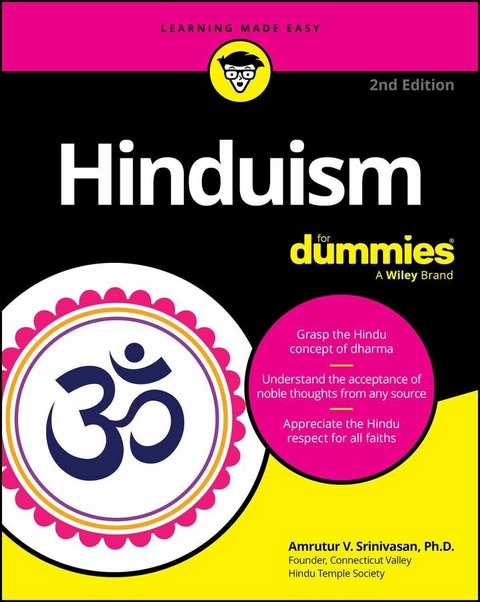
Hinduism For Dummies (eBook)
544 Seiten
For Dummies (Verlag)
9781394315949 (ISBN)
Discover one of the world's most popular belief systems
Hinduism is a fascinating and widespread religion with a diverse array of traditions, practices, scriptures, and deities. In Hinduism For Dummies, 2nd Edition, you'll get a clear view into this widely-practiced and ancient creed. The book contains an easy-to-follow introduction to Hinduism, including its four different sects-Vaishnavism, Shaivism, Shaktism, and Smartism-it's major rituals, and its most sacred teachings.
You'll understand how to recognize the different major gods and goddesses in the Hindu pantheon and the differences that give each of the four sects their distinct culture and theology. You'll also explore the history of what some consider to be the world's oldest religion that's still widely practiced today.
Inside, you'll:
- Understand core beliefs and values
- Discover Hindu wisdom and teachings (including life-cycle rites)
- Discover how to worship inside and outside of your home
- Know the Hindu concept of reality
An interesting and unbiased read, Hinduism For Dummies, 2nd Edition is the go-to guide for everyone who wants to learn more about Hinduism and its most fundamental tenets.
Amrutur V. Srinivasan, Ph.D., also known as Sheenu, has been active in the Hindu Community since 1971 and is the founder of the Connecticut Valley Hindu Temple Society. Dr. Srinivasan teaches the Bhagavad Gita, the Mahabharata, and Sanskrit. His book The Vedic Wedding: Origins, Tradition and Practice won the 2007 USA Book News Best Book Award in the category of Eastern Religions.
Discover one of the world's most popular belief systems Hinduism is a fascinating and widespread religion with a diverse array of traditions, practices, scriptures, and deities. In Hinduism For Dummies, 2nd Edition, you'll get a clear view into this widely-practiced and ancient creed. The book contains an easy-to-follow introduction to Hinduism, including its four different sects Vaishnavism, Shaivism, Shaktism, and Smartism it's major rituals, and its most sacred teachings. You'll understand how to recognize the different major gods and goddesses in the Hindu pantheon and the differences that give each of the four sects their distinct culture and theology. You'll also explore the history of what some consider to be the world's oldest religion that's still widely practiced today. Inside, you'll: Understand core beliefs and values Discover Hindu wisdom and teachings (including life-cycle rites) Discover how to worship inside and outside of your home Know the Hindu concept of reality An interesting and unbiased read, Hinduism For Dummies, 2nd Edition is the go-to guide for everyone who wants to learn more about Hinduism and its most fundamental tenets.
Introduction
There are a billion plus Hindus around the world today. In the United States alone, that number is estimated to be between 2.5 to 3 million. Perhaps your neighbor is a Hindu, or your child goes to school with Hindu children. Maybe your doctor or the guy at the gas station is Hindu. Still, Hinduism isn’t a household word in the Western world.
As I work on this second edition in 2024, some significant changes have happened since the publication of the first edition of this book. For example, in just about five decades, nearly 1,000 Hindu temples have sprung up in the United States alone. That number is most likely to increase. Furthermore, New York City officially declared Diwali, the Hindu festival of lights, to be a public school holiday in 2023. Similar steps have been taken in several school districts, including my own and several states across the country. This is clearly being driven by the increasingly large number of Hindu students enrolled in schools. Major universities have now added Hindu chaplaincy to their outreach programs. Diversity in America, the nation of immigrants, is alive and well. Hindu culture is one of the threads in its magnificent fabric.
Mainstream Hinduism doesn’t proselytize. Hindus have no interest in making you see their way because Hinduism’s fundamental belief is that God has many names. Hindus believe your way may be just as good and that you and they will meet at the end of the journey. Hinduism lets you be. With such a detached outlook, it’s no wonder the faith remains a mystery to most. My aim with this book is to unlock that mystery and help you develop an understanding of this ancient religion.
About This Book
What does one have to do to understand Hinduism? How does one convey that the principal teachings of Hinduism are universal, positive, dynamic — and practical? Hinduism is perhaps the only religion that encourages you to have faith in your own faith. The concepts inherent in such a broad outlook on life need to be shared, which is what this book aims to do.
Some books written about Hinduism are either too highbrow or too elementary. As alternatives, you could study Hinduism by going to India and staying in an ashram learning under a guru (which is the expensive option), or you can go to a center near you, for example, Ramakrishna Vedanta Society — if one exists. What you more likely need is a comprehensive text that gives you an overall picture of the religion and then elaborates on the principal concepts in an informative and enjoyable manner. Look no further. You have come to the right place.
Hinduism For Dummies is organized to help open the door to an understanding of Hinduism. You need to know a few certain facts and concepts if you want to get a feel for this faith. Here are just a few examples that I discuss in greater detail in this book:
- Concept of time and history: Given that Hinduism is the world’s oldest religion and that even scholars can’t agree on precise dates for most milestones, dates are estimates. They can vary not just by a few years here or there, but by centuries! The oral tradition of communicating and maintaining sacred findings lasted long after the invention of writing. This means that few or no dated records exist about many aspects of Hinduism before the Common Era. Further, Hindus believe that time is a continuum; there are no absolute beginnings or endings. This cyclical concept allows for a period of 4.32 million years divided into four yugas (subperiods), with declining values from one yuga to another. We are now in what is known as the Kali Yuga, the last of the four, at the end of which a renewal takes place only to be repeated again — and again.
- Geographical location: The geographical location for thousands of years during which Hinduism developed was mostly the subcontinent of India. In the past couple of centuries, more Hindus have settled in distant lands, like the United States, where the community is thriving.
- Creed: Hinduism has evolved from its core belief in One Supreme Being to a belief in the many representations of the same, from worshipping nature to worshipping deities in temples, distinguishing the Supreme Soul from an individual soul in one approach, and maintaining no such distinction in another — all in parallel, all inclusive, all still flourishing, letting go of nothing. Even atheism is accepted.
- The stories: All of Hindu philosophy and theology is based in sacred scriptures called the Vedas and the Upanishads (which are technically part of the Vedas). But equally valuable lessons are learned through Puranas (God stories from the ancient past) and through Hindu epic stories from the Ramayana and the Mahabharata. Stories — thousands of them — within more stories have helped keep the faith vivid, challenging, and alive through many thousands of years.
In this handy guide, you can find out about all these points and more. Keep in mind that whenever I say “Hindus believe …” I don’t mean that every Hindu believes — but that most Hindus may believe.
The basic tenets and truths of Hinduism are mainly expressed in Sanskrit. Religious Sanskrit, sometimes referred to as Vedic Sanskrit, was used to write poetry (sometimes set to melody with precise rules for intonation) or to write aphorisms and chants (mantras). In this book, I have avoided using Sanskrit lettering. (I include it only in Chapters 22 and 23 so that you can see how beautiful it is.) Instead, I use transliteration, meaning that I use the English alphabet to “spell” the Sanskrit words. Spelling Sanskrit words in English is always tricky because Sanskrit has more sounds than English does, and it’s based on long and short syllables rather than stressed syllables.
Also, when a name has been spelled a certain way (anglicized) for centuries, I have used the anglicized spelling. For example, I use Ganges instead of Ganga, Benares instead of Varanasi, and so on. For historical dating, I use BCE (Before Common Era) or CE (Common Era) rather than B.C. and A.D.
Foolish Assumptions
As I wrote this book, I made a few assumptions about you:
- If you aren’t a Hindu, you take an interest in faiths other than your own that may help provide a glimpse of light with regard to some of the hard questions of life.
- You have friends, family, or colleagues who are Hindus, and you want a better understanding of their faith.
- You’re traveling to India and want to know more about Indian culture, which is largely built around the Hindu religion.
- If you’re a Hindu, you should be on familiar territory, with a variety of useful information under one cover that can serve as a good reference for further exploration.
Icons Used in This Book
In this book, I use icons to identify particular kinds of information:
This icon highlights traditional lessons or ideas and moral fables that Hindus learn from parents and elders, as well as familiar stories derived from the epics and puranas.
This icon highlights concepts, ideas, mandates, and more that come out of any of the Hindu sacred books.
There’s a lot to know about a religion as ancient and vast as Hinduism, but not all of it is vital. I use this icon to highlight interesting but nonessential topics, at least during your first reading.
This icon highlights suggestions or comparisons I’ve included to help you understand the current topic or an idea that may be unfamiliar to you.
Information that appears beside this icon is important for your understanding of Hinduism. Beside this icon, you’ll see key concepts, foundations of the faith, or other essential points that you’ll want to remember.
Beyond This Book
You can discover more information, including the book’s Cheat Sheet, at www.dummies.com. Just search for “Hinduism For Dummies Cheat Sheet” for details that you can refer to again and again.
Where to Go from Here
With all the objectivity I, as a Hindu and author of this book, can muster, I suggest you read Part 1 entirely to get a good overview of Hinduism. Then look at the Table of Contents and index to identify topics that pique your interest. Perhaps you like the idea of festivals; if so, go to Chapter 16. If you’re on your way to a Hindu temple, Chapter 15 is the one you’re looking for. Attending a Hindu wedding? Go to Chapter 17. Maybe you’re visiting a Hindu family; see Chapters 4 and 5. Or maybe you’re a serious type or a student and you want to go deeper or study Hindu philosophy; head to Chapters 19 and 20. There’s something here for everyone.
Upon reading this book either in part or as a whole, if you’re inclined to explore further, I suggest you read the epics, the Ramayana and the Mahabharata, both of which cover every aspect of Hindu thought. Then I strongly recommend you read one speech: that of Swami Vivekananda delivered at the World’s Parliament of Religions in Chicago on September 11, 1893. If you’re in a hurry, just read the last four paragraphs of the speech. In order to do so, go to any search engine and type in “Vivekananda Chicago address.”
Wherever you choose to begin reading this book, I hope you find...
| Erscheint lt. Verlag | 3.1.2025 |
|---|---|
| Sprache | englisch |
| Themenwelt | Geisteswissenschaften ► Religion / Theologie ► Hinduismus |
| Schlagworte | Brahmans • Darshanas • guide to hindu religion • Hinduism basics • Hinduism for Beginners • Hinduism fundamentals • Hinduism guide • hindu religion • hindu religion basics • hindu religion sects • hindu sects • holyday • Pilgrimage • Polytheism • Puranas • Sanskrit • shaivism • Shaktism • smartism • Vaishnavism • Vedanta • vedas |
| ISBN-13 | 9781394315949 / 9781394315949 |
| Informationen gemäß Produktsicherheitsverordnung (GPSR) | |
| Haben Sie eine Frage zum Produkt? |
 EPUB (Adobe DRM)
Kopierschutz: Adobe-DRM
Adobe-DRM ist ein Kopierschutz, der das eBook vor Mißbrauch schützen soll. Dabei wird das eBook bereits beim Download auf Ihre persönliche Adobe-ID autorisiert. Lesen können Sie das eBook dann nur auf den Geräten, welche ebenfalls auf Ihre Adobe-ID registriert sind.
Details zum Adobe-DRM
Dateiformat: EPUB (Electronic Publication)
EPUB ist ein offener Standard für eBooks und eignet sich besonders zur Darstellung von Belletristik und Sachbüchern. Der Fließtext wird dynamisch an die Display- und Schriftgröße angepasst. Auch für mobile Lesegeräte ist EPUB daher gut geeignet.
Systemvoraussetzungen:
PC/Mac: Mit einem PC oder Mac können Sie dieses eBook lesen. Sie benötigen eine
eReader: Dieses eBook kann mit (fast) allen eBook-Readern gelesen werden. Mit dem amazon-Kindle ist es aber nicht kompatibel.
Smartphone/Tablet: Egal ob Apple oder Android, dieses eBook können Sie lesen. Sie benötigen eine
Geräteliste und zusätzliche Hinweise
Buying eBooks from abroad
For tax law reasons we can sell eBooks just within Germany and Switzerland. Regrettably we cannot fulfill eBook-orders from other countries.
aus dem Bereich