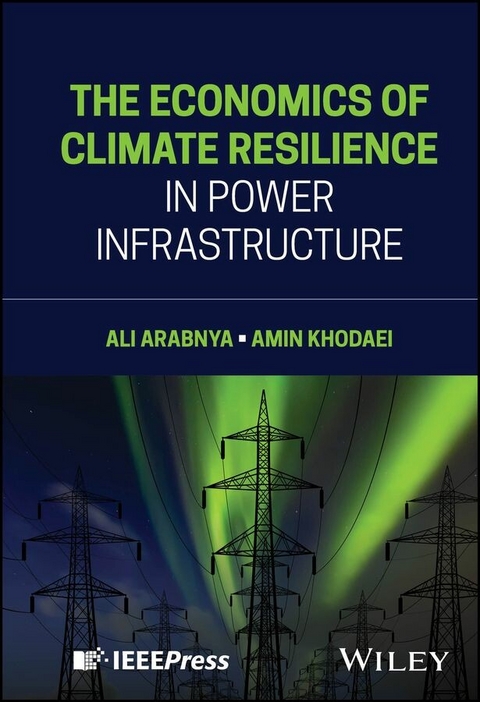
The Economics of Climate Resilience in Power Infrastructure (eBook)
393 Seiten
Wiley-IEEE Press (Verlag)
978-1-394-22076-2 (ISBN)
Full-scope economic perspectives on planning, operations management, and maintenance of climate resilience building measures in power infrastructure
The Economics of Climate Resilience in Power Infrastructure sheds light on the engineering economics of climate adaptation in electric power infrastructure by covering the relevant decision-making processes involved in managing risk and resilience in these systems. The book offers a system-level perspective along with detailed modeling of the most pressing resilience issues, while also providing detailed numerical examples on small test systems throughout the text to help readers see the outcomes of models.
The book starts with an introduction to risk management and the techno-economic considerations for resilience building measures in power systems. Next, economic concepts and mechanisms for managing climate risk in power systems are introduced. Afterward, an economic model for resilience investment in these systems against climate shocks is presented. The authors then discuss an economic asset management model for long-term resilience building in critical infrastructure assets. Subsequently, an economic model for operations management during disasters is proposed, followed by a model for post-disaster restoration.
Written by a pair of distinguished thought leaders, the book explores other topics such as:
- Microgrid applications for decentralization, along with an economic model for resilience-oriented microgrid operations
- A deep defense framework for climate risk management in power systems, along with other factors influencing their operational and financial resilience
- Essential climate risk financing mechanisms and techno-economic factors in managing risk and resilience in the face of wildfires, heat waves, and hurricanes
- Steps for utility and infrastructure owners to recover from climate shocks and natural disasters, for the benefit of shareholders, ratepayers, and policymakers
The Economics of Climate Resilience in Power Infrastructure is an essential resource on the subject for industry practitioners, R&D engineers, infrastructure planners, and graduate students seeking to incorporate the economics of resilience with engineering solutions to streamline the success of climate adaptation measures in the power and energy industry.
Ali Arabnya, PhD, is the Director of Infrastructure Finance and Climate Risk with Quanta Technology and a Research Professor of Electrical and Computer Engineering with the University of Denver. He works at the interface of engineering, finance, and policy in addressing climate change mitigation and adaptation. He holds a PhD in Industrial Engineering from the University of Houston.
Amin Khodaei, PhD, is a Professor of Electrical and Computer Engineering at the University of Denver. He is also the Founder of Plug LLC, an energy sector consultancy. His research interests include emerging technologies for grid modernization and climate resilience. He holds a PhD in Electrical Engineering from the Illinois Institute of Technology.
Full-scope economic perspectives on planning, operations management, and maintenance of climate resilience building measures in power infrastructure The Economics of Climate Resilience in Power Infrastructure sheds light on the engineering economics of climate adaptation in electric power infrastructure by covering the relevant decision-making processes involved in managing risk and resilience in these systems. The book offers a system-level perspective along with detailed modeling of the most pressing resilience issues, while also providing detailed numerical examples on small test systems throughout the text to help readers see the outcomes of models. The book starts with an introduction to risk management and the techno-economic considerations for resilience building measures in power systems. Next, economic concepts and mechanisms for managing climate risk in power systems are introduced. Afterward, an economic model for resilience investment in these systems against climate shocks is presented. The authors then discuss an economic asset management model for long-term resilience building in critical infrastructure assets. Subsequently, an economic model for operations management during disasters is proposed, followed by a model for post-disaster restoration. Written by a pair of distinguished thought leaders, the book explores other topics such as: Microgrid applications for decentralization, along with an economic model for resilience-oriented microgrid operations A deep defense framework for climate risk management in power systems, along with other factors influencing their operational and financial resilience Essential climate risk financing mechanisms and techno-economic factors in managing risk and resilience in the face of wildfires, heat waves, and hurricanes Steps for utility and infrastructure owners to recover from climate shocks and natural disasters, for the benefit of shareholders, ratepayers, and policymakers The Economics of Climate Resilience in Power Infrastructure is an essential resource on the subject for industry practitioners, R&D engineers, infrastructure planners, and graduate students seeking to incorporate the economics of resilience with engineering solutions to streamline the success of climate adaptation measures in the power and energy industry.
| Erscheint lt. Verlag | 27.12.2024 |
|---|---|
| Sprache | englisch |
| Themenwelt | Geisteswissenschaften ► Geschichte |
| Technik ► Elektrotechnik / Energietechnik | |
| Wirtschaft ► Betriebswirtschaft / Management | |
| Schlagworte | climate adaptation • Climate shocks • Critical Infrastructure • decentralization • Energy Economics • Energy systems • heatwaves • Hurricanes • Microgrid • natural disasters • power system economics • Power Systems • Resilience • risk analysis • Smart Grid • sustainability • wildfires |
| ISBN-10 | 1-394-22076-6 / 1394220766 |
| ISBN-13 | 978-1-394-22076-2 / 9781394220762 |
| Informationen gemäß Produktsicherheitsverordnung (GPSR) | |
| Haben Sie eine Frage zum Produkt? |
 EPUB (Adobe DRM)
Kopierschutz: Adobe-DRM
Adobe-DRM ist ein Kopierschutz, der das eBook vor Mißbrauch schützen soll. Dabei wird das eBook bereits beim Download auf Ihre persönliche Adobe-ID autorisiert. Lesen können Sie das eBook dann nur auf den Geräten, welche ebenfalls auf Ihre Adobe-ID registriert sind.
Details zum Adobe-DRM
Dateiformat: EPUB (Electronic Publication)
EPUB ist ein offener Standard für eBooks und eignet sich besonders zur Darstellung von Belletristik und Sachbüchern. Der Fließtext wird dynamisch an die Display- und Schriftgröße angepasst. Auch für mobile Lesegeräte ist EPUB daher gut geeignet.
Systemvoraussetzungen:
PC/Mac: Mit einem PC oder Mac können Sie dieses eBook lesen. Sie benötigen eine
eReader: Dieses eBook kann mit (fast) allen eBook-Readern gelesen werden. Mit dem amazon-Kindle ist es aber nicht kompatibel.
Smartphone/Tablet: Egal ob Apple oder Android, dieses eBook können Sie lesen. Sie benötigen eine
Geräteliste und zusätzliche Hinweise
Buying eBooks from abroad
For tax law reasons we can sell eBooks just within Germany and Switzerland. Regrettably we cannot fulfill eBook-orders from other countries.
aus dem Bereich