


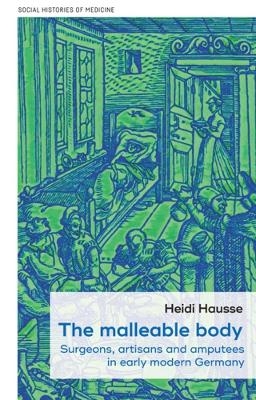
The Malleable Body
Surgeons, Artisans, and Amputees in Early Modern Germany
Seiten
2025
Manchester University Press (Verlag)
978-1-5261-9083-3 (ISBN)
Manchester University Press (Verlag)
978-1-5261-9083-3 (ISBN)
This invaluable study reveals how practices for treating the loss of limbs in early modern Germany transformed western medicine. From amputations to mechanical arms, surgical and artisanal interventions forged a growing perception, fundamental to biomedicine today, that humans could alter the body—that it was malleable. -- .
WINNER of the 2025 European Association for the History of Medicine and Health Book Award
This book uses amputation and prostheses to tell a new story about medicine and embodied knowledge-making in early modern Europe. It draws on the writings of craft surgeons and learned physicians to follow the heated debates that arose from changing practices of removing limbs, uncovering tense moments in which decisions to operate were made. Importantly, it teases out surgeons’ ideas about the body embedded in their technical instructions. This unique study also explores the material culture of mechanical hands that amputees commissioned locksmiths, clockmakers, and other artisans to create, revealing their roles in developing a new prosthetic technology. Over two centuries of surgical and artisanal interventions emerged a growing perception, fundamental to biomedicine today, that humans could alter the body — that it was malleable. -- .
WINNER of the 2025 European Association for the History of Medicine and Health Book Award
This book uses amputation and prostheses to tell a new story about medicine and embodied knowledge-making in early modern Europe. It draws on the writings of craft surgeons and learned physicians to follow the heated debates that arose from changing practices of removing limbs, uncovering tense moments in which decisions to operate were made. Importantly, it teases out surgeons’ ideas about the body embedded in their technical instructions. This unique study also explores the material culture of mechanical hands that amputees commissioned locksmiths, clockmakers, and other artisans to create, revealing their roles in developing a new prosthetic technology. Over two centuries of surgical and artisanal interventions emerged a growing perception, fundamental to biomedicine today, that humans could alter the body — that it was malleable. -- .
Heidi Hausse is Assistant Professor of History at Auburn University -- .
Introduction
1 Writing the craft of surgery
2 Communities face the cold fire
3 Visions of the body
4 After the operation
5 Mechanical hands
6 Prosthetic technology on the move
Epilogue
Index -- .
| Erscheinungsdatum | 06.05.2025 |
|---|---|
| Reihe/Serie | Social Histories of Medicine |
| Zusatzinfo | 33 colour illustrations |
| Verlagsort | Manchester |
| Sprache | englisch |
| Maße | 156 x 234 mm |
| Gewicht | 409 g |
| Themenwelt | Geschichte ► Teilgebiete der Geschichte ► Kulturgeschichte |
| Medizinische Fachgebiete ► Chirurgie ► Ästhetische und Plastische Chirurgie | |
| Studium ► Querschnittsbereiche ► Geschichte / Ethik der Medizin | |
| ISBN-10 | 1-5261-9083-4 / 1526190834 |
| ISBN-13 | 978-1-5261-9083-3 / 9781526190833 |
| Zustand | Neuware |
| Informationen gemäß Produktsicherheitsverordnung (GPSR) | |
| Haben Sie eine Frage zum Produkt? |
Mehr entdecken
aus dem Bereich



aus dem Bereich
Die Revolution des Gemeinen Mannes
Buch | Softcover (2024)
C.H.Beck (Verlag)
CHF 16,80
Eine Geschichte des Geschmacks
Buch | Hardcover (2025)
C.H.Beck (Verlag)
CHF 49,95
vom Mittelalter bis zur Gegenwart
Buch | Softcover (2024)
C.H.Beck (Verlag)
CHF 16,80


