


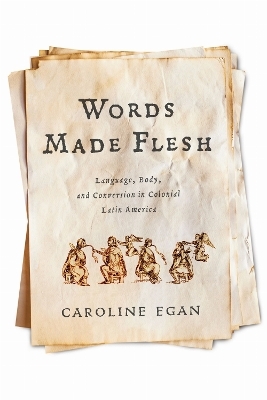
Words Made Flesh
Language, Body, and Conversion in Colonial Latin America
Seiten
2025
University of Pennsylvania Press (Verlag)
978-1-5128-2846-7 (ISBN)
University of Pennsylvania Press (Verlag)
978-1-5128-2846-7 (ISBN)
Examines the role of the body in Indigenous-language religious texts from colonial Latin America
Words Made Flesh examines the role played by corporeality in a series of missionary linguistic and poetic projects from Brazil, Peru, and Mexico in early colonial Latin America. Caroline Egan analyzes how works produced in Indigenous languages for the purpose of evangelization were shaped by and, in turn, transformed native understandings of embodiment.
Egan follows the trajectories of specific understudied words in the colonial corpus, tracing their usage through grammars, dictionaries, doctrinal translations, and hymns in Tupi, Quechua, and Nahuatl. These words, however, might not be the first to come to mind when thinking about missionary projects in the colonial world—such as God and trinity, heaven and hell, angel and demon. Instead, the book examines words like the Tupi îuká (to kill) and manõ (to die); the Quechua sunqu (now often translated as "heart"); and the Nahuatl chōca (to weep), cuīca (to sing), and ihuinti (to get drunk). With complementary emphases on regional specificity and comparative ramifications, Words Made Flesh argues that the changing fortunes of these words speak to significant areas of dialogue and debate between Indigenous communities and missionary writers in the late sixteenth century.
Words Made Flesh examines the role played by corporeality in a series of missionary linguistic and poetic projects from Brazil, Peru, and Mexico in early colonial Latin America. Caroline Egan analyzes how works produced in Indigenous languages for the purpose of evangelization were shaped by and, in turn, transformed native understandings of embodiment.
Egan follows the trajectories of specific understudied words in the colonial corpus, tracing their usage through grammars, dictionaries, doctrinal translations, and hymns in Tupi, Quechua, and Nahuatl. These words, however, might not be the first to come to mind when thinking about missionary projects in the colonial world—such as God and trinity, heaven and hell, angel and demon. Instead, the book examines words like the Tupi îuká (to kill) and manõ (to die); the Quechua sunqu (now often translated as "heart"); and the Nahuatl chōca (to weep), cuīca (to sing), and ihuinti (to get drunk). With complementary emphases on regional specificity and comparative ramifications, Words Made Flesh argues that the changing fortunes of these words speak to significant areas of dialogue and debate between Indigenous communities and missionary writers in the late sixteenth century.
Caroline Egan is Assistant Professor of Colonial Latin American Literature at Northwestern University.
| Erscheinungsdatum | 28.10.2025 |
|---|---|
| Reihe/Serie | The Early Modern Americas |
| Zusatzinfo | 8 b/w illustrations |
| Verlagsort | Pennsylvania |
| Sprache | englisch |
| Maße | 152 x 229 mm |
| Themenwelt | Geisteswissenschaften ► Geschichte ► Regional- / Ländergeschichte |
| Geisteswissenschaften ► Religion / Theologie | |
| Geisteswissenschaften ► Sprach- / Literaturwissenschaft ► Anglistik / Amerikanistik | |
| Geisteswissenschaften ► Sprach- / Literaturwissenschaft ► Literaturwissenschaft | |
| Geisteswissenschaften ► Sprach- / Literaturwissenschaft ► Sprachwissenschaft | |
| ISBN-10 | 1-5128-2846-7 / 1512828467 |
| ISBN-13 | 978-1-5128-2846-7 / 9781512828467 |
| Zustand | Neuware |
| Informationen gemäß Produktsicherheitsverordnung (GPSR) | |
| Haben Sie eine Frage zum Produkt? |
Mehr entdecken
aus dem Bereich


aus dem Bereich
die Geschichte meiner Urgroßmutter
Buch | Hardcover (2025)
C.H.Beck (Verlag)
CHF 32,15
Träume und Macht : eine Biografie
Buch | Hardcover (2025)
C.H.Beck (Verlag)
CHF 61,60


