


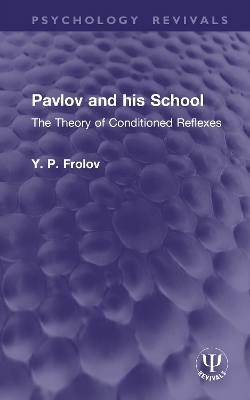
Pavlov and his School
The Theory of Conditioned Reflexes
Seiten
2025
Routledge (Verlag)
978-1-041-02667-9 (ISBN)
Routledge (Verlag)
978-1-041-02667-9 (ISBN)
First published in 1937, this title provided fascinating biographical information about Pavlov himself and is a clear and concise account of the theory of conditioned reflexes demanding no extensive knowledge of nervous physiology. One of the most cited psychologists of the twentieth century, his legacy lives on today in many forms.
Originally published in 1937, Pavlov and his School provides fascinating biographical information about Pavlov himself and is a clear and concise account of the theory of conditioned reflexes demanding no extensive knowledge of nervous physiology. It shows by numerous examples from everyday life the application of Pavlov’s teaching to subjects not generally associated with physiology.
To the specialist its account of the work of Pavlov’s predecessors, which was not generally known, and of Pavlov’s philosophy, should have particular interest, giving as it does a clear picture of the circumstances which led to the evolution of Pavlov’s method of investigating higher nervous activity.
One of the most cited psychologists of the twentieth century, Pavlov's legacy lives on today in many forms, including through his studies of classical conditioning, which continue to be central to modern behaviour therapy.
Originally published in 1937, Pavlov and his School provides fascinating biographical information about Pavlov himself and is a clear and concise account of the theory of conditioned reflexes demanding no extensive knowledge of nervous physiology. It shows by numerous examples from everyday life the application of Pavlov’s teaching to subjects not generally associated with physiology.
To the specialist its account of the work of Pavlov’s predecessors, which was not generally known, and of Pavlov’s philosophy, should have particular interest, giving as it does a clear picture of the circumstances which led to the evolution of Pavlov’s method of investigating higher nervous activity.
One of the most cited psychologists of the twentieth century, Pavlov's legacy lives on today in many forms, including through his studies of classical conditioning, which continue to be central to modern behaviour therapy.
Professor Y. P. Frolov (1892–1967) was, at the time of original publication, a member of the All Union Institute of Experimental Medicine, Moscow.
Author’s Foreword. 1. Pavlov’s Immediate Predecessors: Sechenov and the Behaviourists 2. Pavlov’s Theory of Conditioned and Unconditioned Reflexes 3. The Analysis of Complicated Forms of Behaviour from the Standpoint of Conditioned Reflexes 4. Pavlov’s Views on the Inhibition of Conditioned Reflexes 5. Pavlov’s Theory of Sleep and States Akin to Sleep 6. Experiments with Anthropoid Apes, and the Comparative Physiology of Conditioned Reflexes 7. Pavlov’s Theory of Experimental Neuroses 8. Pavlov’s Method of Work: His School. Index.
| Erscheinungsdatum | 04.06.2025 |
|---|---|
| Reihe/Serie | Psychology Revivals |
| Verlagsort | London |
| Sprache | englisch |
| Maße | 138 x 216 mm |
| Gewicht | 800 g |
| Themenwelt | Geisteswissenschaften ► Psychologie ► Verhaltenstherapie |
| Naturwissenschaften ► Biologie ► Zoologie | |
| ISBN-10 | 1-041-02667-6 / 1041026676 |
| ISBN-13 | 978-1-041-02667-9 / 9781041026679 |
| Zustand | Neuware |
| Informationen gemäß Produktsicherheitsverordnung (GPSR) | |
| Haben Sie eine Frage zum Produkt? |
Mehr entdecken
aus dem Bereich

aus dem Bereich
psychodynamisch denken – verhaltenstherapeutisch handeln
Buch | Hardcover (2023)
Schattauer (Verlag)
CHF 67,20
das Behandlungsprogramm SLEEPexpert für den klinischen Alltag
Buch | Softcover (2024)
Schattauer (Verlag)
CHF 34,95


