


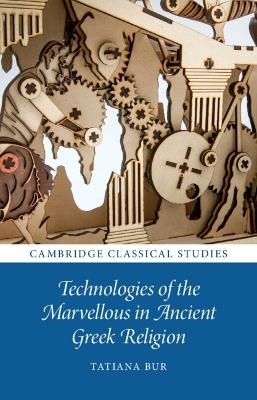
Technologies of the Marvellous in Ancient Greek Religion
Seiten
2025
Cambridge University Press (Verlag)
978-1-009-33168-5 (ISBN)
Cambridge University Press (Verlag)
978-1-009-33168-5 (ISBN)
For the first time investigates the ways that technological, and especially mechanical, strategies were integrated into ancient Greek religion. Presents in full the evidence from the fifth century BCE to the second century CE, thereby revealing the shifting matrices of agency between technical objects, mechanical knowledge, gods, and mortals.
This book investigates the ways that technological, and especially mechanical, strategies were integrated into ancient Greek religion. By analysing a range of evidence, from the tragic use of the deus ex machina to Hellenistic epigrams to ancient mechanical literature, it expands the existing vocabulary of visual modes of ancient epiphany. Moreover, it contributes to the cultural history of the unique category of ancient 'enchantment' technologies by challenging the academic orthodoxy regarding the incompatibility of religion and technology. The evidence for this previously unidentified phenomenon is presented in full, thereby enabling the reader to perceive the shifting matrices of agency between technical objects, mechanical knowledge, gods, and mortals from the fifth century BCE to the second century CE.
This book investigates the ways that technological, and especially mechanical, strategies were integrated into ancient Greek religion. By analysing a range of evidence, from the tragic use of the deus ex machina to Hellenistic epigrams to ancient mechanical literature, it expands the existing vocabulary of visual modes of ancient epiphany. Moreover, it contributes to the cultural history of the unique category of ancient 'enchantment' technologies by challenging the academic orthodoxy regarding the incompatibility of religion and technology. The evidence for this previously unidentified phenomenon is presented in full, thereby enabling the reader to perceive the shifting matrices of agency between technical objects, mechanical knowledge, gods, and mortals from the fifth century BCE to the second century CE.
TATIANA BUR held the Moses and Mary Finley Research Fellowship at Darwin College, Cambridge before joining the Australian National University as Lecturer in Classics. She is the recipient of the Cambridge University Hare Prize in Classics, and co-editor of Technological Animation in Classical Antiquity (2024).
Introduction; Part I. Greek Tragedy and Mechanical Epiphany: 1. Viewing the mēchanē; 2. Visual representations of the gods in tragedy; 3. Theos apo mēchanēs; Part II. Technologies and Ritual Experience; 4. Technical divination and mechanics of sacred space; 5. Dedicated inventions; 6. Pompai and the mechanics of sacred occasion; Part III. Faking the Gods; 7. In the hands of frauds; 8. Theomimesis-theomachy.
| Erscheinungsdatum | 15.07.2025 |
|---|---|
| Reihe/Serie | Cambridge Classical Studies |
| Zusatzinfo | Worked examples or Exercises; 15 Halftones, color |
| Verlagsort | Cambridge |
| Sprache | englisch |
| Gewicht | 542 g |
| Themenwelt | Geschichte ► Allgemeine Geschichte ► Vor- und Frühgeschichte |
| Geschichte ► Allgemeine Geschichte ► Altertum / Antike | |
| Geschichte ► Teilgebiete der Geschichte ► Religionsgeschichte | |
| ISBN-10 | 1-009-33168-X / 100933168X |
| ISBN-13 | 978-1-009-33168-5 / 9781009331685 |
| Zustand | Neuware |
| Informationen gemäß Produktsicherheitsverordnung (GPSR) | |
| Haben Sie eine Frage zum Produkt? |
Mehr entdecken
aus dem Bereich



aus dem Bereich
auf den Spuren der frühen Zivilisationen
Buch | Hardcover (2023)
C.H.Beck (Verlag)
CHF 27,95
Konzepte – Methoden – Theorien
Buch | Softcover (2024)
UTB (Verlag)
CHF 55,85
die archäologische Wahrheit über die Bibel
Buch | Softcover (2023)
C.H.Beck (Verlag)
CHF 25,20


