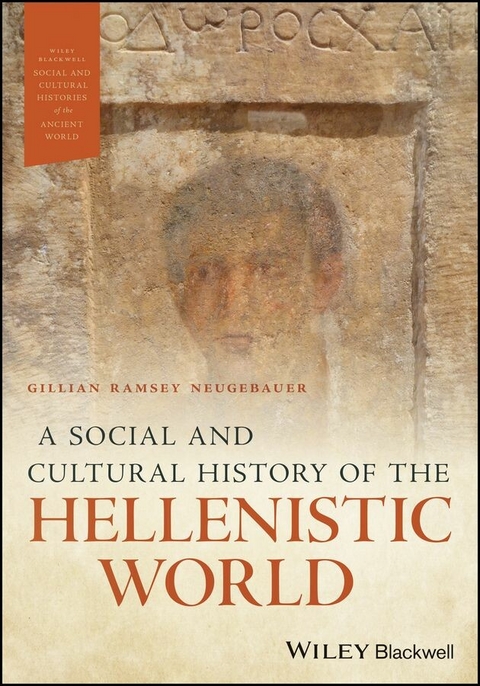
A Social and Cultural History of the Hellenistic World (eBook)
675 Seiten
Wiley-Blackwell (Verlag)
978-1-119-04324-9 (ISBN)
Explore the detailed and personal stories of real people living throughout the Hellenistic world
In A Social and Cultural History of the Hellenistic World, author Gillian Ramsey Neugebauer paints a vivid picture of the men and women of the Hellenistic period, their communities, and their experiences of life. Assuming only minimal knowledge of classical antiquity, this clear and engaging textbook brings to life the real people who lived in the Mediterranean region, the Balkans, around the Black Sea, across North Africa, and the Near East.
Rather than focusing on the elites, royals, and other significant figures of the period, the author draws from a wide range of ancient evidence to explore everyday Hellenistic people in their own context. Reader-friendly chapters offer fresh perspectives on well-studied areas of ancient Greek culture while providing new insights into rarely discussed aspects of day-to-day life in the Hellenistic world. Topics include daily technology, food, clothing, housing, travel, working life, slavery, education, temple economies, and more.
Containing numerous references, further readings, photographs, and figures, A Social and Cultural History of the Hellenistic World is an excellent textbook for undergraduate and graduate courses in Ancient History or Classical Studies programs, particularly those dedicated to Hellenistic history.
GILLIAN RAMSEY NEUGEBAUER is Assistant Professor of Classics at Campion College at the University of Regina, Canada. Her research covers Seleukid and Ptolemaic history, Hellenistic women and queens, and Hellenistic administration and geography. Her recent publications include chapters in Women and Monarchy in the Ancient Mediterranean and The Hellenistic and Roman Near East.
1
Introduction
The Hellenistic world is, in its broadest sense, every region and time period impinged upon by the presence and influence of ancient Greek culture. Geographically, it traverses the entire Mediterranean, the Balkans, around the Black Sea, across North Africa and the Near East as far as the Indian subcontinent, and possibly beyond. Chronologically, it extends throughout Classical antiquity, as long as Greek literature and scholarship remained formative within cultures and ways of knowing. All this makes for a large world, not so distant from our own.
This volume addresses the Hellenistic world within somewhat narrower confines, in keeping with how scholars of antiquity generally define historical periods. By this measure, the Hellenistic world encompasses places and peoples affected by the conquests of Alexander the Great, across the parts of the world controlled by his successors until the time when the Romans annexed them into their empire. In terms of dates, the Hellenistic period runs from one monarch's death to another's: Alexander's in 323 to 30, when the last Macedonian monarch, Kleopatra VII, died and left Egypt to the Romans. In practical terms, this periodization actually means that the Hellenistic period has different durations in different places, depending on when the Romans appeared on the scene – 146 for mainland Greece, 64 for Syria, never for areas east of the Euphrates.
A way to make sense of such a geographically and chronologically varied world is to follow the ups and downs of the different political actors who tried to hold it and govern it, starting with Alexander. There are many excellent political histories of the Hellenistic period (see the reading list below). This volume takes a different approach, that of a social and cultural history. It opens up a window on the fascinating circumstances faced by people living in the Hellenistic world, some things seeming perhaps quite odd, some startlingly familiar.
When it comes down to it, every history is truly written about the historian's present. That is, whatever world the historian inhabits sets the tone, aims, approach, and concerns of their investigation. Thus, this volume probably has a certain perspective reminiscent of the second and third decades of the twenty‐first century, making its assumptions and focus different from the studies of Hellenistic society and cultural life written in the 1940s, 1990s, or even the early 2000s. This might be evident in how the chapter topics are framed and which topics are brought into the foreground versus which ones are allowed to recede. This is due partly to some areas of life being less written about and seeming to deserve some attention, and partly to other areas being so well studied that to go over them in minute detail seems a little redundant. The desire here was not to reinvent Hellenistic history but to add another chapter to it, knowing that more will continue to be written down the road.
What Is Hellenistic?
“Hellenistic” is a word coined in the modern era using ancient Greek grammatical forms to express the concept of “being or becoming Greek,” or we might say, it is an adjective meaning “Greek‐ish.” The ancient Greeks called themselves Hellenes, after a mythical hero, Hellen. They had an adjective hellenikos to describe Greek things; the word hellenikon was sometimes used to describe Greek culture, and they called their language Hellenikē. Before going on, we should note that our word “Greek” comes via Latin from the original Greek word Graikos which also denoted a Hellene. In his study of the hydrological cycle, Aristotle happens to mention that the Graikoi were predecessors of the later Hellenes and lived in central Greece during mythical times around the time of the flood – from the myth of Deucalion the father of Hellen (Mete. 352a–b). The Marmor Parium, an inscribed chronicle of Greek history set up in 263/262 on the island Paros, also records that once Hellen took over from Deucalion, the Graikoi came to be called Hellenes (IG XII,5 444, 6.10–11).
The verb hellenizo referred to speaking Hellenikē, but people often defined it in contrast to speaking other languages or, interestingly, dialects. So the early‐third‐century comic Poseidippos of Cassandreia had a character in one of his dramas say of an Athenian “You speak Attic … but we Hellenes speak Hellenike” (Harmost 28). He seems to be distinguishing between the Athenian Attic dialect and the common Greek in circulation elsewhere, with a bit of cultural prejudice thrown in. Aristotle alludes to this notion of an acceptable common Greek language in a discussion of grammatical errors which show someone to be speaking improperly (Sophistici elenchi 182a). A real‐world example of this comes to us from mid‐third‐century Syria, where someone, perhaps an Arab, laments to his boss that people treat him badly because he does not know how to hellenizein (P.Col.Zen. 4.66; BD 137). He might have been referring to his poor grasp of the Greek language (his letter was penned by a scribe on his behalf), or to his lack of Greek‐ish manners, or perhaps both.
The word hellenismos meant speaking or behaving in a Greek way. The second‐century Stoic philosopher Diogenes of Babylon stated that hellenismos was the prime characteristic of good communication and required that a speaker be precise and polite (Diog. Laert. 7.59). In terms of hellenismos as behaviour, the most famous ancient usage of it is not favourable. The author of 2 Maccabees condemns the Jerusalem high priest Jason for a corrupting and unlawful hellenismos, typified by attending the gymnasium and wearing a certain type of Greek hat (the petasos, see Chapter 9), which was making him contemptuous of Jewish traditions and an embarrassment to the community of the faithful (4.12–13). Jason had also abandoned his Hebrew name Joshua for a new one (Joseph. AJ 12.239).
Hellenism in antiquity was a complex notion; it could be learned and perfected, but it existed in the eye of the beholder and required the approval of others, or it could earn condemnation either as a failed attempt at Greekness or as a rejection of another culture. Calling an entire historical period of Mediterranean and Near Eastern history “Hellenistic,” or the era of Hellenism, is thus a leap of semantics and, perhaps, logic. But it was done long ago, and so, for better or worse, we continue to use the designation and grapple with the terminology's implications for how we understand what culture, and Greekness, meant to people in the past.
More will be discussed in Chapter 3 about the Hellenistic as an historical period, and how we study it. For now, let the introductory description in terms of geography and chronology above suffice. To it we can add the consideration of cultures present in those spaces and times, and there were many. A theme running throughout Hellenistic scholarship is how these different cultures encountered and reacted to the arrival of Greekness. Hellenism could be communicated and lived out in so many specific ways: language use, personal names, manners, education, clothing, cuisine (the petitioner from the papyrus above complained that his sub‐par Greekness made people give him bad quality wine for his rations). Hellenism could be found in systems of governance, the kinds of taxes people paid, favourite board‐games, house décor, music, religion – in short, all the possible dimensions of society and culture. An important factor in the reactions to Hellenism was the mode of the encounter: whether through trade, immigration, warfare, or colonization – essentially, asking what was the power dynamic in the intercultural relationship. So when scholars investigate the Hellenistic, there is always present some thread of curiosity over cultural identity and what Greekness meant to the people under study.
Why Social History?
Social history, or “history from the bottom up,” puts the focus on the ordinary people at the base of society. The method for doing social history embeds the analysis of historical processes, trends, and events in the physical and economic conditions of life, and considers how social relationships and culture shaped the experiences of individuals, families, and wider communities. It also means that we work with the assumption that a full understanding of any society must be rooted in knowing the circumstances of the majority of ordinary people's lives.
When the social history discipline appeared in the mid‐twentieth century, it upturned traditional “top‐down” methods which sought to understand past societies through the unfolding of political events and the attitudes held by people in power. Knowing the political context helps, and Chapter 3 provides an outline of this for the Hellenistic period, but it is only part of history. The reality in the Hellenistic period, and in many other eras, is that a small minority of mostly men held power, and the vast majority of people were poor and politically unimportant. Social history seeks to redress the marginalization of past peoples and bring their lives into the centre of attention.
Practically, this means that every topic in what follows is discussed after considering questions like “Does this relate to poor people?,” “Is there evidence for the...
| Erscheint lt. Verlag | 12.12.2024 |
|---|---|
| Reihe/Serie | Wiley Blackwell Social and Cultural Histories of the Ancient World |
| Sprache | englisch |
| Themenwelt | Geschichte ► Allgemeine Geschichte ► Altertum / Antike |
| Schlagworte | Ancient Greece cultural history • ancient Greece social history • ancient Mediterranean cultural history • ancient Mediterranean social history • Hellenistic cultural history textbook • Hellenistic history textbook • Hellenistic social history textbook |
| ISBN-10 | 1-119-04324-7 / 1119043247 |
| ISBN-13 | 978-1-119-04324-9 / 9781119043249 |
| Informationen gemäß Produktsicherheitsverordnung (GPSR) | |
| Haben Sie eine Frage zum Produkt? |
 EPUB (Adobe DRM)
Kopierschutz: Adobe-DRM
Adobe-DRM ist ein Kopierschutz, der das eBook vor Mißbrauch schützen soll. Dabei wird das eBook bereits beim Download auf Ihre persönliche Adobe-ID autorisiert. Lesen können Sie das eBook dann nur auf den Geräten, welche ebenfalls auf Ihre Adobe-ID registriert sind.
Details zum Adobe-DRM
Dateiformat: EPUB (Electronic Publication)
EPUB ist ein offener Standard für eBooks und eignet sich besonders zur Darstellung von Belletristik und Sachbüchern. Der Fließtext wird dynamisch an die Display- und Schriftgröße angepasst. Auch für mobile Lesegeräte ist EPUB daher gut geeignet.
Systemvoraussetzungen:
PC/Mac: Mit einem PC oder Mac können Sie dieses eBook lesen. Sie benötigen eine
eReader: Dieses eBook kann mit (fast) allen eBook-Readern gelesen werden. Mit dem amazon-Kindle ist es aber nicht kompatibel.
Smartphone/Tablet: Egal ob Apple oder Android, dieses eBook können Sie lesen. Sie benötigen eine
Geräteliste und zusätzliche Hinweise
Buying eBooks from abroad
For tax law reasons we can sell eBooks just within Germany and Switzerland. Regrettably we cannot fulfill eBook-orders from other countries.
aus dem Bereich