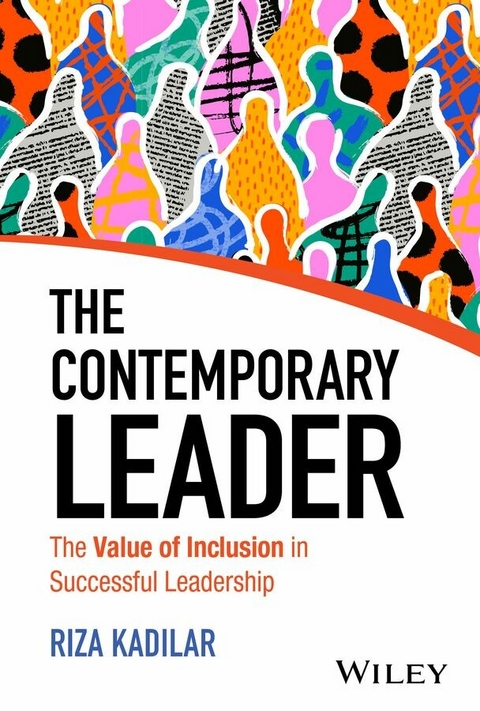
The Contemporary Leader (eBook)
286 Seiten
Wiley (Verlag)
978-1-394-27638-7 (ISBN)
Strategies and tools to become a better leader by developing an inclusive perspective at work
Instead of seeing inclusiveness as a 'trendy concept,' The Contemporary Leader: The Value of Inclusion in Successful Leadership shows its audience on how inclusion is an emotion that is achieved only through effective practice abilities. This book delves into what inclusiveness promises us, discusses the relationship between inclusiveness, productivity, and diversity, evaluates concepts that are useful for us to increase our capacity for inclusion and looks at the obstacles that stand in the way of inclusion (such as unconscious prejudices) to help teach readers understand how to change and become an inclusive leader.
Written by Dr. Riza Kadilar, President of European Mentoring and Coaching Council (EMCC Global), this book explores topics including:
- How inclusion is effected when people feel respected, valued, trusted and safe, have a sense of belonging and are able to be their best self
- Why diversity in aspects like age, appearance, culture and education can be turned into a benefit for any organisation
- Why leaders must regard the differences, and not be regardless of the differences, of their team members
The Contemporary Leader earns a well deserved spot on the bookshelves of all coaches and mentors, business leaders, HR professionals and managers who seek to reinvent their perspective surrounding timely interpersonal topics and achieve greater organisational cohesiveness and success as a result.
RIZA KADILAR, PHD, MBA, is the President of EMCC Global (European Mentoring and Coaching Council). He has 30 years' experience as a senior executive in the European banking sector, is a sought-after speaker, and has acted as a visiting professor at leading universities. Kadilar offers mentoring and coaching services for C-level management, founders, and investors at startups, corporates, and financial institutions. He focuses particularly on growth and compliance issues and the creation of high-performing, inclusive leadership teams.
Strategies and tools to become a better leader by developing an inclusive perspective at work Instead of seeing inclusiveness as a trendy concept, The Contemporary Leader: The Value of Inclusion in Successful Leadership shows its audience on how inclusion is an emotion that is achieved only through effective practice abilities. This book delves into what inclusiveness promises us, discusses the relationship between inclusiveness, productivity, and diversity, evaluates concepts that are useful for us to increase our capacity for inclusion and looks at the obstacles that stand in the way of inclusion (such as unconscious prejudices) to help teach readers understand how to change and become an inclusive leader. Written by Dr. Riza Kadilar, President of European Mentoring and Coaching Council (EMCC Global), this book explores topics including: How inclusion is effected when people feel respected, valued, trusted and safe, have a sense of belonging and are able to be their best self Why diversity in aspects like age, appearance, culture and education can be turned into a benefit for any organisation Why leaders must regard the differences, and not be regardless of the differences, of their team members The Contemporary Leader earns a well deserved spot on the bookshelves of all coaches and mentors, business leaders, HR professionals and managers who seek to reinvent their perspective surrounding timely interpersonal topics and achieve greater organisational cohesiveness and success as a result.
1
Why Inclusion and Why Now?
What Do We Mean by Inclusion?
In today’s world, diversity and inclusion have become two of the most important concepts for the business world on a global scale. You might wonder, “With all the challenges, threats, and difficulties we face, why is such a humane issue so prominent on the agenda?” In this section, I aim to explain that inclusion is indeed an antidote to many of today’s challenges. This means that if humanity is to surmount the obstacles it currently faces, it will only be through the actions of inclusive leaders and the culture of inclusion they are to promote. We begin with this bold assertion.
Throughout human history, societies that organized most efficiently and implemented the most effective cooperation among their individuals have proven to be stronger and more successful against natural elements and other human communities. This advantage has consistently been facilitated more easily through social norms. Yet we recognize that homogeneous structures are significantly more vulnerable to changing conditions. For instance, genetic diversity strengthens human communities against biological and ecological threats. Likewise, diversity in gender, culture, age, geography, and academic disciplines, when synergistically integrated, enhances the resilience of institutions against economic threats. Factors like the rapid pace of change, along with ecological, technological, and geopolitical threats, and digitalization, underscore the benefits of greater diversity within institutions and human communities. In this context, diversity efforts are becoming increasingly vital. However, if individuals with differing characteristics cannot coexist harmoniously, the resulting diversity might cause more destruction rather than success. The answer lies in fostering inclusion and practicing inclusive leadership. Inclusion is defined as a social and psychological state where each individual feels valued, acknowledged, safe, and trusted; experiences a sense of belonging; and can perform at their best – it is a state of feeling which sets it apart from action-oriented concepts like equality and diversity.
Inclusion is defined as a social and psychological state where each individual feels valued, acknowledged, safe, and trusted; experiences a sense of belonging; and can perform at their best.
An inclusive environment fosters warm, trust-based human relationships and encourages sharing, curiosity, contribution, transparency, and the impulse to excel. It also thrives on justice, equity, mutual respect, responsibility, appreciation and being appreciated, collaboration, and the shared experience of success.
To What Change Does Inclusion Owe Its Current Importance?
There’s a saying I find quite resonant: “Partnerships are not made by partners but through common goals”. This adage underscores that creating an inclusive climate is more attainable for organizations that rally around shared objectives and place their primary mission at the forefront.
As Simon Sinek emphasizes in Start with Why,1 “institutions driven by purpose” (a popular term nowadays), where differences align with common goals and visions, foster environments conducive to inclusion. In these organizations, leaders act as facilitators of common goals. We observe that inclusive leadership, particularly in multicultural workplaces, significantly boosts harmony among employees and enhances productivity.
Inclusive leadership, especially in multicultural workplaces, enhances both harmony and productivity among employees.
The increasing significance of inclusion and inclusive leadership perspective is propelled by numerous factors. Among these are the importance of labour unity in societal and historical contexts, advancements in basic sciences, and emerging social developments.
Innovations in Basic Sciences and Social Developments
History lessons have often taught us that it was the great leaders and the pivotal events around them which had shaped our history. Yet there may also be another crucial layer underlying history which involves advancements in the field of science. Innovations in agriculture and military technologies, followed by breakthroughs in basic and later social sciences over the last century, have all played a significant role. Viewing human history through the lens of these developments offers a more effective method to understand the leadership qualities required in each era.
Numerous examples abound, from the invention of the wheel and firearms to the herring fish being caught and salted on open seas, enabling fleets to navigate for months without docking. Innovations such as antibiotics, the telescope, the compass, Cartesian thought, electricity, quantum mechanics, and the internet have all facilitated new understandings of leadership in the years that followed. One of the more subtle examples might be the change in the social status of women. The now-widely-accepted egalitarian practices of our day can partly be attributed to the discovery and widespread use of birth-control pills. When women gained control over their destinies, they also began to break free from their historically prescribed roles in social and economic arenas. This list of influential developments can be extended even further.
Which Scientific Advancements Have Triggered the Progress We Are Now Experiencing in Inclusion?
The questions that arise are numerous. What were these cutting edge technological developments of such importance? What shapes our current understanding of leadership today and will continue to influence it in the near future?
While there is not a single definitive answer, some notable examples include neural networks, genetics-supported neuroscience, quantum mechanics, GPS, and new approaches in sociology and psychology. To delve deeper into this discussion.
The most pivotal development in this regard has been the change in our perspective on the theory of evolution through what might be termed as “multilevel selection” (MLS) theory. Secondly, there are the academic contributions of Elinor Ostrom, the recipient of the Nobel Prize in economics for the year 2009, finding areas of practical application both in societal life and in the business world.
Darwin’s theory of evolution, although now controversially positioned by Huxley’s contributions, initially provided a robust framework for understanding life on Earth and the development of species. Darwin based his theory on three fundamental elements:
- Measurable characteristics of living organisms that change over generations.
- These changes providing them with an advantage in their environment in terms of their survival and the continuation of their lineage.
- The transmission of these changes to future generations.
When these three elements converge, the evolutionary development process as described by Darwin comes to life, gradually becoming a general characteristic of the species.
While this theory effectively explains the development of certain vital characteristics, it does not adequately account for the formation and evolution of social behaviours, moral norms, and societal traditions across generations. Traits such as respect, devotion, politeness, honesty, trust, courage, and even altruism often do not provide an advantage to the individual and may even place them at a disadvantage. Even in modern society, let alone throughout history, these traits do not necessarily offer individuals a survival advantage over selfish, self-centred individuals. So how did these traits develop over time to reach us today, and how have they come to prominence within the concept of “inclusion” that we will extensively discuss in this book?
Yuval Harari, in his book Sapiens, suggests that our ancestors’ ability to dominate other “homo” species was due to their superior organization and cooperation within their communities. Similarly, where Darwin’s theory meets challenges, he touches on the concepts of “individual evolution” and “social evolution”. That is, while the aforementioned traits may disadvantage the individuals exhibiting them, the communities displaying these traits gain an advantage over other communities, supporting the three elements of evolution. While selfish, self-centred individuals may have a competitive edge, history shows that communities that foster cooperation and protect communal interests have been more advantageous.
Another key reason this topic is included in this book is the concept of natural selection, which initially starts in smaller communities and gradually expands to larger ones on a scale from the individual to the entirety of humanity where smaller communities eventually form the larger versions. The technological advancements and their facilitation of more effective demographic movements have transformed what was once a social evolution confined to families, villages, tribes, local communities, or even nations and races into a broader phenomenon through the interaction of larger communities. In other words, while the characteristics of a neighbouring village or country were once elements in evolutionary competition, today we are witnessing a process where subcultures around the world are competing with each other.
Of course, the phenomenon we call evolution manifests through changes observed over generations. It is not yet feasible to...
| Erscheint lt. Verlag | 11.12.2024 |
|---|---|
| Sprache | englisch |
| Themenwelt | Geisteswissenschaften ► Psychologie |
| Schlagworte | Business Coach • Business Leadership • business mentor • diverse team • Diverse Workforce • diversity work • equality work • Executive Development • inclusiveness work • leadership development • Management strategies • Management training |
| ISBN-10 | 1-394-27638-9 / 1394276389 |
| ISBN-13 | 978-1-394-27638-7 / 9781394276387 |
| Informationen gemäß Produktsicherheitsverordnung (GPSR) | |
| Haben Sie eine Frage zum Produkt? |
 EPUB (Adobe DRM)
Kopierschutz: Adobe-DRM
Adobe-DRM ist ein Kopierschutz, der das eBook vor Mißbrauch schützen soll. Dabei wird das eBook bereits beim Download auf Ihre persönliche Adobe-ID autorisiert. Lesen können Sie das eBook dann nur auf den Geräten, welche ebenfalls auf Ihre Adobe-ID registriert sind.
Details zum Adobe-DRM
Dateiformat: EPUB (Electronic Publication)
EPUB ist ein offener Standard für eBooks und eignet sich besonders zur Darstellung von Belletristik und Sachbüchern. Der Fließtext wird dynamisch an die Display- und Schriftgröße angepasst. Auch für mobile Lesegeräte ist EPUB daher gut geeignet.
Systemvoraussetzungen:
PC/Mac: Mit einem PC oder Mac können Sie dieses eBook lesen. Sie benötigen eine
eReader: Dieses eBook kann mit (fast) allen eBook-Readern gelesen werden. Mit dem amazon-Kindle ist es aber nicht kompatibel.
Smartphone/Tablet: Egal ob Apple oder Android, dieses eBook können Sie lesen. Sie benötigen eine
Geräteliste und zusätzliche Hinweise
Buying eBooks from abroad
For tax law reasons we can sell eBooks just within Germany and Switzerland. Regrettably we cannot fulfill eBook-orders from other countries.
aus dem Bereich