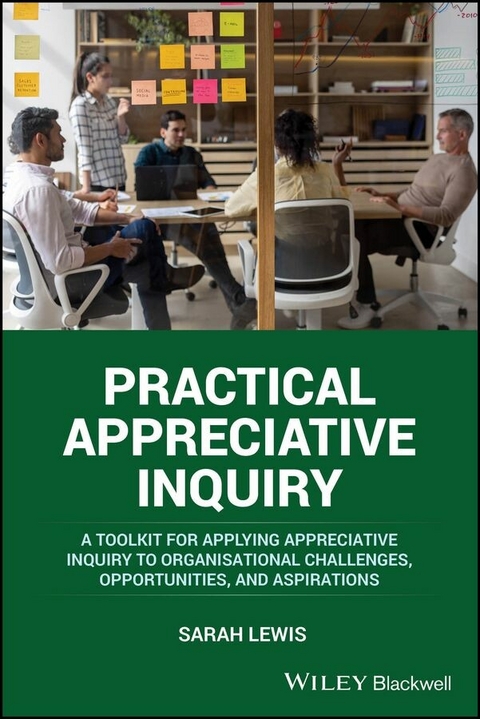
Practical Appreciative Inquiry (eBook)
413 Seiten
Wiley-Blackwell (Verlag)
978-1-394-19813-9 (ISBN)
Create a shared vision built on core strengths and values to improve your organization
Appreciative Inquiry (AI) equips leaders with a revolutionary approach to achieving positive organizational change. Rather than the traditional managerial method of first evaluating a problem and then proposing a solution, AI teaches you to ask, 'What is going right here, and how can we grow more of it?'
In Practical Appreciative Inquiry, expert organizational consultant and facilitator Sarah Lewis teaches you how to apply the AI methodology in an array of management situations. Step by step, this practice-oriented guide helps you leverage the versatility and flexibility of Appreciative Inquiry to make rapid, positive change.
Covering all key aspects of AI, this concise yet comprehensive resource provides a wealth of ideas and activities designed to develop an AI leadership mindset, build resilience within your organization, motivate performance, increase team innovation, support change processes, create AI interventions, and much more. Each chapter features discussion questions, teaching exercises, links to online resources, and real-world case studies of AI in practice.
Whether an experienced practitioner or a newcomer to change management, Practical Appreciative Inquiry: A Toolkit for Applying Appreciative Inquiry to Organisational Challenges, Opportunities, and Aspirations is a must-read for all leaders, managers, and team members wanting to improve their organization, as well as consultants, trainers, and organizational development experts interested in AI.
SARAH LEWIS is Managing Director of Appreciating Change, an Associated Fellow of the British Psychological Society, and a founder and principal member of the Association of Business Psychologists. As a chartered psychologist, Sara has been helping people and organizations change their behavior for more than 30 years. Her clients include government agencies, non-profit organizations, and private sector clients, particularly in the manufacturing, financial, and educational sectors. She is the author of five books, including Appreciative Inquiry for Change Management and Positive Psychology and Change.
Create a shared vision built on core strengths and values to improve your organization Appreciative Inquiry (AI) equips leaders with a revolutionary approach to achieving positive organizational change. Rather than the traditional managerial method of first evaluating a problem and then proposing a solution, AI teaches you to ask, What is going right here, and how can we grow more of it? In Practical Appreciative Inquiry, expert organizational consultant and facilitator Sarah Lewis teaches you how to apply the AI methodology in an array of management situations. Step by step, this practice-oriented guide helps you leverage the versatility and flexibility of Appreciative Inquiry to make rapid, positive change. Covering all key aspects of AI, this concise yet comprehensive resource provides a wealth of ideas and activities designed to develop an AI leadership mindset, build resilience within your organization, motivate performance, increase team innovation, support change processes, create AI interventions, and much more. Each chapter features discussion questions, teaching exercises, links to online resources, and real-world case studies of AI in practice. Whether an experienced practitioner or a newcomer to change management, Practical Appreciative Inquiry: A Toolkit for Applying Appreciative Inquiry to Organisational Challenges, Opportunities, and Aspirations is a must-read for all leaders, managers, and team members wanting to improve their organization, as well as consultants, trainers, and organizational development experts interested in AI.
1
What Is Appreciative Inquiry?
The term appreciative inquiry refers to an approach to achieving change in organisations. This approach is, to some extent, codified in a series of models of practice. At the same time it is a philosophical system of beliefs about the nature of truth, knowledge, and reality, and of how change occurs, or not, in human systems. This combination of profundity and practicality is the basis for appreciative inquiry's versatility, flexibility and robustness. That said, it is not a panacea for all ills. It is as important to know when it is not an appropriate approach as when it is.
In this first chapter we briefly consider the development of appreciative inquiry as a change methodology and outline some of the places to find case study accounts of appreciative inquiry practice beyond those recounted in this book. We look at what distinguishes appreciative inquiry as an approach, particularly the view it takes of organisations as living human systems. The chapter then considers how that difference in perspective affects the mode of practice and the approach to creating change. In examining when it is appropriate to use appreciative inquiry, we look at the nature of different organisational problems and the rise of dialogic organisational development as a broad field of distinctive practice within which appreciative inquiry fits. This chapter notes also that appreciative inquiry is a field application supported by scientific theory from academic sources. We look at this though the lens of evidence‐based standards of intervention and consider the challenge for field‐based practice. Finally we look at, and consider, the validity of some of the critiques of appreciative inquiry since its introduction to the field of organisational development at the end of the 1990s.
What Are the Origins of Appreciative Inquiry?
In 1987, as part of his Ph.D. research, supervised by Suresh Srivastva, into organisational change and development, Cooperrider [1] made a serendipitous discovery: that asking about and focusing on the good aspects of organisational life can produce positive change.* His breakthrough realisation was that organisations can positively and effectively engage with problems without necessarily addressing them head on, without even framing them as problems. This continues to be a revolutionary idea in the world of organisational change where it is still widely believed that to solve a problem you need to talk about the problem as a problem. Appreciative inquiry suggests that we can address, work on and solve problems while talking about the situation in a different way: in an appreciative way. How does appreciative inquiry work?
Figure 1.1 illustrates the process by which a positive inquiry into a positive experience, a practice which forms the basis of appreciative inquiry practice, has an impact on emotional states, relationships and the ability to access resources. This process, through the generation of positive energy, shared aspirations, motivation and ideas, creates the potential and impulsion for action. Positive deviance [2] is a positive psychology term that refers to exceptional performance. It's these examples of exceptional performance that appreciative inquiry brings into focus as a resource for organisational learning, growth and development. The diagram below also illustrates how appreciative inquiry generates hope, a key motivational emotion.
Figure 1.1 Positive Energy: the shared experience and demonstration of positive affect, cognitive arousal agentic behaviour among unit members in their joint pursuit of organisationally salient objectives.
Today, Champlain College, which houses the David L. Cooperrider Center for Appreciative Inquiry,1 lists a variety of organisations using appreciative inquiry. These range from corporations such as Apple, Johnson and Johnson, Coca Cola and Visa, through non‐profits such as the United States Navy, American Red Cross and the State of Massachusetts, to global initiatives such as the UN Global Compact. Case studies can also be found in the core practitioner publication AI Practitioner: The International Journey of Appreciative Inquiry.2 Founded by Anne Radford in 1998, it continues to capture and disseminate appreciative inquiry theory and practice across the globe. Further case studies can be found in the book Appreciative Inquiry for Change Management [3]. A number of case studies are also shared in this book.
How Is Appreciative Inquiry Different to Other Change Methodologies?
There are many factors that distinguish appreciative inquiry from other change practices, as will become evident throughout the book. However, there are four key practices to highlight at this point. One is the specific kinds of question asked by appreciative inquiry, questions that target exploration of, and expand conversation about, the good and the best. Another is its focus on the conscious and deliberate redirecting of attention away from the problem to the aspiration. The third is the creation of a pull motivation through the lived experience of a more attractive future. And the fourth is the involvement of the whole system from the very beginning of the intervention. These practices are explored throughout this book. In essence, while other approaches essentially ask what has gone wrong here and how can we fix it or prevent more of it, appreciative inquiry asks what is going right here and how can we grow more of it.
Behind these surface differences lie differences in understanding the nature of an organisation. Appreciative inquiry views organisations as psychological spaces, full of psychologically alive and complex people: people who experience emotions, have differing relations with each other, who can be fired up, or depressed, just by their imaginations. People who are motivated by things like loyalty, fair play and a sense of justice or betrayal as well as by logic or greed. Appreciative inquiry understands that all of human drama, all the emotions that fuel comedy and tragedy, are present in organisational life. One might say that it views organisations as Shakespearean theatre. Many other approaches tend to treat organisations more like predictable, logical machines.
There are further differences in the mode of practice. Appreciative inquiry is a co‐creative, collaborative methodology, sailing close to the idea of ‘no conversation about me without me’. This means that people are involved in conversations that affect their future from the very beginning. The ambition of this upfront investment is to generate energy for change in all levels of the system simultaneously. Obviously, this speeds up the process compared to a more traditional top‐down linear ‘energy‐pumping’ approach. Involving everyone from the beginning means that more people are simultaneously available to take the lead on different, forward‐focused activities. While this may present challenges of coordination, it means that change can be achieved by a lot of people doing a little, rather than by a few having to do everything. This is a more effective use of organisational energy and makes it less likely any key player will burn‐out through work overload.
Possibly the most important difference between appreciative inquiry and other approaches is that appreciative inquiry views organisations through a social constructionist lens [4].3 Approaching the organisation from this perspective, we view it primarily as a social system that creates, through language, an understanding of itself and of the social world in which it exists. This social world is the context within which possibilities for action do, or don't, exist. As we work to change the social world, through working with perceptions, connections, stories and belief systems, so we work to change the potential for action.
Compared to the facts‐and‐data approach to change, which owes allegiance to the premises of hard science, appreciative inquiry is more akin to anthropology, ethnology or sociology, all of which are interested in the meaning given to objects, the myths, rituals, group norms and mores, the beliefs held by the group about appropriate behaviour that govern the boundaries of the acceptable, the power structures, and the stories told and their significance. This makes appreciative inquiry as an approach to organisational growth and change particularly interesting to those of us who, as psychologists, were trained in the scientific method, yet who also recognise the validity and effectiveness of a social constructionist perspective. As a practitioner, I feel I spend a lot of time balancing on this edge, living in both world views.
How Does Appreciative Inquiry Engage with Organisational Problems?
This is a frequently encountered, valid question. Let's start by clarifying what we mean by problems and problem‐solving.
We solve problems all the time, very effectively, and we tend, as a default linguistic habit, to refer to most challenges in life as problems. When problem‐solving we tend to formulate the issue as a question that needs answering, assemble some data, analyse options against some criteria, select the best option and then implement our decision. For example, I have to organise the logistics of my consultant life. Not so long ago I had to get from a full day's delivery in Dublin in Ireland to Truro in Cornwall for the following afternoon. This turned out to be quite...
| Erscheint lt. Verlag | 5.12.2024 |
|---|---|
| Sprache | englisch |
| Themenwelt | Geisteswissenschaften ► Psychologie |
| Medizin / Pharmazie ► Medizinische Fachgebiete ► Psychiatrie / Psychotherapie | |
| Schlagworte | appreciative inquiry change management • appreciative inquiry guide • appreciative inquiry leadership development • appreciative inquiry organisational development • appreciative inquiry performance improvement • human resources positive psychology |
| ISBN-10 | 1-394-19813-2 / 1394198132 |
| ISBN-13 | 978-1-394-19813-9 / 9781394198139 |
| Informationen gemäß Produktsicherheitsverordnung (GPSR) | |
| Haben Sie eine Frage zum Produkt? |
 EPUB (Adobe DRM)
Kopierschutz: Adobe-DRM
Adobe-DRM ist ein Kopierschutz, der das eBook vor Mißbrauch schützen soll. Dabei wird das eBook bereits beim Download auf Ihre persönliche Adobe-ID autorisiert. Lesen können Sie das eBook dann nur auf den Geräten, welche ebenfalls auf Ihre Adobe-ID registriert sind.
Details zum Adobe-DRM
Dateiformat: EPUB (Electronic Publication)
EPUB ist ein offener Standard für eBooks und eignet sich besonders zur Darstellung von Belletristik und Sachbüchern. Der Fließtext wird dynamisch an die Display- und Schriftgröße angepasst. Auch für mobile Lesegeräte ist EPUB daher gut geeignet.
Systemvoraussetzungen:
PC/Mac: Mit einem PC oder Mac können Sie dieses eBook lesen. Sie benötigen eine
eReader: Dieses eBook kann mit (fast) allen eBook-Readern gelesen werden. Mit dem amazon-Kindle ist es aber nicht kompatibel.
Smartphone/Tablet: Egal ob Apple oder Android, dieses eBook können Sie lesen. Sie benötigen eine
Geräteliste und zusätzliche Hinweise
Buying eBooks from abroad
For tax law reasons we can sell eBooks just within Germany and Switzerland. Regrettably we cannot fulfill eBook-orders from other countries.
aus dem Bereich