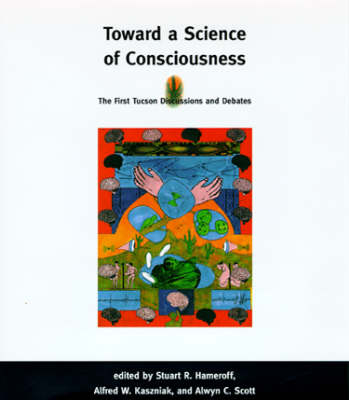
Toward a Science of Consciousness
MIT Press (Verlag)
978-0-262-08249-5 (ISBN)
- Keine Verlagsinformationen verfügbar
- Artikel merken
Scientists and philosophers are focusing more intensely than ever on the nature of our human experience, resulting in a newly coalescing field of Consciousness Studies that has become a worldwide and highly interdisciplinary phenomenon. Toward a Science of Consciousness marks the first major gathering -- a landmark event -- devoted entirely to unlocking the mysteries of consciousness. It explores the whole spectrum of approaches from philosophy of mind and dream research, to neuropsychology, pharmacology, and molecular dynamics, to neural networks, phenomenological accounts, and even the physics of reality. The aim is to lay a sound scientific foundation for future research while also reaching consensus on many scattered areas of inquiry. Following an overview, fifty-five chapters are divided into ten sections: philosophy, cognitive science, medicine/pathology, neurology, neural networks, subneural biology, quantum theory, non-locality in space and time, hierarchical organization, and phenomenology.
In addition to the editors, who are, respectively, an anesthesiologist, a psychologist, and an applied mathematician, contributors include such luminaries as David Chalmers, Michael Conrad, Avshalom Elitzur, Owen Flanagan, David Galin, John Kihlstrom, Christof Koch, Benjamin Libet, Roger Penrose, Karl Pribram, Gary Schwartz, Petra Stoerig, John Taylor, Andrew Weil, Fred Wolf, and many others.
Part 1 Philosophy of mind: facing up to the problem of consciousness, David J. Chalmers; consciousness and the introspective link principle, Giiven Guzeldere; the place of qualia in the world of science, Leopold Stubenberg; the binding problem and neurobiological oscillations, Valerie Gray Hardcastle; deconstructing dreams - the spandrels of sleep, Owen Flanagan. Part 2 Cognitive science: unconscious processes in social interaction, John F. Kihlstrom; efference and the extension of consciousness, Thaddeus M. Cowan; Edelman's biological theory of consciousness, John J. Boitano; the structure of subjective experience - sharpen the concepts and terminology, David Galin; the varieties of conscious experience - biological roots and social usages, Karl H. Pribram. Part 3 Medicine: induction of consciousness in the ischemic brain, James E. Whinnery; conflicting communicative behaviour in a split-brain patient - support for dual consciousness, Victor Mark; left brain says yes, right brain says no - normative duality in the split brain, Marco Iacoboni, Jan Rayman, and Eran Zaidel; inkblot testing of commissurotomy subjects - contrasting modes of organizing reality, Polly Henninger; evidence for language comprehension in a severe "sensory aphasic", Britt Anderson and Thomas Head; self-awareness of deficit in patients with Alzheimer's Disease, Alfred W. Kaszniak and Gina DiTraglia Christenson. Part 4 Experimental neuroscience: toward the neuronal substrate of visual consciousness, Christof Koch; visual perception and phenomenal consciousness, Petra Stoerig and Alan Cowey; levels of awareness and "awareness without awareness" - from data to theory, Gary E. Schwartz; implicit memory during anesthesia, Randall C. Cork; experimental evidence for a synchronization of sensory information to conscious experience, Mikael Bergenheim, Hakan Johansson, Brittmarie Granlund, and Jonas Pedersen; positron emission tomography, emotion, and consciousness, Eric M. Reiman, Richard D. Lane, Geoffrey L. Ahern, Gary E. Schwartz, and Richard J. Davidson; dimensional complexity of human EEG and level of consciousness, Richard C. Watt; collapse of a quantum field may affect brain function, C.M.H. Nunn, C.J.S. Clarke, and B.H. Blott; neural time factors in conscious and unconscious mental functions, Benjamin Libet. (Part contents).
| Erscheint lt. Verlag | 8.5.1996 |
|---|---|
| Reihe/Serie | Complex Adaptive Systems |
| Zusatzinfo | 147 |
| Verlagsort | Cambridge, Mass. |
| Sprache | englisch |
| Maße | 178 x 254 mm |
| Gewicht | 1793 g |
| Themenwelt | Geisteswissenschaften ► Psychologie ► Allgemeine Psychologie |
| Geisteswissenschaften ► Psychologie ► Biopsychologie / Neurowissenschaften | |
| Geisteswissenschaften ► Psychologie ► Verhaltenstherapie | |
| Naturwissenschaften ► Biologie ► Humanbiologie | |
| Naturwissenschaften ► Biologie ► Zoologie | |
| ISBN-10 | 0-262-08249-7 / 0262082497 |
| ISBN-13 | 978-0-262-08249-5 / 9780262082495 |
| Zustand | Neuware |
| Informationen gemäß Produktsicherheitsverordnung (GPSR) | |
| Haben Sie eine Frage zum Produkt? |
aus dem Bereich