


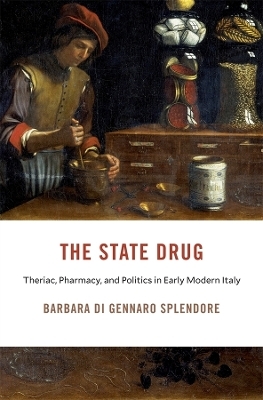
The State Drug
Theriac, Pharmacy, and Politics in Early Modern Italy
Seiten
2025
Harvard University Press (Verlag)
978-0-674-29978-8 (ISBN)
Harvard University Press (Verlag)
978-0-674-29978-8 (ISBN)
In Renaissance Italy, the Galenic “wonder drug” theriac became a vehicle for political, pharmaceutical, and commercial power. The State Drug shows how regimes and medical authorities secured support by promoting and regulating theriac. In turn, it sheds new light on the relationship between medicine and authority in early modern Europe.
A revelatory account of the “wonder drug” theriac, which became a powerful tool in the hands of medical and political authorities at the height of the Italian Renaissance.
From the 1490s, one of the most influential remedies to circulate in Europe was the “wonder drug” theriac. Although it had been in use for centuries, theriac gained special importance in the Renaissance, when Italy became a major hub of its production and export. A quintessential example of Galenic pharmacy, theriac was used to treat everything from venomous bites and poisons to headaches, sore throats, fevers, palsy, and heart problems. Examining this pivotal period in the history of medicine, Barbara Di Gennaro Splendore shows how a panacea became a vehicle for political power as well as intellectual and commercial competition.
So essential was theriac to good health that regimes in Bologna and Venice could secure popular support by asserting regulatory control over this “state drug.” Likewise, medical authorities relied on theriac to solidify their own legitimacy, through public ceremonies replete with music and choreography. Apothecaries and physicians engaged in spirited rivalry over branding and control of production, as well as disputes over optimal recipes, which included opium and viper flesh as well as dozens of other ingredients. Yet as Galenic science came into question in the late seventeenth century, the alliance between politics and pharmacy weakened. Physicians, in particular, grew hesitant over whether to continue promoting theriac at all. While the drug remained beloved, especially among the poor, its political power was significantly diminished by the nineteenth century.
Offering a vivid window into the political history of medicine, The State Drug sheds new light on the fraught, age-old intersection of power and pharmacy.
A revelatory account of the “wonder drug” theriac, which became a powerful tool in the hands of medical and political authorities at the height of the Italian Renaissance.
From the 1490s, one of the most influential remedies to circulate in Europe was the “wonder drug” theriac. Although it had been in use for centuries, theriac gained special importance in the Renaissance, when Italy became a major hub of its production and export. A quintessential example of Galenic pharmacy, theriac was used to treat everything from venomous bites and poisons to headaches, sore throats, fevers, palsy, and heart problems. Examining this pivotal period in the history of medicine, Barbara Di Gennaro Splendore shows how a panacea became a vehicle for political power as well as intellectual and commercial competition.
So essential was theriac to good health that regimes in Bologna and Venice could secure popular support by asserting regulatory control over this “state drug.” Likewise, medical authorities relied on theriac to solidify their own legitimacy, through public ceremonies replete with music and choreography. Apothecaries and physicians engaged in spirited rivalry over branding and control of production, as well as disputes over optimal recipes, which included opium and viper flesh as well as dozens of other ingredients. Yet as Galenic science came into question in the late seventeenth century, the alliance between politics and pharmacy weakened. Physicians, in particular, grew hesitant over whether to continue promoting theriac at all. While the drug remained beloved, especially among the poor, its political power was significantly diminished by the nineteenth century.
Offering a vivid window into the political history of medicine, The State Drug sheds new light on the fraught, age-old intersection of power and pharmacy.
Barbara Di Gennaro Splendore is a researcher specializing in the early modern history of science and medicine. She is currently a Research Fellow at the Italian Council for Agricultural Research and Economics (CREA) in Padua and has been awarded an EU Marie Curie Fellowship at the Universities of Lausanne and Bologna.
| Erscheinungsdatum | 14.08.2025 |
|---|---|
| Reihe/Serie | I Tatti Studies in Italian Renaissance History |
| Zusatzinfo | 25 photos |
| Verlagsort | Cambridge, Mass |
| Sprache | englisch |
| Maße | 156 x 235 mm |
| Gewicht | 711 g |
| Themenwelt | Geschichte ► Allgemeine Geschichte ► Neuzeit (bis 1918) |
| Geisteswissenschaften ► Geschichte ► Regional- / Ländergeschichte | |
| ISBN-10 | 0-674-29978-7 / 0674299787 |
| ISBN-13 | 978-0-674-29978-8 / 9780674299788 |
| Zustand | Neuware |
| Informationen gemäß Produktsicherheitsverordnung (GPSR) | |
| Haben Sie eine Frage zum Produkt? |
Mehr entdecken
aus dem Bereich


aus dem Bereich
Geschichte einer wilden Handlung
Buch | Hardcover (2024)
C.H.Beck (Verlag)
CHF 47,60


