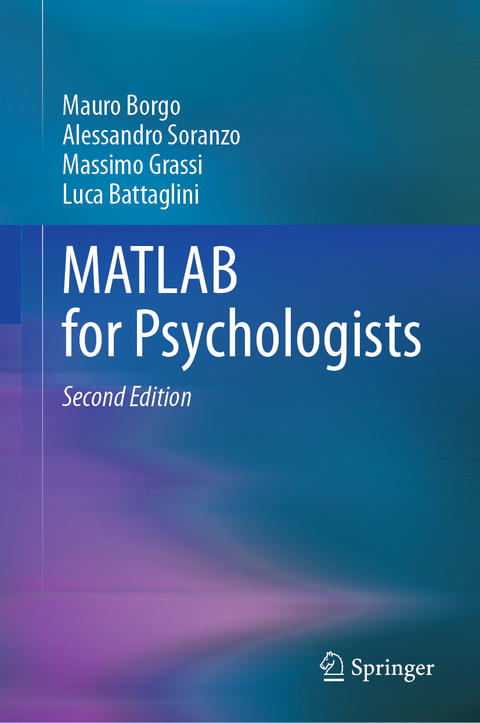
MATLAB for Psychologists
Springer International Publishing (Verlag)
978-3-031-82329-9 (ISBN)
The second edition of this textbook provides a comprehensive and detailed overview of MATLAB and specific tools for creating experiments and analysing data in psychology. In addition to an enhanced focus on connections with external devices and writing experiments, all chapters have been thoroughly revised and updated to provide the latest information and examples compatible with the most recent versions of MATLAB. All scripts have been tested to ensure a reliable and exact response. In addition, the book provides detailed examples of classic experiments (e.g., the Posner task) as well as recommendations for structuring and implementing ad hoc experiments. Each chapter is accompanied by several illustrations, examples, and code to match every reader's expertise and comfort level. This concise volume demonstrates MATLAB's responsiveness to individuals' research needs, whether the task is programming experiments, creating sensory stimuli, running simulations, or calculating statistics for data analysis.
Key areas of coverage include:
- Thinking in a matrix way.
- Handling and plotting data.
- Guidelines for improved programming, sound, and imaging.
- Statistical analysis and signal detection theory.
- Psychophysics Toolbox and its use in connection with external devices.
MATLAB for Psychologists, Second Edition, serves a wide audience of advanced undergraduate and graduate level psychology students, professors, and researchers as well as lab technicians and other professionals involved in programming psychology experiments.
Mauro Borgo, Ph.D., received his B.A. and Ph.D. in Electronic and Telecommunication Engineering in 1999 and 2003, respectively, from the University of Padua, Italy. In 2012, he received the Master in Business and innovation management form Bologna Business School. His interests are in innovation, IoT, signal and data processing, control algorithms, innovative process, agile approach. He is currently in Somfy group as Access Innovation Application Manager.
Alessandro Soranzo, Ph.D., received his M.S. and Ph.D. in Experimental Psychology in 1999 and 2003, respectively, from the University of Trieste, Italy. He is currently employed at the University of Calabria where he teaches Cognitive Psychology. He previously worked for Glasgow Caledonian University (UK), Teesside University (UK) and Sheffield Hallam University (UK). His main research interests focus on visual perception, aesthetics, psychology of art and research methods.
Massimo Grassi, Ph.D., received his M.S. and Ph.D. in Experimental Psychology in 1997 and 2003, respectively, from the University of Padua, Italy. He has also been a Visiting Scientist at University of Sussex (UK). He is associate professor at University of Padua (Italy) where he teaches Introduction to Psychology and Psychology of Music. His main research interests focus on auditory and audiovisual perception and the relationships between perception and cognition.
Luca Battaglini, Ph.D., received his M.S. and Ph.D. in Experimental Psychology in 2012 and 2015, respectively, from the University of Padua, Italy. He has also been a visiting researcher at the University of Sussex and the University of Plymouth (UK). He is currently an associate professor at the University of Padua, where he teaches Psychophysics of Vision and Psychology of Sensory Processes. His main research interests focus on visual perception, non-invasive brain stimulation, and motion perception.
Chapter 1. Basic Operations.- Chapter 2. Data Handling.- Chapter 3. Plotting Data.- Chapter 4. Programming.- Chapter 5. A Better Sound.- Chapter 6. Create and Process Images.- Chapter 7. Data Analysis.- Chapter 8. The Charm of Graphical User Interface.- Chapter 9. Psychtoolbox: Video.- Chapter 10. Psychtoolbox: Sound, Keyboard, and Mouse.- Chapter 11. Connection with External Devices.- Chapter 12. Hands-on Writing Experiments.
| Erscheinungsdatum | 09.04.2025 |
|---|---|
| Zusatzinfo | XV, 278 p. 95 illus., 77 illus. in color. |
| Verlagsort | Cham |
| Sprache | englisch |
| Maße | 155 x 235 mm |
| Themenwelt | Geisteswissenschaften ► Psychologie |
| Schlagworte | Biosignals, MATLAB, behavioral science • Computational functions, MATLAB, psychology • Computer programming, MATLAB, behavioral science • Data analysis, collection, handling, MATLAB • Data types, data variable, MATLAB, psychology • Experimental psychology, MATLAB, behavioral science • Exporting data, MATLAB, behavioral science • GUI, graphical user interface, MATLAB, psychology • Import/export images, MATLAB, behavioral science • Importing data, MATLAB, behavioral science • Loops generation, MATLAB, behavioral science • Matrix laboratory, MATLAB, psychology • Neural networks, MATLAB, psychology • Problem solving, MATLAB, behavioral science • Program flux, MATLAB, behavioral science • Programming language, MATLAB, psychology • Psychological toolboxes, MATLAB • Simulation, MATLAB, behavioral science • Small data set, MATLAB, behavioral science • Statistics, MATLAB, developmental science |
| ISBN-10 | 3-031-82329-X / 303182329X |
| ISBN-13 | 978-3-031-82329-9 / 9783031823299 |
| Zustand | Neuware |
| Informationen gemäß Produktsicherheitsverordnung (GPSR) | |
| Haben Sie eine Frage zum Produkt? |
aus dem Bereich