


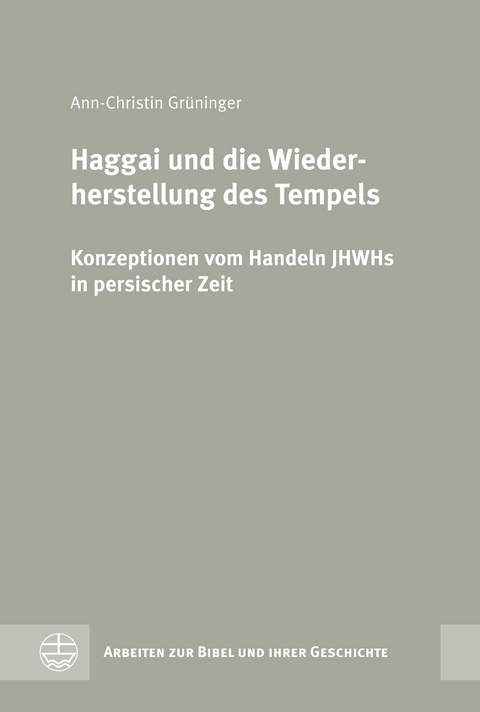
Haggai und die Wiederherstellung des Tempels
Konzeptionen vom Handeln JHWHs in persischer Zeit
Seiten
2025
Evangelische Verlagsanstalt
9783374078103 (ISBN)
Evangelische Verlagsanstalt
9783374078103 (ISBN)
Vor dem Hintergrund der etablierten These, dass die Wiederherstellung des Tempels in der frühen nachexilischen Zeit in der Haggai-Schrift allein als Werk Gottes angesehen wird, fokussiert sich diese Studie auf die Darstellung der Gottesfigur. Unter Anwendung sowohl der klassischen exegetischen Methoden als auch narratologischer Analyseelemente eröffnen sich neue, bisher in der Forschung nur wenig beachtete Perspektiven. So zeigt die traditionsgeschichtliche Analyse, dass die Haggai-Schrift Bezug auf die altorientalische Tempelbauideologie nimmt und diese theologisch transformiert. Als zentrales Gottesbild dieser Schrift lässt sich schließlich die Vorstellung von JHWH als einem emphatischen Pädagogen, der sein Volk zum Handeln ermutigt, identifizieren.
[Haggai and the Restoration of the Temple. Conceptions of YHWH's Actions in Persian Times]Against the background of the established thesis that the restoration of the temple in the early post-exilic period is seen in Haggai solely as the work of God, this study focusses on the representation of the divine figure. By applying both classical exegetical methods and narratological elements of analysis, new perspectives are developed that have so far received little attention in research. Thus, the tradition-historical analysis shows that Haggai refers to the ancient Oriental temple building ideology and transforms it theologically. Finally, the idea of YHWH as an emphatic pedagogue who encourages his people to act can be identified as the central image of God in Haggai.
[Haggai and the Restoration of the Temple. Conceptions of YHWH's Actions in Persian Times]Against the background of the established thesis that the restoration of the temple in the early post-exilic period is seen in Haggai solely as the work of God, this study focusses on the representation of the divine figure. By applying both classical exegetical methods and narratological elements of analysis, new perspectives are developed that have so far received little attention in research. Thus, the tradition-historical analysis shows that Haggai refers to the ancient Oriental temple building ideology and transforms it theologically. Finally, the idea of YHWH as an emphatic pedagogue who encourages his people to act can be identified as the central image of God in Haggai.
Ann-Christin Grüninger, Dr. theol., Jahrgang 1984, studierte 2005 bis 2011 Evangelische Theologie und Philosophie an der Universität Osnabrück. Von 2011 bis 2024 war sie als Wissenschaftliche Mitarbeiterin am Lehrstuhl für Exegese und Theologie des Alten Testaments (Prof. Dr. Beate Ego) an der Evangelisch-Theologischen Fakultät der Ruhr-Universität Bochum tätig; 2017 wurde sie dort promoviert. Die vorliegende Arbeit stellt ihre überarbeitete Habilitationsschrift dar.
| Erscheinungsdatum | 29.04.2025 |
|---|---|
| Reihe/Serie | Arbeiten zur Bibel und ihrer Geschichte (ABG) ; 77 |
| Verlagsort | Leipzig |
| Sprache | deutsch |
| Maße | 155 x 230 mm |
| Themenwelt | Geisteswissenschaften ► Religion / Theologie ► Christentum |
| Schlagworte | Handeln Gottes • Jerusalem • Perserzeit • Prophetie • Tempelbau • Zwölfprophetenbuch |
| ISBN-13 | 9783374078103 / 9783374078103 |
| Zustand | Neuware |
| Informationen gemäß Produktsicherheitsverordnung (GPSR) | |
| Haben Sie eine Frage zum Produkt? |
Mehr entdecken
aus dem Bereich


aus dem Bereich
und was sie über die Kirche verraten
Buch | Hardcover (2024)
C.H.Beck (Verlag)
CHF 39,90


