


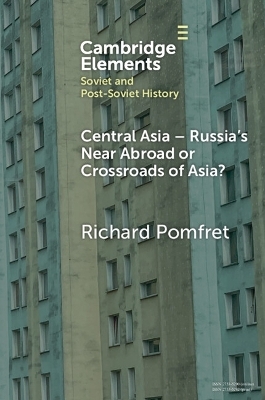
Central Asia - Russia's Near Abroad or Crossroads of Asia?
Seiten
2025
Cambridge University Press (Verlag)
9781009507752 (ISBN)
Cambridge University Press (Verlag)
9781009507752 (ISBN)
This Element evaluates Central Asian countries' special position as Russia's near abroad, highlighting their historical importance and connection. After Soviet integration, new trade links and infrastructure modified these links. Economic dependency on Russia has reduced over the past three decades, leading to political independence.
This Element assesses the claim that Central Asian countries hold a special position as Russia's near abroad. The region has been important for millennia, and only after conquest in the second half of the nineteenth century did Russia become important for Central Asia. This connection became stronger after 1917 as Central Asia was integrated into the Soviet economy, with rail, roads, and pipelines all leading north to Russia. After independence, these connections were gradually modified by new trade links and by new infrastructure, while Russia's demand for unskilled labour during the 1999–2014 oil boom created a new economic dependency for Tajikistan and the Kyrgyz Republic. In 1991, political independence could not be accompanied by economic independence, but over the next three decades economic dependence on Russia was reduced, and the Central Asian countries have felt increasingly able to adopt political positions independent of Russia.
This Element assesses the claim that Central Asian countries hold a special position as Russia's near abroad. The region has been important for millennia, and only after conquest in the second half of the nineteenth century did Russia become important for Central Asia. This connection became stronger after 1917 as Central Asia was integrated into the Soviet economy, with rail, roads, and pipelines all leading north to Russia. After independence, these connections were gradually modified by new trade links and by new infrastructure, while Russia's demand for unskilled labour during the 1999–2014 oil boom created a new economic dependency for Tajikistan and the Kyrgyz Republic. In 1991, political independence could not be accompanied by economic independence, but over the next three decades economic dependence on Russia was reduced, and the Central Asian countries have felt increasingly able to adopt political positions independent of Russia.
1. Introduction; 2. Incorporation into the tsarist and soviet empires; 3. Economic change since 1991; 4. Redirected economic relations and multi-vector foreign policies; 5. Looking forward; Note on abbreviations; Glossary of international agreements since 1991; References and Further Reading.
| Erscheinungsdatum | 11.03.2025 |
|---|---|
| Reihe/Serie | Elements in Soviet and Post-Soviet History |
| Zusatzinfo | Worked examples or Exercises |
| Verlagsort | Cambridge |
| Sprache | englisch |
| Maße | 152 x 229 mm |
| Gewicht | 113 g |
| Themenwelt | Geisteswissenschaften ► Geschichte ► Regional- / Ländergeschichte |
| Sozialwissenschaften ► Politik / Verwaltung ► Europäische / Internationale Politik | |
| Wirtschaft ► Volkswirtschaftslehre ► Makroökonomie | |
| ISBN-13 | 9781009507752 / 9781009507752 |
| Zustand | Neuware |
| Informationen gemäß Produktsicherheitsverordnung (GPSR) | |
| Haben Sie eine Frage zum Produkt? |
Mehr entdecken
aus dem Bereich


aus dem Bereich
die Geschichte meiner Urgroßmutter
Buch | Hardcover (2025)
C.H.Beck (Verlag)
CHF 32,15
Träume und Macht : eine Biografie
Buch | Hardcover (2025)
C.H.Beck (Verlag)
CHF 61,60


