


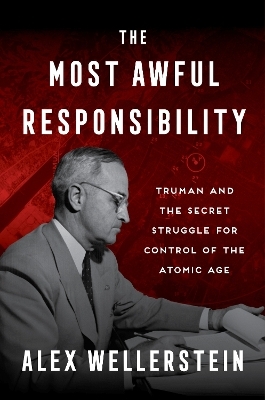
The Most Awful Responsibility
Truman and the Secret Struggle for Control of the Atomic Age
Seiten
2026
Harper (Verlag)
978-0-06-337943-5 (ISBN)
Harper (Verlag)
978-0-06-337943-5 (ISBN)
- Lieferbar (Termin unbekannt)
- Versandkostenfrei
- Auch auf Rechnung
- Artikel merken
"I thought I knew the story but learned much that I didn’t know. Outstanding!"— Richard Rhodes
“This is historical research at its best.” — Dan Carlin
President Truman’s choice to drop the atomic bomb is the most debated decision in the 20th Century. But what if Truman’s actual decision wasn’t what everyone thinks it was?
The conventional narrative is that American leaders had a choice: Invade Japan, which would have cost millions of Allied and Japanese lives, or instead, use the atom bomb in the hope of convincing Japan to surrender. Truman, the story goes, carefully weighed the pros and cons before deciding that the atomic bomb would be used against Japanese cities, as the lesser of two evils.
But nuclear historian Alex Wellerstein argues that is not what happened. Not only did Truman not take part in the decision to use the bomb, but the one major decision that he did make was a very different one — one that he himself did not fully understand until after the atomic bomb was used. The weight of that decision, and that misunderstanding, became the major reason that atomic bombs have not been used again since World War II.
Based on a close reading of the historical record, The Most Awful Responsibility shows that, despite his reputation as an ardent defender of the atomic bomb, Truman:
Wanted to avoid the “murder” and “slaughter” of innocent civilians
Believed that the atomic bomb should never be used again
Hoped that nuclear weapons would be outlawed in his lifetime
Wellerstein makes a startling case that Truman was possibly the most anti-nuclear American president of the twentieth century, but his ambitions were strongly constrained by the domestic and international politics of the postwar world and the early Cold War. This book is a must-read for all who want to truly understand not only why the bomb was dropped on Japan but also why it has not been used since.
“This is historical research at its best.” — Dan Carlin
President Truman’s choice to drop the atomic bomb is the most debated decision in the 20th Century. But what if Truman’s actual decision wasn’t what everyone thinks it was?
The conventional narrative is that American leaders had a choice: Invade Japan, which would have cost millions of Allied and Japanese lives, or instead, use the atom bomb in the hope of convincing Japan to surrender. Truman, the story goes, carefully weighed the pros and cons before deciding that the atomic bomb would be used against Japanese cities, as the lesser of two evils.
But nuclear historian Alex Wellerstein argues that is not what happened. Not only did Truman not take part in the decision to use the bomb, but the one major decision that he did make was a very different one — one that he himself did not fully understand until after the atomic bomb was used. The weight of that decision, and that misunderstanding, became the major reason that atomic bombs have not been used again since World War II.
Based on a close reading of the historical record, The Most Awful Responsibility shows that, despite his reputation as an ardent defender of the atomic bomb, Truman:
Wanted to avoid the “murder” and “slaughter” of innocent civilians
Believed that the atomic bomb should never be used again
Hoped that nuclear weapons would be outlawed in his lifetime
Wellerstein makes a startling case that Truman was possibly the most anti-nuclear American president of the twentieth century, but his ambitions were strongly constrained by the domestic and international politics of the postwar world and the early Cold War. This book is a must-read for all who want to truly understand not only why the bomb was dropped on Japan but also why it has not been used since.
Alex Wellerstein is an Associate Professor in the Science and Technology Studies program at the Stevens Institute of Technology and a visiting researcher at the Nuclear Knowledges program, Center for International Studies, Sciences Po, Paris. He is the author of Restricted Data: The History of Nuclear Secrecy in the United States, and he has written for The New Yorker, Atlantic, Harper’s Magazine, and many other venues. He is perhaps best known as the creator of the NUKEMAP, the world’s most popular online nuclear weapons effects simulator. He is also the author of the Doomsday Machines blog, and he has taught at Harvard, MIT, and Georgetown University.
| Erscheinungsdatum | 19.11.2025 |
|---|---|
| Verlagsort | New York |
| Sprache | englisch |
| Maße | 152 x 229 mm |
| Gewicht | 528 g |
| Themenwelt | Literatur ► Biografien / Erfahrungsberichte |
| Sachbuch/Ratgeber ► Geschichte / Politik | |
| Natur / Technik ► Fahrzeuge / Flugzeuge / Schiffe ► Militärfahrzeuge / -flugzeuge / -schiffe | |
| Geschichte ► Allgemeine Geschichte ► Neuzeit (bis 1918) | |
| Geschichte ► Allgemeine Geschichte ► 1918 bis 1945 | |
| Geschichte ► Teilgebiete der Geschichte ► Militärgeschichte | |
| Sozialwissenschaften ► Politik / Verwaltung | |
| ISBN-10 | 0-06-337943-0 / 0063379430 |
| ISBN-13 | 978-0-06-337943-5 / 9780063379435 |
| Zustand | Neuware |
| Informationen gemäß Produktsicherheitsverordnung (GPSR) | |
| Haben Sie eine Frage zum Produkt? |
Mehr entdecken
aus dem Bereich
aus dem Bereich
von der frühen Neuzeit bis ins Computerzeitalter
Buch | Hardcover (2025)
De Gruyter (Verlag)
CHF 83,90
rockets, missiles, and drones as instruments of fear and coercion
Buch | Softcover (2025)
Oxford University Press Inc (Verlag)
CHF 34,90


