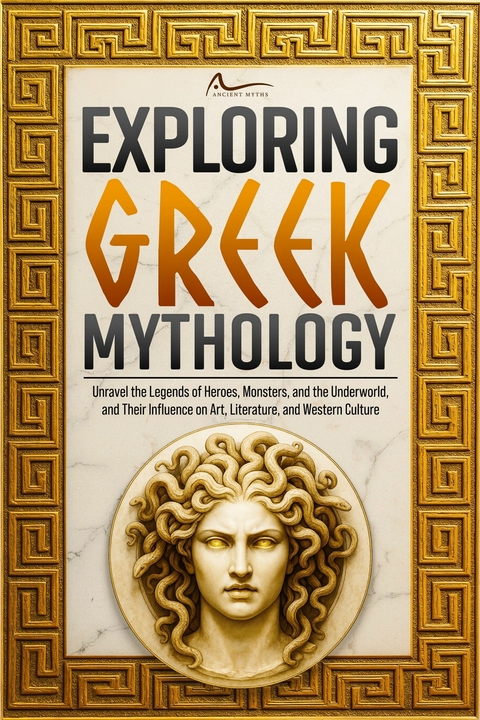
Exploring Greek Mythology (eBook)
126 Seiten
Ancient Myths Publishing (Verlag)
978-0-00-066403-7 (ISBN)
Ever wondered why Greek Myths still captivate us today?
Unlock the Timeless Power of Greek Mythology and Transform Your Understanding of Art, Literature, and Culture!
Dive deep into the World of Gods, Heroes, and Monsters - A journey that will change how you see the world forever!
Are you lost in the labyrinth of Greek mythology? Like many, you might find yourself fascinated yet overwhelmed by its complexity.
The intricate web of tales featuring Zeus, Hercules, and Medusa is not just confusing but also seems disconnected from our modern lives. Without a guide, these stories remain an untapped source of wisdom, leaving you with a sense of missing out on something profound.
Imagine if you continue to ignore these myths... You'll miss the hidden influences shaping much of our art, literature, and culture.
The wisdom encoded in these ancient tales will remain locked away, just out of reach, leaving you disconnected from a rich heritage that could have enriched your understanding of the world.
But fear not! 'Exploring Greek Mythology' is your golden key to unlocking these secrets.
This isn't just another book; it's a revelation, a transformative journey that connects you deeply with the stories that have shaped our civilization.
Inside you will find...
✅ The Secret Behind Zeus's Thunderbolt and How It Inspires Modern Leadership
✅ The Hercules Method: Turning Personal Struggles into Triumphant Life Lessons
✅ Aphrodite's Love Blueprint: Influencing Today's Concepts of Romance and Beauty
✅ The Underworld Uncovered: Life, Death, and Lessons Beyond
✅ Monsters and Mythos: Understanding Our Deepest Fears Through Ancient Stories
✅ Artistic Genius: How Greek Myths Shaped the Masterpieces of the Renaissance
✅ Mythology in Modern Narratives: Unraveling Ancient Threads in Today's Bestsellers
Why is this book different? Unlike other texts that merely recount these myths, 'Exploring Greek Mythology' delves into their profound implications on modern society.
It's not just about learning what these stories are; it's about understanding why they matter to you today.
This book is crafted with the wisdom of a historian and the insight of a storyteller, making it an unparalleled guide in your exploration.
Take the first step on your mythological journey today. Don't let another day pass without unlocking the wisdom of the past.
Get your copy and embark on an adventure that will forever change the way you view the world around you!
CHAPTER 1
THE OLYMPIAN GODS
AND GODDESSES
Mount Olympus is the highest mountain in the universe. It is believed that higher beings, such as the gods and goddesses, lived up there. They used to reside on its sky-high perch and rule over the other creatures of this world. The written sagas indicate that the deities also looked like human beings. They were not different in appearance but in powers. Many myths have also indicated that the deities had no human defects or desires.
They could shape-shift into animals and other things. The ancient Greek tales show that there were 12 gods and goddesses who supervised the other creatures of the Greek world. All people in the universe obeyed and worshipped them.
The Origin of the Gods
According to the myths, the Olympians are the offspring of the Titans Cronus and Rhea. It all started when Cronus betrayed his father, Uranus. He castrated his father with a stone sickle and threw his genitals into the ocean. He did that to take control of the universe.
Now, Cronus was guilty and feared that his children would do the same and kill him. Hence, to prevent that, he swallowed all his kids. As this ritual continued, Rhea, his wife, saved her youngest son, Zeus, by wrapping a stone in the cloth, tricking him into thinking it was Zeus.
Eventually, Zeus grew up and led a rebellion against his father and the other Titans. He joined forces with other powerful creatures to be successful in the battle against his father and the other Titans. He established a world where the Olympian gods and goddesses had the final say and were the leaders of the Greek world.
Now, all the Olympians are related and linked to one another. However, the numerous distinct and sometimes conflicting myths within Greek mythology make it challenging to establish a clear connection among them. The Romans have also taken inspiration from Greek mythology and curated their own mythology.
There are countless gods and goddesses in Greek mythology. All of them are distinct, having their own attributes, stories, and characteristics. There are different interpretations and variations in Greek mythology. Hence, it can be challenging to determine and estimate the exact number of deities. Therefore, here is a list of the Greek universe's most influential, powerful, and major gods.
1. Zeus (King of the Gods, Sky, and Thunder)
Zeus is also known as Jupiter in Roman. He was the most powerful king of the Greek world, and was mainly associated with the sky, the supervision of gods, and thunder. In ancient Greek mythology, he is portrayed as an imposing, ruling, and powerful figure. Depictions of Zeus in artwork often show him wielding a thunderbolt as his weapon. As the supreme ruler of the Olympian gods, he embodied the virtues of justice and harmony, maintaining balance in the world.
In many myths, Zeus is often depicted as a womanizer as he was known to engage in extramarital affairs and romantic associations with women other than his wife, Hera.
Despite this image, Zeus still has quite a clean and reputable status among the other Olympian gods. He is a prominent figure in many famous Greek folk tales.
2. Hera (Queen of the Gods, Marriage, and Childbearing))
Hera was the queen of Olympus, the wife of Zeus, and the goddess responsible for marriage and childbirth. She is depicted as a regal and powerful figure in Greek mythology, indicating her importance and influence in ancient times. Hera is often characterized as jealous and vengeful in Greek mythology, particularly in response to Zeus's many love affairs. However, despite this portrayal, she still held a significant position of importance in ancient Greek mythology.
She is famously known as the protector of women, and often called upon when women give birth. Hera's complex personality can be seen in numerous legends and stories.
The duality of Hera’s nature, capable of both nurturing and vengeful behavior, was well-known in Greek mythology. Many tales showcase her strength and power, particularly when seeking revenge on Zeus for his infidelities. Her symbols include the peacock and the cow.
3. Poseidon (God of the Sea, Earthquakes, and Horses)
Poseidon was a muscular, handsome, and bearded god. He was famous because of his masculine beauty. He is primarily known to be responsible for the sea, horses, and earthquakes. He has been portrayed in several art pieces riding a chariot and pulling horses. He has a violent and short temperament. Due to his nature, he is often associated with storms and natural disasters. However, no matter how angry he gets, he is prominent for being the protector of the sailors.
He is often called upon for help during sea voyages. He is the master of the sea, and the sea god is quite revengeful. He was also the culprit behind the Trojan War (more about that in later chapters), as he had a grudge against the former king, Laomedon of Troy.
He is the father of Polyphemus, the one-eyed creature in the Odyssey. Demigod Triton, the half-god and hero, is also his offspring. His sign includes a trident (a three-pronged pitchfork) and a horse.
4. Hades (God of the Underworld and Wealth)
His Roman name is Pluto. Hades is the leader and god of the underworld. He rules over the world of the dead and all creatures residing there. Hades is the powerful god that is feared by mortal beings. Many myths describe him as a stern and unyielding deity.
He is an angry god married to Persephone, the goddess of greenery and the underworld. He is the brother of Zeus and Poseidon. In numerous Greek myths, Hades is also described as Plouton. Plouton translates to someone wealthy and prosperous. This is because he was often associated with precious matters and metals found underground, such as gold and diamonds.
5. Aphrodite (Goddess of Love, Sexuality, and Beauty)
Aphrodite is the epitome of beauty, and her Roman name is Venus. She is the Greek goddess responsible for love, beauty, and sexuality. She is also known as the protector of sailors. There are many myths associated with her birth. The controversial story explains that Aphrodite, the prettiest goddess, was born from the sea form, which was formed when Cronus castrated his father, Uranus, and threw his genitals into the sea.
In addition to being known as a goddess of love, beauty, and fertility in Greek mythology. She is often depicted as flirtatious and has many myths that allude to her having extramarital affairs with other gods and mortals, including Ares, the god of war. Despite being married to Hephaestus, she was known for her numerous love affairs and romantic entanglements. She is forever remembered as a beautiful goddess, and her symbols are an excellent allusion to her beauty. They include, myrtle trees, roses, doves, and seashells.
6. Apollo (God of Music, Prophecy, Poetry, Plague, and Healing)
Apollo’s Roman name is Phoebus, and he is the offspring of Titan Leto and the god Zeus. He has a twin brother named Artemis. He is the god of poetry and music. He is portrayed as youthful, handsome, and quite famous for his beauty. Apollo has the power to cure epidemic and simultaneously use his arrow to cause a worldwide plague. He is a lyre player and a skilled archer. He is often related to light and the truth.
Everyone in the Greek universe liked him; he was their compassionate and inspiring deity. His symbols include a lyre, a crow, a laurel tree, and a dolphin. Apollo is also an influential figure in ancient Greek mythology.
Artemis (Goddess of the Moon, Wilderness, Childbirth, the Hunt, and Virginity)
In Greek mythology, Artemis is responsible for childbirth, the hunt, the wilderness, virginity, and the moon. Her Roman name is Diana, and is often depicted with a deer or hunting dog and carrying a bow and arrow.
In myths, Artemis is described as a young female skilled at archery. She had a passion for wild animals and often used silver arrows to hunt them down. She is the twin sister of Apollo and the daughter of Zeus and Leto.
Artemis was considered pure, sacred, and highly valued in ancient Greek mythology. Many heroes and deities pursued her. Still, she refused to give up her virginal status. She was the protector of wild animals and females. She is famously tagged ”Lady of the Wild Things” in the Greek cosmos.
7. Ares (the God of War and Violence)
He is the god of war, and his Roman name is Mars. Everyone in the Greek universe feared him, keeping his battle lust and violence in mind. He is portrayed as a cowardly yet cruel figure. Regardless of how he is perceived, Ares has a reputable status among gods, but he is sometimes ridiculed and scorned.
Ares is the son of King Zeus and Queen Hera of the kingdom, but he was treated as an outcast. Nobody in his household liked him. He received love from Aphrodite and engaged in a lengthy love affair with her. His symbols reflect his violent personality; they include a dog carrying a bloody spear and a vulture.
8. Athena (Goddess of Wisdom, Battles, and Ships)
Athena was incredible in wisdom, possessed a high war prowess, and was skilled in crafts. She is also known as the patron goddess of the city of Athens and the protector its people. She is one of the prominent figures of Greek mythology. Her Roman name is Minerva. She is a warrior goddess gifted with high intelligence and strategic thinking. She is the complete opposite of Ares and often outmaneuvers her opponents.
According to Greek mythology, she was born fully grown and armored on Zeus' forehead, which made her his favorite child. She was often associated with the owl, a symbol of...
| Erscheint lt. Verlag | 30.10.2024 |
|---|---|
| Sprache | englisch |
| Themenwelt | Geschichte ► Allgemeine Geschichte ► Vor- und Frühgeschichte |
| ISBN-10 | 0-00-066403-0 / 0000664030 |
| ISBN-13 | 978-0-00-066403-7 / 9780000664037 |
| Informationen gemäß Produktsicherheitsverordnung (GPSR) | |
| Haben Sie eine Frage zum Produkt? |
 EPUB (Adobe DRM)
Größe: 1,7 MB
Kopierschutz: Adobe-DRM
Adobe-DRM ist ein Kopierschutz, der das eBook vor Mißbrauch schützen soll. Dabei wird das eBook bereits beim Download auf Ihre persönliche Adobe-ID autorisiert. Lesen können Sie das eBook dann nur auf den Geräten, welche ebenfalls auf Ihre Adobe-ID registriert sind.
Details zum Adobe-DRM
Dateiformat: EPUB (Electronic Publication)
EPUB ist ein offener Standard für eBooks und eignet sich besonders zur Darstellung von Belletristik und Sachbüchern. Der Fließtext wird dynamisch an die Display- und Schriftgröße angepasst. Auch für mobile Lesegeräte ist EPUB daher gut geeignet.
Systemvoraussetzungen:
PC/Mac: Mit einem PC oder Mac können Sie dieses eBook lesen. Sie benötigen eine
eReader: Dieses eBook kann mit (fast) allen eBook-Readern gelesen werden. Mit dem amazon-Kindle ist es aber nicht kompatibel.
Smartphone/Tablet: Egal ob Apple oder Android, dieses eBook können Sie lesen. Sie benötigen eine
Geräteliste und zusätzliche Hinweise
Buying eBooks from abroad
For tax law reasons we can sell eBooks just within Germany and Switzerland. Regrettably we cannot fulfill eBook-orders from other countries.
aus dem Bereich