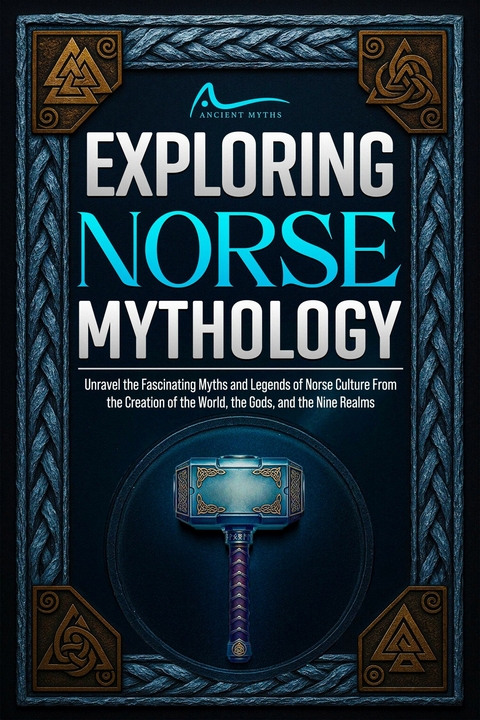
Exploring Norse Mythology (eBook)
130 Seiten
Ancient Myths Publishing (Verlag)
978-0-00-066398-6 (ISBN)
Uncover the Mysteries of the Ancient North...
Journey Through the Enigmatic World of Norse Mythology and Discover Secrets That Will Awaken Your Imagination!
From the Depths of Yggdrasil to the Shores of Midgard - Experience a saga like no other!
Are you intrigued by the ancient tales of Odin, Thor, and Loki? Do Norse legends, with their formidable giants, mystical realms, and the fabled Ragnarok, capture your imagination, yet seem shrouded in mystery?
The complex world of Norse mythology is not just a series of stories; it's a rich tapestry of belief and tradition that has influenced cultures for centuries.
But without a guide, these myths can seem inaccessible, their deeper meanings lost in translation.
Fear not! 'Exploring Norse Mythology' is your map to these ancient treasures.
This book isn't just a collection of stories; it's a portal to another time and place, offering a unique glimpse into a world that continues to fascinate and inspire.
Here's what you'll find:
✅ Unveiling the Norse Cosmos and the Birth of the Nine Realms
✅ Odin's Wisdom Quest: Lessons in Knowledge and Sacrifice
✅ Thor's Might: Understanding True Strength and Heroism
✅ Loki's Tricks: The Art of Deception and Its Consequences
✅ Ragnarok Revealed: Decoding the End of the World and Its Rebirth
✅ The Valkyries' Choice: Exploring the Role of Fate and Destiny
✅ The Runes Deciphered: Ancient Wisdom for Modern Times
This book is crafted not just for myth enthusiasts but for anyone seeking to understand the profound impact of these ancient stories on our modern world.
Embark on your Viking journey today. Don't let the sagas of old remain a mystery.
Get your copy and set sail on an epic adventure through the captivating world of Norse mythology!
CHAPTER 1:
UNDERSTANDING NORSE MYTHOLOGY
The people of Norse were originally known as the Vikings. Eventually, they were converted to Christianity. However, in the Middle Ages, they had a vibrant religion known to be linked to the Nordic landscape. The principles based on which their faith was established today are called the North Mythology. This concept is known to give life to the Vikings. The mythology revolves around several complex entities, such as Odin, Thor, Freya, and Loki. This mythology is also often associated with the god and goddesses.
You might be astonished that the Norse religion never had a title. People simply called this way of living “the tradition or ritual.” However, some individuals continued to follow it after the arrival of Christianity. They were called heathens, as some resided on the land of the heaths. While in the countryside, they were called stuck.
Mankind craves a religion and a compelling mythology to follow. This satisfies their desire for significance in their lives and allows them to experience sacred love. The faith of the Norse was no different. People followed this religion because it was appropriate to the time and place. Some traditions may make sense presently, while others may appear odd. However, if you try to understand these concepts with an open mind, you’ll slowly understand why people want to live in the presence of transcendent majesty. What’s more astonishing is that even though the last God of Vikings has laid his sword for ages, people are still fascinated by their legacy.
What makes Vikings different is their ability to perceive life. They didn’t want to take salvation from this world and its difficulties. Instead, they were happy to live life within the boundaries of what they called culture and nature. Another highlight of their faith was that they never sugar-coated the graveness of the present world. They were here for all of it. It was based on accepting all the hardships and staying positive. They were more focused on performing the greater good that could benefit the people and others in their surroundings. A life full of good deeds was the life of the Vikings.
The Vikings were raiders, conquerors, and traders from Sweden, Denmark, Iceland, Norway, and Iceland during the Viking Age. The approximate time frame was 793-1066 CE. They used to travel west to North America and east to Baghdad. The believers of Norse mythology used to write in runes, speak the Old Norse language, and used to follow the ancestral religion.
You might be asking what could have prompted their journey. Like present humans, this was motivated by universal wants such as prestige, riches, and power. Today, a person with more wealth is thought to be more deserving of respect and power. However, unlike in the modern world, they used to acquire precious metals such as gold, silver, and jewels instead of money. Aside from that, possessing land was regarded as valuable.
Today we all can learn about the power of Vikings. We now know how pre-Christianity religion used to work. Along with all the theme variations, we can also figure out the mode of life the people of that time used to prefer. It is majorly due to the treaties, poems, and sagas that were written even when the people converted to the Christian religion.
You may have questions about Norse mythology after hearing so much about it. For example, what is the historical significance of this theme? Is it worthwhile to invest your time and effort in studying this topic? If so, keep reading to obtain answers to all of your questions.
The Importance of Mythology in Norse Culture
Have you ever seen superhero movies? You might have seen a common pattern in them. They all have a mighty power unknown to people common living on Earth. People keep wondering where they come from or who they are. They are no less than a god originating in an alien space. What’s more relatable in these stories is a strong villain.
These stories have taken inspiration from several mythologies that are famous to this day. Nowadays, Norse culture is becoming popular, and several filmmakers seem to take inspiration from them.
The reason behind this popularity is the myths that are a great part of Norse culture. Just like now, mythology is also important in the given tradition. The reason is somewhat similar: the myths connected to religion. The myths of the Norse are filled with stories of gods and goddesses and their tales.
Unfortunately, not all the entities among them are positive. People take inspiration from these gods in the Norse culture and obey the one to which they want to channel their energy in them. Among the 66 gods and goddesses, Odin is the head of all gods. Another god, Tyr, also known as the God of war, is debated as the head of war by some experts. In the Norse culture, Tyr was taken as a symbol of worship in case of warfare. They obeyed Tyr to awaken their inner warrior and gain victory.
The wife of Odin is known as Freya, the Goddess of beauty and fertility. In the Norse culture, she is a powerful deity and popular in their culture. However, there is some poetry written by Germanic people about how Freya was accused of giving sexual favors to all the other gods and elves. However, they are always denied by her, but sadly it is stated that she couldn’t prove herself right.
Another God seen to be discussed in the Norse culture is Thor. He is known to have a massive hammer which he used to smite away all the giants. He wasn’t taken very seriously and is known to be a thug, famous for his bumbling loutish personality.
Norse Mythology is the name given to the framework of Scandinavian mythology that was maintained throughout and around the period of the Viking Age (from 790 CE to roughly 1100 CE). The world of Nordic mythology is both complex and all-encompassing. It begins with a creation myth in which the first gods kill a giant and turn his body parts into the world. Other realms are said to exist beneath the Yggdrasil tree, and Ragnarok is said to be the event that ultimately leads to the destruction of the known world. Its polytheistic pantheon, which is led by the deity with one eye, Odin, and which encompasses a huge number of various gods and goddesses, all of whom were revered in rituals that were ingrained in the ancient Scandinavians' day-to-day lives, was founded on the belief that the gods and goddesses were interconnected.
It is no easy task to peel back the layers of history in order to build a fully comprehensive and accurate image of the myths, beliefs, and practices as they truly were during the Viking Age. This is particularly difficult to do for a civilization that relied mostly on oral tradition, as Scandinavia did for the most part throughout this time period. As a result of this, the information that we know about the Norse gods is simply the "tips of the narrative icebergs" (Schjdt, 219).
What Is A Myth?
Myths are as old as humankind and have their origin in the attempts of primitive people to explain the mysteries of the world around them, such as thunder and lightning, floods and fire, rain and drought, earthquakes and volcanic eruptions, night and day, the Sun, Moon, and stars, the seasons, the existence of plants and animals, man and woman, and birth and death. Myths have been passed down from generation to generation since the beginning of human history. Myths satisfy the urge that people have to believe in some higher being or beings that have control over the everyday lives and destiny of humans. This need is fulfilled when people tell stories about these creatures. In a number of the mythologies from throughout the globe, a sky deity or universal father figures with an earth mother. In many instances, like the tales of the Norse, people believed in a set of attendant gods and goddesses, as well as villains such as demons, dragons, and other monsters; giants and dwarfs; and supernatural forces. In addition, people thought that these gods and goddesses were accompanied by a set of attendant gods and goddesses.
Myths provide individuals with a framework for organizing their lives. The myths are a reflection of their ethical standards, the rituals and traditions that are important to their culture, and the methods in which they do their work. Myths are essentially tales that focus on the conflict that exists between good and evil, as well as order and chaos. They are a portent of the final disintegration of order as well as the rebirth that will follow.
Myths regarding the origin of the world and the animals and plants that make up life on Earth have been handed down verbally from one generation to the next, from family to family, and from community to community for a very long time. Due to the passage of thousands of years before the stories were committed to writing, the tales were subject to alteration depending on the whims of the narrators. As groups of people traveled across a continent, they modified their myths and legends to fit the new topography and weather conditions that they encountered. Stories that may have originated in India, the Middle East, or the southern part of Europe underwent significant transformations when they were recounted by people living in the harsh, rugged, and frozen countries of the north, where the summers were brief and the winters were terrible.
Last but not...
| Erscheint lt. Verlag | 30.10.2024 |
|---|---|
| Sprache | englisch |
| Themenwelt | Geschichte ► Allgemeine Geschichte ► Vor- und Frühgeschichte |
| ISBN-10 | 0-00-066398-0 / 0000663980 |
| ISBN-13 | 978-0-00-066398-6 / 9780000663986 |
| Informationen gemäß Produktsicherheitsverordnung (GPSR) | |
| Haben Sie eine Frage zum Produkt? |
 EPUB (Adobe DRM)
Größe: 1,8 MB
Kopierschutz: Adobe-DRM
Adobe-DRM ist ein Kopierschutz, der das eBook vor Mißbrauch schützen soll. Dabei wird das eBook bereits beim Download auf Ihre persönliche Adobe-ID autorisiert. Lesen können Sie das eBook dann nur auf den Geräten, welche ebenfalls auf Ihre Adobe-ID registriert sind.
Details zum Adobe-DRM
Dateiformat: EPUB (Electronic Publication)
EPUB ist ein offener Standard für eBooks und eignet sich besonders zur Darstellung von Belletristik und Sachbüchern. Der Fließtext wird dynamisch an die Display- und Schriftgröße angepasst. Auch für mobile Lesegeräte ist EPUB daher gut geeignet.
Systemvoraussetzungen:
PC/Mac: Mit einem PC oder Mac können Sie dieses eBook lesen. Sie benötigen eine
eReader: Dieses eBook kann mit (fast) allen eBook-Readern gelesen werden. Mit dem amazon-Kindle ist es aber nicht kompatibel.
Smartphone/Tablet: Egal ob Apple oder Android, dieses eBook können Sie lesen. Sie benötigen eine
Geräteliste und zusätzliche Hinweise
Buying eBooks from abroad
For tax law reasons we can sell eBooks just within Germany and Switzerland. Regrettably we cannot fulfill eBook-orders from other countries.
aus dem Bereich