


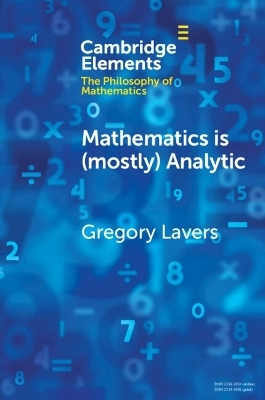
Mathematics is (mostly) Analytic
Seiten
2025
Cambridge University Press (Verlag)
978-1-009-11111-9 (ISBN)
Cambridge University Press (Verlag)
978-1-009-11111-9 (ISBN)
This Element looks at Quine's arguments against the concepts of analyticity. It mentions Boghossian's distinction between epistemic and metaphysical accounts of analyticity. It shows how analyticity is related to truth, necessity and questions of ontology. The relation of analyticity to the axiomatic method in mathematics is mentioned.
This Element outlines and defends an account of analyticity according to which mathematics is, for the most part, analytic. The author begins by looking at Quine's arguments against the concepts of analyticity. He shows how Quine's position on analyticity is related to his view on explication and shows how this suggests a way of defining analyticity that would meet Quine's own standards for explication. The author then looks at Boghossian and his distinction between epistemic and metaphysical accounts of analyticity. Here he argues that there is a straightforward way of eliminating the confusion Boghossian sees with what he calls metaphysical accounts. The author demonstrates that the epistemic dimension of his epistemic account is almost entirely superfluous. The author then discusses how analyticity is related to truth, necessity, and questions of ontology. Finally, he discusses the vagueness of analyticity and also the relation of analyticity to the axiomatic method in mathematics.
This Element outlines and defends an account of analyticity according to which mathematics is, for the most part, analytic. The author begins by looking at Quine's arguments against the concepts of analyticity. He shows how Quine's position on analyticity is related to his view on explication and shows how this suggests a way of defining analyticity that would meet Quine's own standards for explication. The author then looks at Boghossian and his distinction between epistemic and metaphysical accounts of analyticity. Here he argues that there is a straightforward way of eliminating the confusion Boghossian sees with what he calls metaphysical accounts. The author demonstrates that the epistemic dimension of his epistemic account is almost entirely superfluous. The author then discusses how analyticity is related to truth, necessity, and questions of ontology. Finally, he discusses the vagueness of analyticity and also the relation of analyticity to the axiomatic method in mathematics.
1. Introduction; 2. Quine and analyticity; 3. Boghossian and truth in virtue of meaning; 4. Analyticity and its relation to other concepts; 5. The analyticity of mathematics: Final thoughts; References.
| Erscheinungsdatum | 22.01.2025 |
|---|---|
| Reihe/Serie | Elements in the Philosophy of Mathematics |
| Zusatzinfo | Worked examples or Exercises |
| Verlagsort | Cambridge |
| Sprache | englisch |
| Maße | 152 x 229 mm |
| Gewicht | 116 g |
| Themenwelt | Geisteswissenschaften ► Philosophie |
| ISBN-10 | 1-009-11111-6 / 1009111116 |
| ISBN-13 | 978-1-009-11111-9 / 9781009111119 |
| Zustand | Neuware |
| Informationen gemäß Produktsicherheitsverordnung (GPSR) | |
| Haben Sie eine Frage zum Produkt? |
Mehr entdecken
aus dem Bereich



aus dem Bereich
wie Tiere den Tod verstehen
Buch | Hardcover (2025)
Insel Verlag
CHF 42,90
eine Ethik des Verzichts
Buch | Softcover (2025)
Reclam (Verlag)
CHF 9,80
Buch | Softcover (2025)
Wiley-VCH (Verlag)
CHF 30,80


