Zum Hauptinhalt springen
Nicht aus der Schweiz? Besuchen Sie lehmanns.de
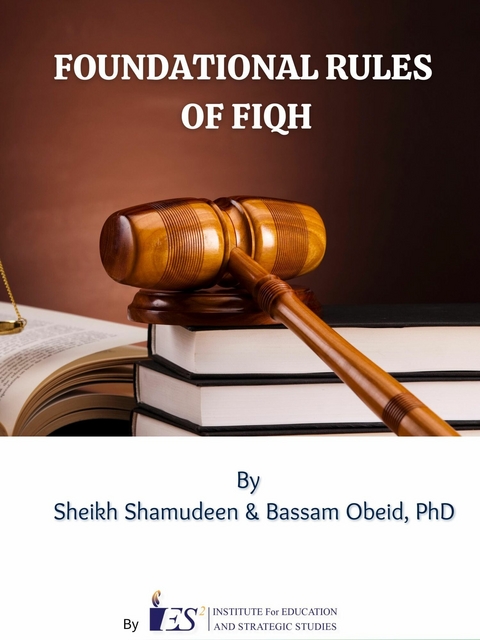
Foundational Rules of FiQh -  PhD Bassam Obeid,  Shamu Deen

Foundational Rules of FiQh (eBook)

eBook Download: EPUB
2024 | 1. Auflage
84 Seiten
Bookbaby (Verlag)
9798350961287 (ISBN)
Systemvoraussetzungen
3,56 inkl. MwSt
(CHF 3,45)
Der eBook-Verkauf erfolgt durch die Lehmanns Media GmbH (Berlin) zum Preis in Euro inkl. MwSt.
  • Download sofort lieferbar
  • Zahlungsarten anzeigen
This book is a translation, explanation and commentary of many foundational Rules of Fiqh. This book presents the concept of 'Foundational Rulings' (AlQawaid AlFiqhiyyah) as a means of simplifying the vast body of knowledge that is Islamic Jurisprudence. This approach provides a bird's-eye view of Islam, enabling the reader to grasp the essential principles and apply them to various situations.

Sheikh Bassam I. Obeid is the Imam at the Islamic Center of Charlotte (ICC). He is originally from Lebanon and is a graduate of the Islamic University of Medina. As the Head Imam, he serves as the Spiritual and Prayer Leader for the masjid, preaching, teaching, and abiding by Islamic Law. Sheikh Bassam Obeid has been an instrumental figure for the continued success and betterment of the Muslim community in Charlotte.
This book is a translation, explanation, and commentary of many foundational Rules of Fiqh. The knowledge of Islam is vast, and the details of Islamic Jurisprudence are extensive. There are so many methodologies in interpreting the guidance from the Quran and Sunnah, the tools utilized in extracting the verdicts, the massive quantity of issues, and the variety of opinions are so copious that it is impossible for most people to know them all. The concept of "e;Foundational Rulings"e; (AlQawaid AlFiqhiyyah) is an attempt to simplify the big picture of the Deen. Equipped with this knowledge and Maqasid AshShari'ah AlIslamiyyah (goals and objectives of the Shari'ah,) one can have a bird's eye view of Islam. These foundational rulings are a way to approach Islamic jurisprudence that simplifies the big picture of Islam. They are the "e;bones"e; of Islamic law. The foundational rulings are based on the Quran and Sunnah, and they are the basis for all Islamic law. They are the framework of Islam, and they are necessary to understand and apply Islamic law.

Terminologies:
Fiqh (الْفِقْه): The word Fiqh linguistically means ‘to comprehend’. In Islamic context it is used to refer to the studies of Islamic jurisprudence. The field of knowledge that deals with the ‘what’ and ‘how’ of all matters with guidance from the Quran and Sunnah. If a Muslim needs to know what the verdict for him is concerning a specific matter and how he is expected to execute that verdict, then the subject of Fiqh defines that for him. It informs him what to do and how to do it.
Hukm (الْحُكْمُ): ‘A verdict’ is the singular of Ahkam (الْأَحْكَامُ). Each hukm is one of 5 verdicts passed on a specific matter as it relates to the action of the Mukallaf (responsible party, defined later). The five Ahkaam are:
1.Wajib - وَاجِبٌ (Obligatory)
2.Mustahab - مُسْتَحَبٌّ (Recommended)
3.Mubah – مُبَاحٌ (Permissible)
4.Makrouh - مَكْرُوهٌ (Disliked)
5.Haram حَرَامٌ (Forbidden).
Every verdict concerning every matter as it relates to the Mukallaf must be one of these five. There are no other verdicts relative to the Mukallaf beyond these.
Definitions: There are varying definitions of each of these five verdicts. Here are the most popular and intuitive.
Wajib: It is what Allah has made obligatory, where the one who does it for the pleasure of Allah and according to the Sunnah of The Messenger of Allah is rewarded and the one who neglects it deserves to be punished.
Mustahab: This is something that it is recommended for a person to do. If he does it, he is rewarded but if he does not do it, he deserves no punishment.
Mubah: This is something that is permissible. It is the same whether the person does it or not. There are no rewards or punishment attached to this verdict.
Makrouh: This is something that is discouraged. If the person leaves it off for the pleasure of Allah , he is rewarded but if he does it, he does not deserve to be punished. However, if a person persists in doing things that are Makrouh, the verdict with respect to him may change to Haram.
Haram: It is what Allah had forbidden, where the one who avoids it for the sake of Allah is rewarded and the one who does it deserves to be punished.
I say, ‘deserves to be punished’ and not that he will be punished because it is possible that Allah may forgive the person and hence, he will not be punished.
Here I listed five verdicts. This is the opinion of most scholars. I follow this opinion in this discourse.
Correctness and invalidity (الصِّحَّةُ وَالْبُطْلَانُ أَوِ الْفسَادُ):
Two other verdicts are: correctness and invalidity. We say that something is correct (صَحِيْحٌ) or invalid (بَاطِلٌ - فَاسِدٌ).
The difference between these two verdicts and the previous 5 are that these are with respect to the action whereas the previous 5 are with respect to the Mukallaf (The responsible person).
I will demonstrate the difference with an example:
If one does Salah knowingly without wudu (ablution), assuming that one had the ability and means to perform wudu, then his Salah is invalid (بَاطِلَةٌ). The verdict is passed against his Salah, the action not him. The verdict with respect to him is that it was Wajib (obligatory) upon him to do Salah with wudu and forbidden for him to do Salah without wudu.
AlMukallaf (الْمُكَلَّفُ): ‘The one responsible and accountable’ is derived from the word:
كَلَّفَيُكَلِّفُتَكْلِيْفًاوَالْمُكَلَّفُ اسْمُ الْمَفْعُوْلِ
He made (s/o) responsible/accountable – he makes (s/o) responsible/accountable - responsibility/accountability – and Mukallaf is the name of the object of the verb, the one made responsible and accountable.
So, AlMukallaf is the person upon whom the verdict is passed. When it is said that something is obligatory that is not a precise statement. What is really meant is that the action of the Mukallaf in association with the thing is obligatory. The thing itself cannot be and is not obligatory. For example: If it is said that Salah is obligatory, what is meant is that doing Salah is obligatory upon a specific person (AlMukallaf).
This is the same if it is said that something is forbidden. For example: if it is said that pork is forbidden, what it meant is that the consumption of pork is forbidden on a specific person (AlMukallaf). Pork is not forbidden. Consumption of pork is forbidden. Salah is not obligatory. Doing Salah is obligatory. Just like this are the other 3 Ahkaam. The target of the verdict (hukm) then is not the thing, rather, it is the action of the Mukallaf in association to the thing.
The requirements for responsibility/accountability (شُرُوْطُ التَّكْلِيْفِ):
Islam
The person must be a Muslim.
Age
The person must have reached the age of responsibility.
Mind
The person must be of sane mind.
Awareness
The person must be informed of the rule.
Ability
The person must have the ability to execute the verdict.
Absence of obstacles
-
There must be no obstacles that exempt the person from the verdict.
For example: menses for a woman from Salah or sickness for a person from fasting.
This is briefly the requirements for a person to be Mukallaf. In the absence of all or any of these requirements the verdict is lifted with respect to that individual.
Qawa’id (الْقَوَاعِدُ) is the plural of Qa’idah (الْقَاعِدَةُ) which literally means a base or foundation. In this context, it is used to mean a rule of Fiqh that applies to many categories (أَبْوَاب) of Fiqh and not only to a specific category. It is a general or foundational rule.
A rule that applies to a specific category of Fiqh is called a Dabit (الضَّابِطُ – A guideline).
The categories of Fiqh (أَبْوَابُ الْفِقْهِ): This is a very subjective study about Fiqh. There is no consensus on this matter. Many scholars have suggested various categorizations of the Chapters of Fiqh. Here, I will share the categorization according to Al-Imam AshShatibi in ‘AlMuwafaqaat’. He mentions four major categories of Fiqh:
1.Al’Ibaadaat (الْعِبَادَات) Acts of worships:
2.AlMu’aamalaat...

Erscheint lt. Verlag 28.10.2024
Sprache englisch
Themenwelt Geisteswissenschaften Religion / Theologie Islam
ISBN-13 9798350961287 / 9798350961287
Informationen gemäß Produktsicherheitsverordnung (GPSR)
Haben Sie eine Frage zum Produkt?
EPUBEPUB (Ohne DRM)
Größe: 374 KB

Digital Rights Management: ohne DRM
Dieses eBook enthält kein DRM oder Kopier­schutz. Eine Weiter­gabe an Dritte ist jedoch rechtlich nicht zulässig, weil Sie beim Kauf nur die Rechte an der persön­lichen Nutzung erwerben.

Dateiformat: EPUB (Electronic Publication)
EPUB ist ein offener Standard für eBooks und eignet sich besonders zur Darstellung von Belle­tristik und Sach­büchern. Der Fließ­text wird dynamisch an die Display- und Schrift­größe ange­passt. Auch für mobile Lese­geräte ist EPUB daher gut geeignet.

Systemvoraussetzungen:
PC/Mac: Mit einem PC oder Mac können Sie dieses eBook lesen. Sie benötigen dafür die kostenlose Software Adobe Digital Editions.
eReader: Dieses eBook kann mit (fast) allen eBook-Readern gelesen werden. Mit dem amazon-Kindle ist es aber nicht kompatibel.
Smartphone/Tablet: Egal ob Apple oder Android, dieses eBook können Sie lesen. Sie benötigen dafür eine kostenlose App.
Geräteliste und zusätzliche Hinweise

Buying eBooks from abroad
For tax law reasons we can sell eBooks just within Germany and Switzerland. Regrettably we cannot fulfill eBook-orders from other countries.

Mehr entdecken
aus dem Bereich