


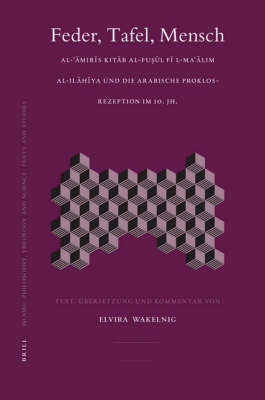
Feder, Tafel, Mensch
Al-ʿĀmirīs Kitāb al-Fuṣūl fī l-Maʿālim al-ilāhīya und die arabische Proklos-Rezeption im 10. Jh.
Seiten
2006
Brill (Verlag)
978-90-04-15255-7 (ISBN)
Brill (Verlag)
978-90-04-15255-7 (ISBN)
Al-ʽĀmirī’s Chapters on Metaphysical Topics are an impressive example of the fusing of Greek Neoplatonism with Islamic Theology. Being a paraphrase of the Proclean Elements of Theology, they provide a better understanding of the tradition of the Liber de Causis in Arabic.
This volume deals with the philosopher Abū l-Ḥasan al-ʽĀmirī (died 992) and his reception of Neoplatonism, focusing on his Kitāb al-Fuṣūl fī l-maʽālim al-ilāhīya, the Chapters on Metaphysical Topics (Arabic text with German translation).
The Chapters on Metaphysical Topics paraphrase sections of the Elements of Theology by the Neoplatonist Proclus (died 485) and are therefore part of the Arabic Procliana.
The commentary analyses al-ʽĀmirī’s combination of Greek philosophy with Islamic theology, especially the harmonization of philosophical and Qur’anic terminology (universal Intellect is the Pen, universal Soul the Tablet) and man’s position between the two worlds. On the basis of a textual comparison between al-ʽĀmirī’s work, the Greek text of Proclus and the Arabic writings of the Liber de Causis-tradition, the book argues for the existence of a “Ur-Liber de causis”.
This volume deals with the philosopher Abū l-Ḥasan al-ʽĀmirī (died 992) and his reception of Neoplatonism, focusing on his Kitāb al-Fuṣūl fī l-maʽālim al-ilāhīya, the Chapters on Metaphysical Topics (Arabic text with German translation).
The Chapters on Metaphysical Topics paraphrase sections of the Elements of Theology by the Neoplatonist Proclus (died 485) and are therefore part of the Arabic Procliana.
The commentary analyses al-ʽĀmirī’s combination of Greek philosophy with Islamic theology, especially the harmonization of philosophical and Qur’anic terminology (universal Intellect is the Pen, universal Soul the Tablet) and man’s position between the two worlds. On the basis of a textual comparison between al-ʽĀmirī’s work, the Greek text of Proclus and the Arabic writings of the Liber de Causis-tradition, the book argues for the existence of a “Ur-Liber de causis”.
Elvira Wakelnig, Ph.D. in Islamic Studies at the University of Erlangen-Nürnberg (2005), research associate at the University of Bochum (Glossarium Graeco-Arabicum), short-term Frances A. Yates fellowship at the Warburg Institute (London), at present post-doc fellowship at the University of Halle-Wittenberg.
| Erscheint lt. Verlag | 12.9.2006 |
|---|---|
| Reihe/Serie | Islamic Philosophy, Theology and Science. Texts and Studies ; 67 |
| Verlagsort | Leiden |
| Sprache | deutsch |
| Gewicht | 951 g |
| Themenwelt | Geisteswissenschaften ► Philosophie ► Östliche Philosophie |
| Geisteswissenschaften ► Philosophie ► Philosophie Altertum / Antike | |
| ISBN-10 | 90-04-15255-5 / 9004152555 |
| ISBN-13 | 978-90-04-15255-7 / 9789004152557 |
| Zustand | Neuware |
| Informationen gemäß Produktsicherheitsverordnung (GPSR) | |
| Haben Sie eine Frage zum Produkt? |
Mehr entdecken
aus dem Bereich

aus dem Bereich


