


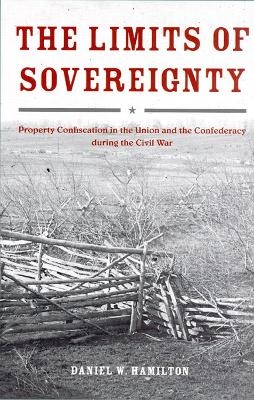
The Limits of Sovereignty
Property Confiscation in the Union and the Confederacy during the Civil War
Seiten
2007
University of Chicago Press (Verlag)
978-0-226-31482-2 (ISBN)
University of Chicago Press (Verlag)
978-0-226-31482-2 (ISBN)
- Titel z.Zt. nicht lieferbar
- Versandkostenfrei
- Auch auf Rechnung
- Artikel merken
Americans take for granted that government does not have the right to permanently seize private property without just compensation. Yet for much of American history, such a view constituted the weaker side of an ongoing argument about government sovereignty and individual rights. What brought about this drastic shift in legal and political thought?
Daniel W. Hamilton locates that change in the crucible of the Civil War. In the early days of the war, Congress passed the First and Second Confiscation Acts, authorizing the Union to seize private property in the rebellious states of the Confederacy, and the Confederate Congress responded with the broader Sequestration Act. The competing acts fueled a fierce, sustained debate among legislators and lawyers about the principles underlying alternative ideas of private property and state power, a debate which by 1870 was increasingly dominated by today’s view of more limited government power.
Through its exploration of this little-studied consequence of the debates over confiscation during the Civil War, The Limits of Sovereignty will be essential to an understanding of the place of private property in American law and legal history.
Daniel W. Hamilton locates that change in the crucible of the Civil War. In the early days of the war, Congress passed the First and Second Confiscation Acts, authorizing the Union to seize private property in the rebellious states of the Confederacy, and the Confederate Congress responded with the broader Sequestration Act. The competing acts fueled a fierce, sustained debate among legislators and lawyers about the principles underlying alternative ideas of private property and state power, a debate which by 1870 was increasingly dominated by today’s view of more limited government power.
Through its exploration of this little-studied consequence of the debates over confiscation during the Civil War, The Limits of Sovereignty will be essential to an understanding of the place of private property in American law and legal history.
Daniel W. Hamilton is assistant professor at Chicago-Kent College of Law.
| Erscheint lt. Verlag | 2.2.2007 |
|---|---|
| Sprache | englisch |
| Maße | 16 x 24 mm |
| Gewicht | 482 g |
| Themenwelt | Geschichte ► Allgemeine Geschichte ► Neuzeit (bis 1918) |
| Geisteswissenschaften ► Geschichte ► Regional- / Ländergeschichte | |
| Geschichte ► Teilgebiete der Geschichte ► Militärgeschichte | |
| ISBN-10 | 0-226-31482-0 / 0226314820 |
| ISBN-13 | 978-0-226-31482-2 / 9780226314822 |
| Zustand | Neuware |
| Informationen gemäß Produktsicherheitsverordnung (GPSR) | |
| Haben Sie eine Frage zum Produkt? |
Mehr entdecken
aus dem Bereich
aus dem Bereich
Geschichte einer wilden Handlung
Buch | Hardcover (2024)
C.H.Beck (Verlag)
CHF 47,60


