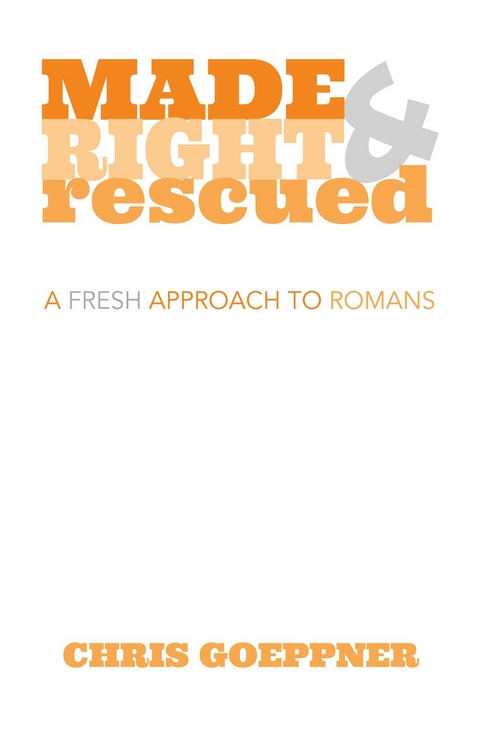
Made Right & Rescued (eBook)
180 Seiten
Bookbaby (Verlag)
979-8-3509-8013-4 (ISBN)
Chris Goeppner (pronounced Gep-ner) is the founding pastor of Riverbank Church, which he launched in 2010 after moving from South Florida to New England. Chris and his wife Penny live in White River Junction, Vermont with their two dogs. As a father of two sons, Chris enjoys music, family time, and cheering for the Boston Celtics and Miami Hurricanes football. His journey from Florida to Vermont reflects his commitment to faith, family, and the people in his adopted New England home.
"e;Why in the world do we need another book about Romans?"e; It's a fair question. Haven't countless scholars and pastors already dissected this letter inside and out? What more could possibly be said? "e;Made Right and Rescued"e; isn't about uncovering a hidden, never-before-seen truth in Romans. It's about taking those timeless truths about being rescued by God and made right in Christ, and serving them up in a way that's easier to digest. Pastor Chris Goeppner wants to help newer believers get their heads around this theological masterpiece. Romans isn't just another letter in the New Testament; it's the foundation of our faith, the roadmap of Christian doctrine, the guide to Christian living. For someone new to faith, it can seem like a mountain that's way too steep to climb. All those big theological concepts about righteousness, justification, and sanctification can be pretty intimidating. Think of this book as your friendly guide up that mountain. Pastor Chris breaks down Paul's message into accessible pieces to open up a treasure trove of wisdom. "e;Made Right and Rescued"e; simplifies some of the important truths of Christian theology for the everyday person. The church sometimes does a great job of going deep - and that's good but sometimes that can end up confusing people more than helping people. The church can get so caught up in the complexities that it loses sight of the simple, beautiful truths at the core of faith - like the fact that God has rescued us and made us right through Christ. The truths in Romans are too important, too life-changing to stay locked up in dusty old academic books or hidden behind big theological words. This doesn't mean Pastor Chris is watering down the message or avoiding the tough stuff. Not at all. He'll still wrestle with sin, salvation, justification, and sanctification but in a way that connects with readers' everyday life, that speaks to the heart as well as the mind. Whether you're new to faith or you've been walking with Jesus for decades, Pastor Chris's prayer is that this book will help you see Romans - and the Good News it proclaims about our rescue and righteousness - with fresh eyes. May we all experience the freedom that comes through the grace of simplicity as we encounter God's truth in this remarkable letter.
1
THE IDENTITY CHALLENGE
Romans 1:1-6, 16
Have you ever stopped to really think about who you are? I mean, truly, at your core? In our world today, it seems like everyone’s obsessed with identity. We’re constantly being told to “find ourselves,” “express ourselves,” and “be true to ourselves.” But what if I told you that the way our culture defines identity is completely backwards from what God intended?
The Setting: A Letter That Changed the World
Picture this: It’s about 2,000 years ago, and the Apostle Paul is sitting down to write a letter. He’s never been to Rome, but he’s heard all about the believers there. Rome was like the New York City of its day - a melting pot of cultures, ideas, and, yes, identities. You had Jews who had embraced Jesus as their Messiah, sitting next to former pagan Gentiles who had turned from their old ways to follow Christ. Talk about a diverse crowd!
Paul’s about to drop some heavy truth on them, and he knows it. So, he starts by establishing his identity right off the bat. Let’s look at how he introduces himself: “This letter is from Paul, a slave of Christ Jesus, chosen by God to be an apostle and sent out to preach his Good News.” (Romans 1:1, NLT)
Now, hold up a second. Did you catch that? Paul calls himself a “slave of Christ Jesus.” In our day, that word “slave” makes us cringe, and for good reason. But Paul’s using it to make a powerful point about his identity. He’s saying, “I’m all in for Jesus. I’m completely devoted to Him. Everything I am and everything I do is about Jesus.”
The Identity Crisis of Our Age
Before we dig deeper into Paul’s words, let me ask you something: How do you define your identity? In our world today, we’re taught that our identity comes from within. It’s all about our feelings, our desires, our self-expression.
I recently read this fascinating book called “Strange New World” by Carl Trueman. It breaks down how we got to this place in our culture. Over the past 100 years, especially in the last 50, and even more so in the last 20, our understanding of identity has shifted dramatically. This way of thinking is called “expressive individualism.” It’s the idea that to be truly authentic, you need to act on your feelings and express your inner self, whatever that looks like. Now, don’t get me wrong - feelings aren’t bad. God gave us emotions for a reason. But basing our entire identity on how we feel? That’s a recipe for confusion and disaster.
Let’s break this down a bit more. Expressive individualism has its roots in the teachings of secular thinkers like Sigmund Freud and Karl Marx. These ideas have seeped into every aspect of our culture. They’ve shaped how we view ourselves, our relationships, even our purpose in life. Here’s the core of expressive individualism: it holds that each person has a unique core of feeling and intuition that should unfold or be expressed if individuality is to be realized. In other words, your deepest feelings and desires define who you are, and to be truly yourself, you need to express those feelings and follow those desires.
Sounds pretty good, right? After all, who doesn’t want to be true to themselves? But here’s the problem: our feelings are fickle. They change. They can be influenced by all sorts of things - our circumstances, our physical state, even what we had for breakfast! If we base our identity on something as changeable as our feelings, we’re building on shifting sand.
Moreover, expressive individualism tells us that we’re the ultimate authority on who we are. It’s up to us to define ourselves, to create our own identity. But is that really true? Can we really be objective about ourselves?
This mindset has led to some of the most confusing and troubling aspects of our modern culture. We see it in the constant pressure to “find yourself” or “reinvent yourself.” We see it in the idea that you can change your identity at will, based on how you feel at any given moment. We see it in the relentless pursuit of self-fulfillment, often at the expense of commitments and relationships.
The result? An identity crisis of epic proportions. People are more confused than ever about who they
are and what their purpose is. They’re chasing after an ever-changing ideal of self-expression, never finding solid ground to stand on.
But here’s the thing: this isn’t how God designed us to live. He didn’t create us to be endlessly searching for our identity within ourselves. He created us to find our identity in relationship with Him.
The Christian Alternative: Identity in Christ
Paul’s introduction gives us a radically different view of identity. Let’s break it down:
“Slave of Christ Jesus” - Paul’s saying his primary identity is in his relationship with Jesus. He’s surrendered everything to Christ.
This is a complete 180 from expressive individualism. Instead of saying “I need to express my inner self to be truly me,” Paul’s saying “I’ve given up my right to self-definition. I belong to Jesus now.”
What does this mean practically? It means that our core identity isn’t found in our job, our relationships, our achievements, or even our feelings. It’s found in our relationship with Jesus. We’re not defined by what we do, but by who we belong to.
This doesn’t mean we lose our individuality. Far from it! But it means that our individuality finds its true expression when it’s surrendered to Christ. It’s like a musical instrument - it makes its most beautiful music not when it’s played randomly, but when it’s played according to the composer’s score.
“Chosen by God” - Paul recognizes that his identity and purpose come from God’s invitation, not his own feelings or choices.
This is huge. Paul’s not saying “I chose this path for myself.” He’s saying “God chose me.” This flies in the face of our culture’s obsession with self-determination. It tells us that our ultimate identity isn’t something we create - it’s something we receive.
Think about what this means. Your value doesn’t come from what you can do or achieve. It comes from the fact that God has chosen you. You’re wanted. You’re valued. Not because of anything you’ve done, but because of who God is and what He’s done for you.
“Sent out to preach his Good News” - Paul’s identity is tied to his mission. Who he is shapes what he does.
Here’s where we see that finding our identity in Christ doesn’t lead to passivity. It leads to purpose. Paul knows who he is (a slave of Christ), he knows he’s chosen by God, and that leads him to embrace his mission of sharing the Good News.
When we find our identity in Christ, it doesn’t just change how we see ourselves. It changes how we live. We’re not just trying to “express ourselves” anymore. We’re living out the purpose God has given us.
This is the complete opposite of how our culture views identity. While the world says, “Look within,” Paul’s saying, “Look to Jesus.” While our culture says, “Express yourself,” Paul’s saying, “Express Jesus.”
Now, I want you to picture Paul for a second. This guy was a big deal before he met Jesus. He was like the valedictorian of Jewish scholars, respected and admired. But he gave all that up. He says, “I am a slave of Jesus Christ.” That’s a mic-drop moment right there!
The Two-Fold Nature of Christian Identity
So, what does this mean for us? Well, Christian identity boils down to two things:
- Who You Are: A surrendered servant, chosen by God.
- What You Do: A messenger of the Good News.
Everything about Paul’s identity goes back to Jesus Christ. Everything. And who you are and what you do are intrinsically connected. You can’t separate them.
This is so different from what our culture tells us. The world says “Find yourself, then do what makes you happy.” The Christian identity says “Find yourself in Christ, then do what He’s called you to do.”
The Declaration of Unashamed Identity
Paul caps off his introduction with a powerful statement in Romans 1:16: “For I am not ashamed of this Good News about Christ. It is the power of God at work, saving everyone who believes—the Jew first and also the Gentile.” (NLT)
When Paul says he’s not ashamed, he’s not just talking about overcoming fear. He’s declaring his complete alignment with Jesus and His message, even when it’s uncomfortable or unpopular.
In a world that tells us to be ashamed of anything that doesn’t align with the current cultural narrative, Paul’s words are revolutionary. He’s saying, “I don’t care if this message isn’t popular. I don’t care if it doesn’t fit with what society says. This is who I am, and I’m not ashamed of it.”
The Challenge:...
| Erscheint lt. Verlag | 22.11.2024 |
|---|---|
| Sprache | englisch |
| Themenwelt | Geisteswissenschaften ► Religion / Theologie ► Christentum |
| ISBN-13 | 979-8-3509-8013-4 / 9798350980134 |
| Informationen gemäß Produktsicherheitsverordnung (GPSR) | |
| Haben Sie eine Frage zum Produkt? |
 EPUB (Ohne DRM)
Größe: 2,6 MB
Digital Rights Management: ohne DRM
Dieses eBook enthält kein DRM oder Kopierschutz. Eine Weitergabe an Dritte ist jedoch rechtlich nicht zulässig, weil Sie beim Kauf nur die Rechte an der persönlichen Nutzung erwerben.
Dateiformat: EPUB (Electronic Publication)
EPUB ist ein offener Standard für eBooks und eignet sich besonders zur Darstellung von Belletristik und Sachbüchern. Der Fließtext wird dynamisch an die Display- und Schriftgröße angepasst. Auch für mobile Lesegeräte ist EPUB daher gut geeignet.
Systemvoraussetzungen:
PC/Mac: Mit einem PC oder Mac können Sie dieses eBook lesen. Sie benötigen dafür die kostenlose Software Adobe Digital Editions.
eReader: Dieses eBook kann mit (fast) allen eBook-Readern gelesen werden. Mit dem amazon-Kindle ist es aber nicht kompatibel.
Smartphone/Tablet: Egal ob Apple oder Android, dieses eBook können Sie lesen. Sie benötigen dafür eine kostenlose App.
Geräteliste und zusätzliche Hinweise
Buying eBooks from abroad
For tax law reasons we can sell eBooks just within Germany and Switzerland. Regrettably we cannot fulfill eBook-orders from other countries.
aus dem Bereich