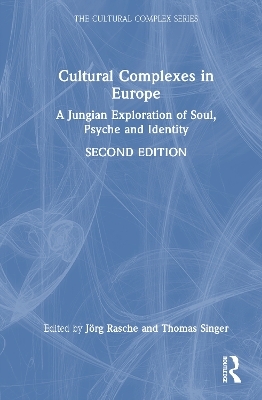
Cultural Complexes in Europe
Routledge (Verlag)
978-1-041-00420-2 (ISBN)
This is a new approach to old questions: What makes a people feel at home? How do their traditions and narratives form a cultural Self and identity? How do they differ from one another? Exploring cultural complexes blends knowledge of history, economics, sociology, anthropology, geography, psychology, religious studies, literature, and poetry. But as every complex is built around an emotional core, the study of how cultural complexes live in the psyche is not limited to these disciplines. Each author and reader engages in a confrontation with their emotions, prejudices, and projections. The shape that the ideas and feelings of a cultural complex take in the psyche can be inchoate, rapidly shifting and yet paradoxically long standing, and often quite immune and impermeable to the reason that traditional disciplines of thought would impose on them. These cultural complexes do not necessarily provide a coherent or linear sequencing of facts and events because that is not how they actually exist and function in the psyche of individuals and groups. At the same time, cultural complexes shape what it means to be a citizen of a particular city, region, or country of Europe.
This remarkable book is an important read for Jungian analysts and those interested in Europe’s historical and cultural development.
Jörg Rasche, MD, is a Jungian analyst in Berlin. He served for many years as president of the German Jungian Association (DGAP) and was vice-president of IAAP and president of the German Association for Sandplay Therapy (DGST). His books and articles include reflections on creativity, music, politics, and non-violent conflict resolution. Thomas Singer, MD, is a psychiatrist and Jungian psychoanalyst who trained at Yale Medical School, Dartmouth Medical School, and the C. G. Jung Institute of San Francisco. He is the author of many books and articles that include The Cultural Complexes Series. He serves on the board of ARAS (Archive for Research into Archetypal Symbolism) and has served as co-editor of ARAS Connections for many years.
Part 1: Soul, Identity, and Cultural Complexes in Individual European Countries 1. Poland: The Suffering Hero and Messianism in a Polish Cultural Complex 2. Greece: The Inner Riddle of “Greek Psychic Debt,” 3. Spain: The Catalan Vault 4. Czech Republic: The Forefather Cultural Complex 5. Serbia: Belgrade: Limes and the City Part 2: The Feminine and Cultural Complexes in Europe 6. Denmark: Mother Denmark 7. Italy: Queens, Saints, Heretics, Prostitutes 8. Austria: Sisi 9. Italy: “Small Mother Complex” and the Royal Feminine Part 3: The Greater European Family: Cultural Complexes in All European Countries 10. Europe: The Jewish Anima 11. Israel: My European Animus 12. Israel: A Very Narrow Bridge: Israel and Its Cultural Complexes 13. Europe: The Ghosts of Two World Wars 14. Europe: Europe and Islam
| Erscheinungsdatum | 12.03.2025 |
|---|---|
| Reihe/Serie | The Cultural Complex Series |
| Zusatzinfo | 13 Halftones, black and white; 13 Illustrations, black and white |
| Verlagsort | London |
| Sprache | englisch |
| Maße | 156 x 234 mm |
| Gewicht | 720 g |
| Themenwelt | Geisteswissenschaften ► Psychologie ► Entwicklungspsychologie |
| Geisteswissenschaften ► Psychologie ► Psychoanalyse / Tiefenpsychologie | |
| Geisteswissenschaften ► Psychologie ► Sozialpsychologie | |
| ISBN-10 | 1-041-00420-6 / 1041004206 |
| ISBN-13 | 978-1-041-00420-2 / 9781041004202 |
| Zustand | Neuware |
| Informationen gemäß Produktsicherheitsverordnung (GPSR) | |
| Haben Sie eine Frage zum Produkt? |
aus dem Bereich