


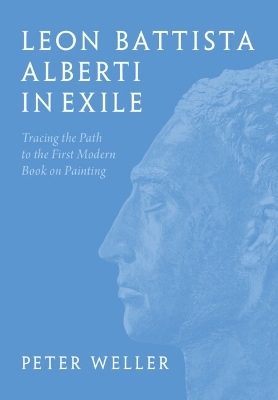
Leon Battista Alberti in Exile
Tracing the Path to the First Modern Book on Painting
Seiten
2025
Cambridge University Press (Verlag)
978-1-009-54866-3 (ISBN)
Cambridge University Press (Verlag)
978-1-009-54866-3 (ISBN)
Leon Battista Alberti emerged in 1435 with De pictura, the modern era's earliest discourse on Western art. Peter Weller challenges the popular notion that De pictura's compendium on lines, points, mathematics, composition, narrative, and portraiture is primarily the result of Alberti's return to Florence and his short exposure to its visual art.
The prodigy poet, playwright, architect, painter, and humanist savant Leon Battista Alberti emerged in 1435 with De pictura ['On Painting'], the modern era's earliest discourse on Western art, written in classical Latin by an ostensible practitioner of the craft. Alberti has captivated the art world from his own epoch to ours, and his dubious Florentine identity enables this allure. In this volume, Peter Weller challenges the popular notion that De pictura's compendium on lines, points, mathematics, composition, narrative, and portraiture is primarily the result of Alberti's return to Florence and his short exposure to its visual art. Weller argues that Rome, Padua, Bologna, and northern Europe – environs where Alberti studied, worked, and lived during exile – empowered his paramount intellectual-artistic gift. Scrutiny of Alberti's evolution before Florence illuminates how this original Renaissance man merged the two most conspicuous cultural developments of early modern Italy – visual art and humanism — to create De pictura, our first modern book on painting.
The prodigy poet, playwright, architect, painter, and humanist savant Leon Battista Alberti emerged in 1435 with De pictura ['On Painting'], the modern era's earliest discourse on Western art, written in classical Latin by an ostensible practitioner of the craft. Alberti has captivated the art world from his own epoch to ours, and his dubious Florentine identity enables this allure. In this volume, Peter Weller challenges the popular notion that De pictura's compendium on lines, points, mathematics, composition, narrative, and portraiture is primarily the result of Alberti's return to Florence and his short exposure to its visual art. Weller argues that Rome, Padua, Bologna, and northern Europe – environs where Alberti studied, worked, and lived during exile – empowered his paramount intellectual-artistic gift. Scrutiny of Alberti's evolution before Florence illuminates how this original Renaissance man merged the two most conspicuous cultural developments of early modern Italy – visual art and humanism — to create De pictura, our first modern book on painting.
Peter Weller is an independent scholar of Italian Renaissance art.
Preface; Acknowledgments; Preliminaries: 'the Florence problem'; Introduction; 1. Padua: historical realm and intellectual culture; 2. Alberti in Padua I: intellectual evolution (c. 1412–1420); 3. Alberti in Padua II: visual evolution (c. 1412–1420); 4. Alberti in Bologna (c. 1421–1428?); 5. Alberti in Rome (c. late 1420s–1434); 6. Finalities: Florence (finally); Bibliography; Index.
| Erscheinungsdatum | 04.03.2025 |
|---|---|
| Zusatzinfo | Worked examples or Exercises |
| Verlagsort | Cambridge |
| Sprache | englisch |
| Maße | 187 x 260 mm |
| Gewicht | 990 g |
| Themenwelt | Kunst / Musik / Theater ► Kunstgeschichte / Kunststile |
| Geschichte ► Allgemeine Geschichte ► Neuzeit (bis 1918) | |
| Geisteswissenschaften ► Geschichte ► Regional- / Ländergeschichte | |
| ISBN-10 | 1-009-54866-2 / 1009548662 |
| ISBN-13 | 978-1-009-54866-3 / 9781009548663 |
| Zustand | Neuware |
| Informationen gemäß Produktsicherheitsverordnung (GPSR) | |
| Haben Sie eine Frage zum Produkt? |
Mehr entdecken
aus dem Bereich


aus dem Bereich
Geschichte einer wilden Handlung
Buch | Hardcover (2024)
C.H.Beck (Verlag)
CHF 47,60


