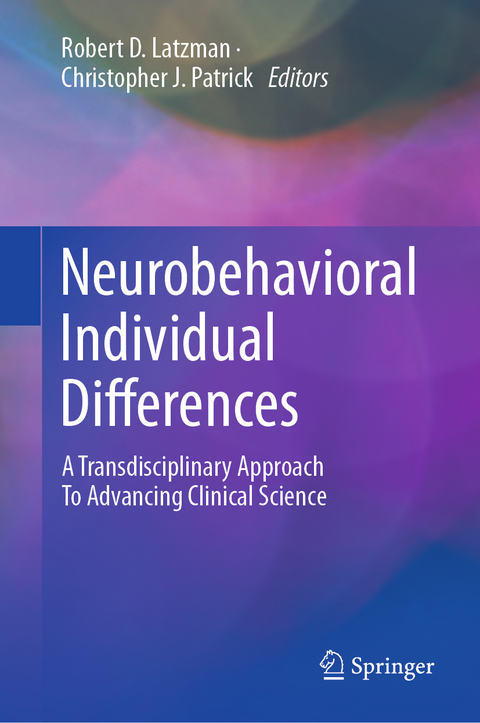
Neurobehavioral Individual Differences
Springer International Publishing (Verlag)
978-3-031-77966-4 (ISBN)
This is the first book of its kind to bring together a diverse set of human and nonhuman animal researchers to explore neurobehavioral trait dimensions with optimal relevance to mental illness: threat sensitivity, reward sensitivity, inhibitory control, affiliative capacity, and schizotypy. The volume presents foundational material, methodological considerations, and the integration of animal and human studies, providing a careful investigation of neurobehavioral trait dimensions. A special feature is the inclusion of paired chapters contrasting animal and human studies that demonstrate the state of the field. It also discusses the most promising neurobehavioral trait dimensions for understanding the processes associated with human mental illness. This integrated perspective fosters a deeper understanding of how individual differences in neurobiology contribute to the diversity of human behavior and the complex nature of mental health disorders. Taken together, insights into neurobehavioral traits promise to catalyze new research directions, inform policy decisions, and ultimately improve outcomes for individuals grappling with mental illness.
Dr. Robert D. Latzman is Scientific Director, Global Clinical Sciences in the Neuroscience Therapeutic Area at Takeda Pharmaceuticals. He was previously Associate Professor in the Departments of Psychology and Neuroscience at Georgia State University. He was the former co-chair of the Hierarchical Taxonomy of Psychopathology (HiTOP) Consortium's Neurobiological Foundations workgroup and Associate Editor at the Journal of Personality Disorders and Journal of Personality Assessment. Dr. Latzman received a Ph.D. in Clinical Psychology from the University of Iowa and a B.S. in Human Development with Honors from Cornell University. He completed a predoctoral clinical child/pediatric neuropsychology internship (residency) and a postdoctoral fellowship in the Department of Psychiatry and Human Behavior at the University of Mississippi Medical Center. He has received a number of recognitions including the J.S. Tanaka Award from the Association for Research in Personality and was selected as a "Face of the Future" by the Society for Research in Psychopathology. He is the author of more than 175 scholarly articles and book chapters, investigating both human and nonhuman primate subjects.
Christopher J. Patrick is a Distinguished Research Professor of Clinical Psychology at Florida State University (FSU) and Director of FSU's Clinical PhD program. His scholarly interests include psychopathy, antisocial behavior, substance abuse, personality, fear and fearlessness, psychophysiology, and affective and cognitive neuroscience. He is author of more than 370 articles and book chapters, and Editor of the Handbook of Psychopathy (Guilford Press, 2006; 2nd ed., 2018). Dr. Patrick is a Past President of both the Society for Scientific Study of Psychopathy (SSSP) and the Society for Psychophysiological Research (SPR), a recipient of Early Career awards from SPR (1995) and the American Psychological Association (APA; 1993), and recipient of Lifetime Career Contribution awards from both SSSP (2013) and SPR (2023). He is also a Fellow of APA and of the Association for Psychological Science. He served in 2010 as a Workgroup Member for the National Institute of Mental Health's Research Diagnostic Criteria (RDoC) initiative, and from 2008-2013 as a Scientific Advisor to the DSM-5 Personality and Personality Disorders (PPD) Work Group. He is currently a member of the American Psychiatric Association's DSM-5 Review Committee for Externalizing Disorders and Personality Disorders, and a member of the Hierarchical Taxonomy of Psychopathology (HiTOP) Consortium.
PART I.- 1. Advancing clinical science through the study of neurobehavioral traits.- 2. Methodological considerations: Integrating measures across assessment modalities.- 3. Animal models of neurobehavioral trait dimensions.- . PART II.- 4. Threat sensitivity and fear-based forms of psychopathology.- 5. Selecting Anxiety: The Central Extended Amygdala as an Arbiter of Emotion-Relevant Responses.- 6. The Neural Substrates of Individual Differences in Reward Sensitivity in Mental Health.- 7. Individual differences in Reward Sensitivity in Nonhuman Animals.- 8. Inhibitory control and externalizing proneness in humans: A neurobehavioral-
developmental perspective.- 9. Animal models in the study of impulsivity.- 10. Conceptual affiliation in neurobehavioral trait terms: A developmental
psychopathology perspective.- 11. Social processes in animals: Individual differences in affiliative capacity.- 12. Reflections on schizotypy, schizophrenia, and psychopathology: What do we mean
when we use these terms?.
| Erscheinungsdatum | 24.03.2025 |
|---|---|
| Zusatzinfo | VI, 300 p. 13 illus., 7 illus. in color. |
| Verlagsort | Cham |
| Sprache | englisch |
| Maße | 155 x 235 mm |
| Themenwelt | Geisteswissenschaften ► Psychologie ► Klinische Psychologie |
| Geisteswissenschaften ► Psychologie ► Psychoanalyse / Tiefenpsychologie | |
| Medizin / Pharmazie ► Medizinische Fachgebiete ► Psychiatrie / Psychotherapie | |
| Schlagworte | Animal Models • Biobehavioral traits • clinical science • Developmental Psychology • neurobehavioral trait dimensions • Neurobehavioral traits • nonhuman animals • psychopathology • Psychosis • reward sensitivity • threat sensitivity |
| ISBN-10 | 3-031-77966-5 / 3031779665 |
| ISBN-13 | 978-3-031-77966-4 / 9783031779664 |
| Zustand | Neuware |
| Informationen gemäß Produktsicherheitsverordnung (GPSR) | |
| Haben Sie eine Frage zum Produkt? |
aus dem Bereich