


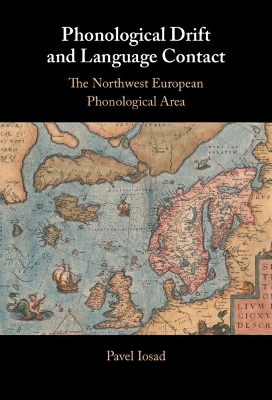
Phonological Drift and Language Contact
The Northwest European Phonological Area
Seiten
2025
Cambridge University Press (Verlag)
978-1-108-49738-1 (ISBN)
Cambridge University Press (Verlag)
978-1-108-49738-1 (ISBN)
Despite typological differences, the languages of northern Europe share unusual sound patterns. Using the latest advances in theoretical linguistics, the study of sound change, and language variation, this book offers insights into the development of these features and what they tell us about past cultural and linguistic contacts.
Several language families of northern Europe – Germanic, Celtic, and Uralic – share phonetic and phonological patterns that are typologically unusual. This book demonstrates how we can better understand these convergences: they exemplify the phenomenon of drift. Using the latest advances in theoretical linguistics, the study of sound change, and language variation, it offers insights into the development of these features and what they tell us about past cultural and linguistic contacts. Although the languages are not closely related, an understanding of drift grounded in the theory of the life cycle of phonological patterns reveals the workings of convergent developments. Covering a wide range of vernacular varieties, this book shows how phonological microvariation is illuminated by an approach grounded in the theory of the life cycle and historical sociolinguistics. It is essential reading for historical and theoretical linguists, and anyone with an interest in the cultural and linguistic contacts across northern Europe.
Several language families of northern Europe – Germanic, Celtic, and Uralic – share phonetic and phonological patterns that are typologically unusual. This book demonstrates how we can better understand these convergences: they exemplify the phenomenon of drift. Using the latest advances in theoretical linguistics, the study of sound change, and language variation, it offers insights into the development of these features and what they tell us about past cultural and linguistic contacts. Although the languages are not closely related, an understanding of drift grounded in the theory of the life cycle of phonological patterns reveals the workings of convergent developments. Covering a wide range of vernacular varieties, this book shows how phonological microvariation is illuminated by an approach grounded in the theory of the life cycle and historical sociolinguistics. It is essential reading for historical and theoretical linguists, and anyone with an interest in the cultural and linguistic contacts across northern Europe.
Pavel Iosad is Professor of Synchronic and Diachronic Phonology at the University of Edinburgh. His work spans theoretical phonology and historical linguistics, with a focus on Celtic, Germanic, Romance, and Slavic languages. His notable publications include A Substance-free Framework for Phonology (2017).
Introduction; 1. Setting the scene; 2. Research context; 3. Theoretical background; 4. The sychrony and diachrony of preaspiration; 5. North Germanic; 6. Celtic; 7. The Sámi Languages; 8. Preaspiration and language contact; 9. Conclusion.
| Erscheinungsdatum | 24.05.2025 |
|---|---|
| Zusatzinfo | Worked examples or Exercises |
| Verlagsort | Cambridge |
| Sprache | englisch |
| Themenwelt | Geisteswissenschaften ► Sprach- / Literaturwissenschaft ► Sprachwissenschaft |
| ISBN-10 | 1-108-49738-1 / 1108497381 |
| ISBN-13 | 978-1-108-49738-1 / 9781108497381 |
| Zustand | Neuware |
| Informationen gemäß Produktsicherheitsverordnung (GPSR) | |
| Haben Sie eine Frage zum Produkt? |
Mehr entdecken
aus dem Bereich


aus dem Bereich
Eine Wiederentdeckung
Buch | Softcover (2025)
Piper (Verlag)
CHF 19,55
Das umfassende Standardwerk auf der Grundlage der aktuellen amtlichen …
Buch | Hardcover (2024)
Duden (Cornelsen Verlag)
CHF 48,95


