The Weight of Reasons
Oxford University Press Inc (Verlag)
978-0-19-778692-5 (ISBN)
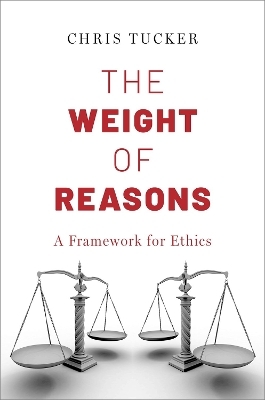
In his comprehensive guide to weighing reasons, Chris Tucker explains how to weigh reasons well, from daily choices to complex ethical puzzles.
There are two central claims in the book. The first concerns the weights of reasons, namely Weight Pluralism, the idea that reasons have more than one weight value and these values are not always equal. A reason's justifying weight is how well it makes an act permissible. A reason's requiring weight is how well it makes a permissible act required. For instance, the self-interested reasons that make it permissible to go out for dinner one night generally do not also make it impermissible or wrong to stay home instead. This fact is to be explained, Tucker argues, by holding that self-interested reasons have more justifying than requiring weight.
The second central claim concerns weighing reasons. The most natural model for weighing reasons is Single Scale: the idea that reasons are weighed on a single two-sided scale. Since our reasons to eat out have more justifying weight than requiring weight, Single Scale distorts how those reasons work. If one were to put the reasons to go out on the left pan and the reasons to stay home on the right pan, and the reasons to go out are weightier, then Single Scale incorrectly entails that you are required to eat out--i.e., eating out is permissible/okay and staying home is impermissible/wrong. This verdict is incorrect because the self-interested reasons that make it permissible to go out to eat tonight generally do not also make it wrong to stay home instead. To properly represent such reasons, Tucker replaces Single Scale with Dual Scale, which is the idea that reasons are weighed on two scales rather than one.
The book also addresses what the general issue of weighing reasons is, whether they have commending weight, whether weight values are context sensitive, how to tell what the weights of reasons are, how reasons for are related to reasons against, and how the weights of reasons aggregate.
Chris Tucker is the Francis S. Haserot Professor of Philosophy at William & Mary. He specializes in ethics, epistemology, and the philosophy of religion. He is the editor of Seemings and Justification: New Essays on Dogmatism and Phenomenal Conservatism (Oxford University Press, 2013) and has published more than 30 articles and chapters.
Introduction
Part I. Weighty Matters
Chapter 1: Minding the Metaphors of Weight and Weighing
Chapter 2: A Holist Balance Scale
Part II. From Single to Dual Scale
Chapter 3: The Representational Limits of Single Scale
Chapter 4: The Representational Power of Dual Scale
Chapter 5: Weighing Reasons Against
Part III. Ethical Puzzles Resolved
Chapter 6: Against Weight Monism
Chapter 7: Moral Options and the Normative Significance of Small Improvements
Chapter 8: The All or Nothing Ranking Reversal and the Unity of Morality
Part IV. Wrapping Up
Chapter 9: Modeling Requirement for Any Number of Options
10: Conclusion
| Erscheinungsdatum | 25.02.2025 |
|---|---|
| Zusatzinfo | 10 b/w illustrations |
| Verlagsort | New York |
| Sprache | englisch |
| Maße | 149 x 210 mm |
| Gewicht | 499 g |
| Themenwelt | Geisteswissenschaften ► Philosophie ► Erkenntnistheorie / Wissenschaftstheorie |
| Geisteswissenschaften ► Philosophie ► Ethik | |
| ISBN-10 | 0-19-778692-8 / 0197786928 |
| ISBN-13 | 978-0-19-778692-5 / 9780197786925 |
| Zustand | Neuware |
| Informationen gemäß Produktsicherheitsverordnung (GPSR) | |
| Haben Sie eine Frage zum Produkt? |
aus dem Bereich