


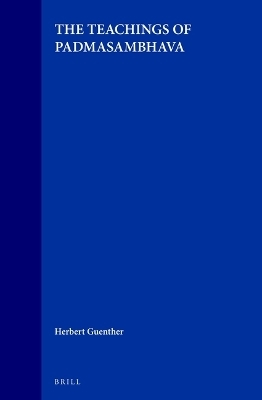
The Teachings of Padmasambhava
Seiten
1996
Brill (Verlag)
9789004105423 (ISBN)
Brill (Verlag)
9789004105423 (ISBN)
This pioneering study sheds new light on the development of Buddhist ideas as introduced by the visionary Padmasambhava. It is based on primary source material and highlights the experiential aspects of process-oriented thinking.
This study explores the ideas of the enigmatic and controversial visionary, known as Padmasambhava. It takes as its starting point a unique and hitherto untouched source: Padmasambhava's writings preserved in the rNying-ma rgyud-'bum that remain excluded from the standard editions of the Tibetan Tanjur collections to this day.
The first chapter explains Padmasambhava's holistic background that reflects an anthropocosmic worldview. The second chapter deals with the problem of how this anthropocosmic whole becomes enworlded as samsara and of how the enworlded experiencer disentangles himself from it and regains his original wholeness.
The third chapter assesses Padmasambhava's psychological insights and their hermeneutical interpretations. In this study, Herbert Guenther discloses the mind of one of the greatest spiritual geniuses in human history, Padamasambhava — wanderer, mystic, and one of the original founders of Tibetan Buddhism. Here his teachings step out from obscurity to speak with a wonderful clarity. In them is found a surprisingly postmodern portrait of how process dynamics self-organize to construct and "light up" our worlds of experience.
This study explores the ideas of the enigmatic and controversial visionary, known as Padmasambhava. It takes as its starting point a unique and hitherto untouched source: Padmasambhava's writings preserved in the rNying-ma rgyud-'bum that remain excluded from the standard editions of the Tibetan Tanjur collections to this day.
The first chapter explains Padmasambhava's holistic background that reflects an anthropocosmic worldview. The second chapter deals with the problem of how this anthropocosmic whole becomes enworlded as samsara and of how the enworlded experiencer disentangles himself from it and regains his original wholeness.
The third chapter assesses Padmasambhava's psychological insights and their hermeneutical interpretations. In this study, Herbert Guenther discloses the mind of one of the greatest spiritual geniuses in human history, Padamasambhava — wanderer, mystic, and one of the original founders of Tibetan Buddhism. Here his teachings step out from obscurity to speak with a wonderful clarity. In them is found a surprisingly postmodern portrait of how process dynamics self-organize to construct and "light up" our worlds of experience.
Herbert Guenther, Ph.D. (Munich and Vienna), D.Litt., is Professor Emeritus of Far Eastern Studies at the University of Saskatchewan, Saskatoon, Canada. He has published extensively on Buddhist philosophy and psychology with special emphasis on their phenomenological and hermeneutical implications.
| Erscheint lt. Verlag | 1.7.1996 |
|---|---|
| Reihe/Serie | Brill's Indological Library ; 12 |
| Verlagsort | Leiden |
| Sprache | englisch |
| Maße | 155 x 235 mm |
| Gewicht | 517 g |
| Einbandart | Leinen |
| Themenwelt | Geisteswissenschaften ► Religion / Theologie ► Buddhismus |
| ISBN-13 | 9789004105423 / 9789004105423 |
| Zustand | Neuware |
| Informationen gemäß Produktsicherheitsverordnung (GPSR) | |
| Haben Sie eine Frage zum Produkt? |
Mehr entdecken
aus dem Bereich

aus dem Bereich
erste vollständige Ausgabe - Mit einleitendem Kommentar des XIV. …
Buch | Softcover (2025)
Goldmann (Verlag)
CHF 25,90
Philosophische Betrachtungen
Buch | Softcover (2024)
Aufbau TB (Verlag)
CHF 20,95


