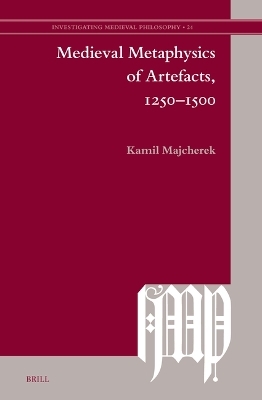
Medieval Metaphysics of Artefacts, 1250–1500
Brill (Verlag)
978-90-04-72153-1 (ISBN)
Are artefacts, that is, human-made objects, distinct from the natural things that they are made out of? For example, is a chair a thing distinct from the pieces of wood used in making it? This question is intensely debated in contemporary metaphysics, but it is little known that there was an equally heated and sophisticated debate concerning this issue in the late Middle Ages.
This book provides the first comprehensive reconstruction, analysis, and evaluation of this discussion, looking at both the most famous figures such as William of Ockham as well as dozens of previously unstudied texts available in manuscript form only.
Kamil Majcherek, Ph.D. (2022), University of Toronto, is Title A Fellow in History of Philosophy of Trinity College, Cambridge. His main interests lie in late medieval metaphysics and natural philosophy. He is currently mainly interested in late medieval metaphysics of numbers.
Acknowledgments
Note on Previously Published Pieces
List of Abbreviations
Short Biographical Notes
Introduction
1 The Problem of Artefacts
2 Status Quaestionis
3 Sources and Scope
4 Outline
1 Nature and Art
1 Nature as a Principle of Motion and Rest
2 Natural Things
3 Art as a Productive Habit
4 Artificial Things
5 Artificial Forms
Excursus1: Why Can Artefacts Not Be Substances?
1 Introduction
2 Sources
3 Rationale
4 Other Limitations on the Productive Capacity of Art
5 Conclusion
2 The Nature of Artificial Change
1 Introduction
2 Artificial Forms: Modi vs. Res
3 Artefact Realists on Changed Involved in the Making of Artefacts
4 Artefact Nominalism in First Approximation
5 Artefact Nominalists on the Nature of Change Involved in the Making of Artefacts
6 Artefact Nominalists on the Two Other Realist Arguments
7 Artefact Nominalists on Local Motion and Change
8 Conclusion
Excursus2: The Peculiar Status of Artificial Forms and Artefacts
1 Introduction
2 Thirteenth-Century Commentators on the Status of Artificial Forms
3 Paul of Venice on the Status of Artificial Forms
4 Paul of Venice on Artefacts as Wholes
3 The Problem of Multipart Artefacts
1 Introduction
2 Ockham’s Argument
3 Realist Reply 1: Walter Burley
4 Realist Reply 2: Paul of Venice
5 Realist Reply 3: Theodoric of Magdeburg
6 Conclusion
Excursus3: Artefacts, Principle of Motion, and Reduplication
1 Introduction
2 The Realist Position
3 The Nominalist Position
4 Productivity of Art
1 Introduction
2 Realist Argument(s) Based on the Productivity of Art
3 Nominalist Account of the Productivity of Art
4 Realist Critique of the Nominalist Solution
5 Conclusion
Excursus4: Artificial Production and Natural Generation
1 Introduction
2 The View of the “Ancient Materialists”
3 Ancient Materialism and Artefact Nominalism
4 Conclusion
5 Problems of Separability
1 Introduction
2 The Principle of Separability: The Realist View
3 A Nominalist Critique of the Realist Version of the Principle of Separability
4 The Principle of Separability: The Nominalist View
5 Conclusion
Excursus5: The Relational View of Artefacts and Its Discontents
1 Introduction
2 Henry of Ghent: The Reductive Relational View
3 John Duns Scotus: The (Anti?)Reductive Relational View
4 John of Pouilly and Bernard of Auvergne: The Rejection of the Relational View
5 The Nominalist Rejection of the Relational View
Final Conclusion
Appendix: Critical Editions
TextI: Anonymous, Quaestiones super libros Physicorum, lib. II, qq.19–21
TextII: Bernard of Auvergne, Reprobationes Henrici de Gandavo Quodlibet VII, q.1 (selected passages)
TextIII: John of Pouilly, Quodlibet II, q.16/22
TextIV: Anonymous, Quaestiones super octo libros Physicorum, q.26
TextV: Theodoric of Magdeburg, Quaestiones super octo libros Physicorum, lib. I, q.1
TextVI: Anonymous, Quaestiones super libros Physicorum, lib. II, q.3
TextVII: Lawrence of Lindores, Quaestiones super octo libros Physicorum, lib. I, qq.1 and 4
TextVIII: Hugolinus of Orvieto and Anonymus Erfordiensis, Quaestiones super octo libros Physicorum, lib. I, q.1
TextIX: John Aurifaber, Quaestiones super octo libros Physicorum, lib. I, q.1
TextX: Blasius of Parma, Quaestiones super octo libros Physicorum, v. prima, lib. I, q.1, et v. altera, lib. I, q.1
TextXI: John Hennon, Commentarius in libros Physicorum, lib. II, q.2, dub. 3
TextXII: John le Damoiseau, Commentarius in libros Physicorum, lib. II, q.3 (selected passages)
Bibliography
| Erscheinungsdatum | 15.05.2025 |
|---|---|
| Reihe/Serie | Investigating Medieval Philosophy ; 24 |
| Verlagsort | Leiden |
| Sprache | englisch |
| Maße | 155 x 235 mm |
| Gewicht | 1029 g |
| Themenwelt | Geschichte ► Allgemeine Geschichte ► Mittelalter |
| Geisteswissenschaften ► Philosophie ► Metaphysik / Ontologie | |
| Geisteswissenschaften ► Philosophie ► Philosophie des Mittelalters | |
| ISBN-10 | 90-04-72153-3 / 9004721533 |
| ISBN-13 | 978-90-04-72153-1 / 9789004721531 |
| Zustand | Neuware |
| Informationen gemäß Produktsicherheitsverordnung (GPSR) | |
| Haben Sie eine Frage zum Produkt? |
aus dem Bereich