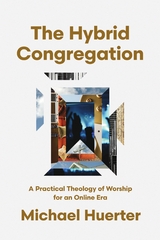
The Hybrid Congregation (eBook)
192 Seiten
IVP Academic (Verlag)
978-1-5140-1143-0 (ISBN)
Michael Huerter (PhD, Baylor University) is a pastor at Holmeswood Baptist Church in Kansas City, Missouri, where he leads worship and works to build community and connection. As a lifelong church musician and digital native, he is interested in engaging with and contributing to scholarship that bridges the gap between research and practical ministry.
Michael Huerter (PhD, Baylor University) is a pastor at Holmeswood Baptist Church in Kansas City, Missouri, where he leads worship and works to build community and connection. As a lifelong church musician and digital native, he is interested in engaging with and contributing to scholarship that bridges the gap between research and practical ministry.
1
Enter the
Internet
Several pastors I have worked with have remarked, with varying degrees of humor and exasperation, how rarely congregants seem to remember the content of their sermons. They have also named the felt struggle of inviting a community to the renewing of their minds in following Christ when this community is gathered for perhaps a few hours one day of the week, and the rest of the week is bombarded with constant messaging, advertising, and news stories apparently designed to fuel our demons, not summon our best selves: “How can a weekly church service compete with this environment inundated by greed, fear, anger, and injustice?”
These concerns are not limited to the age of the internet; they have been the challenge of ministry for a long, long time. It is worth recognizing that these forces are connected to economic models that seek to generate profit and power. The love of money is the root of each of these kinds of evil, and these voices clamor for our attention constantly. Directing our attention elsewhere and stepping outside the rushing current of the temptations Christ faced in the desert—toward consumption, influence, and possessions—is a central practice of discipleship and worship. This has remained true throughout the history of the church, but these age-old questions require fresh examination in our new media environment.
Just as previous communication technologies reshaped human relationships, institutions, and self-understanding, the internet has become a driving force in human society in recent decades. Our personal lives and our communities; the ways we communicate, share news, and do business; the challenges faced by institutions, governments, and nations; global economies and sociological changes affecting billions of people—all have been affected profoundly by the internet. To understand what churches are facing in regard to their music ministry online, it is crucial to begin with an understanding of some of these powerful currents and events.
I will begin this chapter by describing broader cultural impacts of the internet. I will continue by bringing philosophical and theological scholarship to bear on the significance of these changes. Once that groundwork is laid, I will focus more specifically on church music and the changes and challenges brought about in that sphere by the internet. Here I will share insights from personal interviews with scholars and ministry practitioners. Finally, I will synthesize and propose a way forward for church music, based on the content of this chapter.
Attention, Please!
Picture this scene: A dark room is lit by a slowly turning array of green stars. A blue spotlight illuminates a man wearing a white T-shirt and sunglasses, seated at a keyboard. He begins to play and sing:
Welcome to the Internet
Have a look around
Anything that brain of yours can think of can be found . . .
Could I interest you in everything?
All of the time?1
Bo Burnham’s 2021 Netflix comedy special Bo Burnham: Inside is a curious glimpse into the mind of a White, male, Millennial comedian who is hyperaware of and reflective on the oddities and perils of the internet. Inside was filmed by Burnham in his home, with no film crew or audience, over the first year of the Covid-19 pandemic and reflects on numerous aspects of Burnham’s experience of lockdown. It has received numerous awards, and this musical number, “Welcome to the Internet,” has over 143 million views on YouTube in addition to Netflix streams. “Welcome to the Internet” positions Burnham as a personification of the internet itself, or perhaps an amalgam of Silicon Valley tech moguls and media corporations with a generous pinch of dramatically animated Disney villain thrown in.
The song highlights many of the problems and concerns raised by the internet: the chaotic juxtaposition of bubbly, happy content with virtual front-row seats to worldwide tragedy and violence; the online pornography industry and other exploitative uses of the medium; the dizzying overwhelm of constant stimulation and access to more information than we will ever make sense of; and the impact on children’s mental and social formation as they grow up in a world so different from what their parents experienced.
On January 9, 2019, Bo Burnham was part of a panel discussion hosted by the Child Mind Institute on the topic “Self-Esteem in the Age of Social Media.” The conversation touched on the psychological well-being of children and adults but also grappled with the economic systems at play in a world defined by social media. Burnham remarked, “We used to colonize land. That was the thing you could expand into, and that’s where money was to be made. We colonized the entire earth. There was no other place for the businesses and capitalism to expand into. And then they realized . . . human attention. . . . They are now trying to colonize every minute of your life.”2 Burnham is drawing attention to a profound shift in the way that global economies function in the age of the internet. This shift toward an economy that (in Burnham’s words) colonizes human attention and time is a fundamental concern for thinking productively about the church’s discipleship and musical practices in the twenty-first century.
The dynamics described by Burnham’s comedy suggest a larger set of issues around the internet and its impact on our lives. While the internet has ushered in positive technological advancement, it has also corresponded with and contributed to cultural forces of distraction, alienation, and objectification. These dynamics are of huge importance to Christian formation and community, particularly worship. Christian worship (including music and a range of other rituals) is meant to positively direct human attention, to bring us into deeper connection with God, the world, and ourselves, and to remind us of the worth and goodness of creation. Worship invites us to seek righteousness, justice, beauty, and flourishing life for all God’s creatures, and therefore runs counter to any influence toward disintegration, disconnection, or degradation.
How We Got Here: The Internet at the Turn of the Millennium
The 1990s saw the rise of a developing conversation about the internet’s potentials and problems, as well as parallels with previous technologies. In 1998, Gray Young named the excitement and anxiety felt at the cusp of a new millennium. Excitement suggested great possibilities ahead: free exchange of information, greater freedoms, equality, and connection between individuals and communities around the world. Anxiety suggested a vision of “the Internet portending the downfall of civilized society” through rampant pornography, the decimation of privacy in the face of corporate and federal surveillance, the end of reliable journalism, the destruction of copyright, and violent criminals and terrorists taking advantage of the technology.3
These optimistic and pessimistic readings of the internet’s potential have proven to accurately reflect our current reality; these are many of the same opportunities and pitfalls we encounter now. Young asked whether the internet could improve life, or whether we should perhaps be afraid it would ruin life, and how governments and businesses should and would regulate, restrict, or embrace it. Even as the internet has developed and become more inseparable from our daily lives than ever before, these questions remain salient and pressing.
The same concerns Young articulated in 1998 are crucial for us in the third decade of the twenty-first century. It is important to remember that new technologies may take decades, or even centuries, to become fully integrated into society; at the same time, new expressions of these technologies are being produced at dizzying rates. There is so much rapid change occurring, and we are far from fully understanding the revolution we are living through. Young compares the internet to a “precocious child,” full of latent potential and capable of making foolish and dangerous choices, with political, academic, and economic leaders being analogous to young parents unsure how to encourage the former and curtail the latter. Young asks, “Will the child grow to be a Nobel Prize winner or an uncontrollably brilliant psychopath?”4 Like the printing press, radio, and television before it, the internet asks of us: What will it be? Will it become a force for good or for evil in the world? How will it interact with and transform existing technologies and economies?
On February 19, 1998, George Conrades gave an address to the Institute of Electrical and Electronics Engineers that aimed to shed light on these questions. The event was the 1998 Network Operations and Management Symposium in New Orleans. Conrades was at the time president of GTE Internetworking, which would later be acquired by Bell Atlantic and go on to become Verizon. Conrades predicted that the internet, which was already indispensable to much of American society, would soon “disappear.” By this he meant that, like other technologies before it, its use and constant presence would become normalized. Conrades remarked, “All successful technologies ultimately disappear. They penetrate so deeply into our environment, they become indistinguishable from...
| Erscheint lt. Verlag | 10.6.2025 |
|---|---|
| Verlagsort | Lisle |
| Sprache | englisch |
| Themenwelt | Religion / Theologie ► Christentum ► Kirchengeschichte |
| Schlagworte | algorithm • attention • Christian • Church • Communication • Community • Contemporary • digital • economy • Electronic • Embodiment • Facebook • Faith • Formation • God • Internet • media • Meditation • music • post-covid • Social • Stream • Technology • twitch • Video • virtual • Web • youtube • Zoom |
| ISBN-10 | 1-5140-1143-3 / 1514011433 |
| ISBN-13 | 978-1-5140-1143-0 / 9781514011430 |
| Informationen gemäß Produktsicherheitsverordnung (GPSR) | |
| Haben Sie eine Frage zum Produkt? |
 EPUB (Wasserzeichen)
DRM: Digitales Wasserzeichen
Dieses eBook enthält ein digitales Wasserzeichen und ist damit für Sie personalisiert. Bei einer missbräuchlichen Weitergabe des eBooks an Dritte ist eine Rückverfolgung an die Quelle möglich.
Dateiformat: EPUB (Electronic Publication)
EPUB ist ein offener Standard für eBooks und eignet sich besonders zur Darstellung von Belletristik und Sachbüchern. Der Fließtext wird dynamisch an die Display- und Schriftgröße angepasst. Auch für mobile Lesegeräte ist EPUB daher gut geeignet.
Systemvoraussetzungen:
PC/Mac: Mit einem PC oder Mac können Sie dieses eBook lesen. Sie benötigen dafür die kostenlose Software Adobe Digital Editions.
eReader: Dieses eBook kann mit (fast) allen eBook-Readern gelesen werden. Mit dem amazon-Kindle ist es aber nicht kompatibel.
Smartphone/Tablet: Egal ob Apple oder Android, dieses eBook können Sie lesen. Sie benötigen dafür eine kostenlose App.
Geräteliste und zusätzliche Hinweise
Buying eBooks from abroad
For tax law reasons we can sell eBooks just within Germany and Switzerland. Regrettably we cannot fulfill eBook-orders from other countries.
aus dem Bereich