


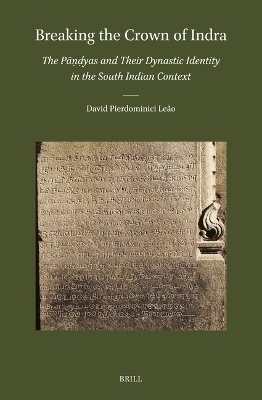
Breaking the Crown of Indra
Brill (Verlag)
978-90-04-72072-5 (ISBN)
From the first years of our era up to the 18th century, in between wars, conquests, defeats and stellar political risings: Breaking the Crown of Indra takes you through a long and engaging quest to answer the apparently simple question “Who were the Pāṇḍyas?”
With the help of epigraphic evidence, literary texts, and temple chronicles never translated before, David Pierdominici Leão reconstructs the evolution of the Pāṇḍya royal perception through the different periods of this Tamil kingdom. His study investigates the so-called phenomenon of the “Pāṇḍyaness”, a concept enriched by different dynastic identities, mythical narratives of deeds and divinised sovereigns.
David Pierdominici Leão, Ph.D. (2018), Sapienza University in Rome, is a Researcher in the Department of Languages and Cultures of India and South Asia at the Jagiellonian University. He is the author of several articles on Indian literature and history.
Acknowledgements
Abbreviations
Introduction
1 The concept of#x201C;Pāṇḍyaness”
2 Methodological considerations
3 Conclusive remarks
1 The World of the Caṅkam Heroes: Pāṇḍya rulers in the shadow of time
1 Historical background: the earliest references
2 The Caṅkam era and literature, and the Three Academies
3 The Puṟanāṉūṟu: tribal warriors of the South
4 “The Good Counsel in Madurai”: the King and the city
5 The Cilappatikāram: the beginning of the Pāṇḍya dynastic narratives
6 The kōvai string for the Pāṇḍya: aesthetics exemplified through the royal persona
7 Conclusive remarks
2 Family matters: dynastic perception and copper plates in the age of the#x201C;First Empire”
1 Historical scenario
2 The Early Pāṇḍya epigraphical corpus: preliminary considerations
3 The Pāṇḍya royal identity engraved on copper: the Vēḷvikuṭi plates
4 The#x201C;smaller” Ciṉṉamaṉūr plates
5 The Taḷavāypuram plates
6 The#x201C;larger” Ciṉṉamaṉūr charter
7 The Civakāci plates
8 Conclusive remarks
3 The Emerald King: the apogee of the Pāṇḍya power during the#x201C;Second Empire”
1 Historical introduction
2 The Pāṇḍya narratives#x201C;in exile” and during the reconquest
3 The#x201C;Second Empire”: the golden age of Jaṭāvarman SundaraI
4 Celebrating the glory of the dhārmika Emperor in Tirupati
5 The King and the god in#x015A;rīraṅgam: who is who?
6 Conclusive remarks
4 The Poet who sang the god in Teṅkāśi: sacralization of identity and precarious kingship
1 Historical frame
2 The Pāṇḍyas outside Madurai in the 14th–15th centuries
3 The Teṅkāśi kingdom in the 15th–16th centuries
4 Maṇḍalakavi and the Pāṇḍyakulodayamahākāvya
5 The Tiruviḷaiyāṭaṟpurāṇam and the Hālāsyamāhātmya
6 Thundering clouds and the#x201C;mortal man”: legitimising the divine power
7 A new city for the god: Teṅkāśi and Arikesari Parākrama
8 A god is born: the new idiom of the Pāṇḍya royal ideology
9 The hero of the poem: Jaṭilavarman Parākrama Kulaśekhara
10 The physical description of the Teṅkāśi King
11 The#x015B;āstric conception of Indian royalty
12 The royal body and alaṃkāras: the new sovereign in the kāvya production
13 Merging into the sacred: geopolitics and transfiguring digvijayas
14 Yelling against history:#x201C;epic of resistance” and cultural reaction
5 Flower garlands shading away: royal genealogies and the nostalgy of power
1 Historical introduction
2 Remembering the past, the ineffectiveness of the present: the later Teṅkāśi genealogies
3 The Putukkōṭṭai copper plates
4 The#x015A;rīvilliputtūr record
5 The Taḷavāyagrahāram plates (ś. 1504)
6 The Taḷavāyagrahāram plates (ś. 1510)
7 Last glimpse before the curtains fall: 1754 CE
Appendix1: List of Pāṇḍya Kings in the Puṟanāṉūṟu
Appendix2: Early Pāṇḍyas
Appendix3: Transition—The Second Empire
Appendix4: The Teṅkāśi Court in the 15th–16th centuries
Appendix5: Teṅkāśi after Parākrama Kulaśekhara
Appendix6: The most recurrent Pāṇḍya dynastic narratives
Bibliography
Index
| Erscheinungsdatum | 06.03.2025 |
|---|---|
| Reihe/Serie | Brill's Indological Library ; 61 |
| Verlagsort | Leiden |
| Sprache | englisch |
| Maße | 155 x 235 mm |
| Gewicht | 768 g |
| Themenwelt | Geisteswissenschaften ► Geschichte ► Regional- / Ländergeschichte |
| ISBN-10 | 90-04-72072-3 / 9004720723 |
| ISBN-13 | 978-90-04-72072-5 / 9789004720725 |
| Zustand | Neuware |
| Informationen gemäß Produktsicherheitsverordnung (GPSR) | |
| Haben Sie eine Frage zum Produkt? |
aus dem Bereich


