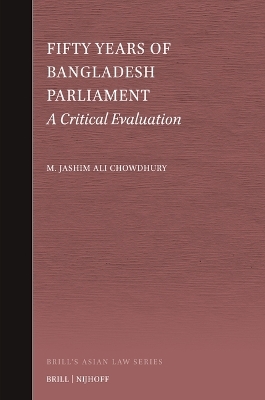
Fifty Years of Bangladesh Parliament
Martinus Nijhoff (Verlag)
978-90-04-72082-4 (ISBN)
M. Jashim Ali Chowdhury Ph.D. (2022), is a Lecturer in the University of Hull Law School. Earlier, he served in Bangladesh as an Associate Professor (University of Chittagong), Assistant Professor and Senior Lecturer (Northern University Bangladesh) and Lecturer in Law (The University of Information Technology and Sciences and Metropolitan University).
Foreword
Preface
Abbreviations
Table of Cases
1 The Dilemma of Design
1 The “Westminster” Template
2 The Dilemma
2.1 A Less-than-Ideal Orientation
2.2 A Continuing “Hegemon”
2.3 “Cross-imperial or Cross-colonial Borrowing”
3 Fitting a Misfit
4 A Bagful of Problems
4.1 Personalisation and Radicalisation of Politics
4.2 Military Interventions
4.3 Corrupt and Dynastic Political Parties
5 A Brief History of Bangladesh Parliaments
6 The “Eastminster Deviations”
7 Existing Literature and Contribution of this Book
8 Structure of the Book
2 Organisation, Position and Powers
1 Introduction
2 Composition of the Parliament
2.1 Parliamentary Election Process
2.2 The Speaker and Deputy Speaker
3 Parliament’s Relation with Other State Organs
3.1 Parliament and the Government
3.2 Parliament and the Judiciary
3.3 Parliament and the People
4 General Powers and Functions of the Parliament
4.1 Law Making and Constitutional Amendment Powers
4.2 Financial Powers
4.3 Accountability Powers
5 Conclusion
3 A Subdued Legislature
1 Introduction
1.1 Questioning and Debating the Government
1.2 Parliamentary Questions
1.3 Parliamentary Debate
2 Legislative Processes as Tools of Accountability
2.1 Pre-legislative Stage
2.2 Legislative Stage
3 Scrutiny by the Parliamentary Committees
3.1 Committee Work for Constituency Benefits, Re-election, and Career Prospects
3.2 Committees as Suppliers of Information, Expertise and Scrutiny
3.3 Coalition Logic for Committee Assertiveness
3.4 Partisan Cartelisation of Parliamentary Committees
4 Political Parties as the Agents of Accountability
4.1 Inter-party Relations within the Parliament
4.2 Intra-party Accountability
5 Conclusion
4 A Defiant Judiciary
1 Introduction
2 Parliament and the Judiciary’s Inter-institutional Comity
2.1 Bangladesh Parliament’s position on the Sub Judice Rule
2.2 Bangladesh Supreme Court’s Incoherence over the Exclusionary Rule
2.3 Internal Process Doctrine
3 The Concept of Judicial Accountability
3.1 Judges’ Democratic Accountability to the Parliament
3.2 Judges’ Explanatory Accountability to the Parliamentary Committees
4 Judicial Review of the Statute Laws and Constitutional Amendments
4.1 “Strong” and “Weak” Forms of Judicial Review
4.2 Bangladesh’s “Strong Form” Judicial Review
5 Importance of “Democratic Dialogue”
5.1 Potentials of Dialogic Judicial Review in Bangladesh
6 Conclusion
5 A Disengaged Electorate
1 Introduction
2 The Parliament’s Electoral Accountability
2.1 Nature of the Elections
2.2 Fairness of the Electoral Process
2.3 Fairness of the Electoral Outcome
3 The Parliament’s Continuing Accountability
3.1 Public Relations of the Parliament
3.2 Constituency Works of the mp s
4 Parliament’s Operational Accountability
4.1 Avenues of Public Participation
4.2 Petitioning the Parliament
5 Conclusion
6 The Problems of Reform
1 Introduction
2 The Failed “Revolutions”
2.1 The Military Rulers of 1975–1990
2.2 The Military-Backed Government of 2007–2008
3 The “Constitutional Bargain”-ers without “Democratic Instrumental Vision”
3.1 A Crippled Election Commission
3.2 A Stillborn and Failed Caretaker Government
3.3 Reluctance in Capacity Building
4 Parliamentary Reform: The Role of Time, Attitude and Institutions
4.1 Norton’s Attitudinal and Formalist Theory
4.2 Kelso’s Contextual and Institutional Theory
4.3 Adoption of the Parliamentary System in 1972
4.4 Abolition of the Parliamentary System and Failure of the One-Party System in 1975
4.5 Revival of the Parliamentary System in 1991
4.6 Abolition of the Caretaker Government in 2011
5 Conclusion
7 The “Eastminster Deviations” and Ways Ahead
1 Introduction
2 Three “Eastminster” Deviations
3 Parliament’s Failure to Hold the Executive Accountable
3.1 Ministerial (Non)Responsibility
3.2 A Mere Legitimizer
3.3 Controlled Deliberation
3.4 Cartelized Committees
4 Antagonistic Relation with the Judiciary
5 Detachment from the People
5.1 Crisis of Electoral Legitimacy
5.2 The Localised mp s
5.3 A Detached Citizenry
6 Roadblocks to Parliamentary Reform
7 The “Perseverance Despite”
8 The Ways Ahead
8.1 Incremental and Intermediate Reforms
8.2 A Democratic Dialogue between the Parliament and Judiciary
8.3 Waiting for a Realignment of the Political Landscape
9 Conclusion
Bibliography
Index
| Erscheinungsdatum | 30.04.2025 |
|---|---|
| Reihe/Serie | Brill's Asian Law Series ; 14 |
| Sprache | englisch |
| Maße | 155 x 235 mm |
| Gewicht | 643 g |
| Themenwelt | Geschichte ► Teilgebiete der Geschichte ► Militärgeschichte |
| Recht / Steuern ► Allgemeines / Lexika | |
| Recht / Steuern ► EU / Internationales Recht | |
| Recht / Steuern ► Öffentliches Recht | |
| Recht / Steuern ► Rechtsgeschichte | |
| Recht / Steuern ► Steuern / Steuerrecht | |
| Recht / Steuern ► Wirtschaftsrecht ► Handelsrecht | |
| ISBN-10 | 90-04-72082-0 / 9004720820 |
| ISBN-13 | 978-90-04-72082-4 / 9789004720824 |
| Zustand | Neuware |
| Informationen gemäß Produktsicherheitsverordnung (GPSR) | |
| Haben Sie eine Frage zum Produkt? |
aus dem Bereich