


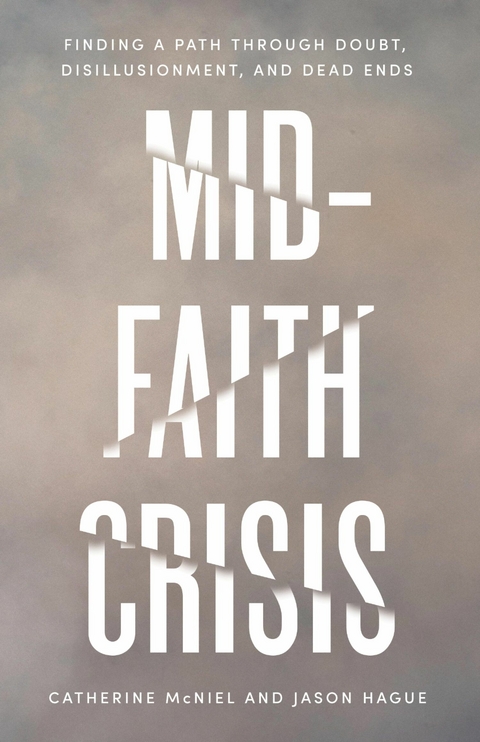
Mid-Faith Crisis (eBook)
208 Seiten
IVP (Verlag)
978-1-5140-1037-2 (ISBN)
Jason Hague is the associate pastor of Christ's Center Church near Eugene, Oregon, and the author of Aching Joy: Following God Through the Land of Unanswered Prayer. Jason has written extensively on the subject of the Christian faith and autism, special needs families, and his own spiritual journey toward hope for his own non-speaking autistic son. His writing has appeared in Christianity Today, Focus on the Family, and Fathom. He and his wife have five children.
Catherine McNiel is a chaplain, author, editor, and speaker searching for the creative, redemptive work of God in our ordinary lives. She lives in the Chicagoland area with her husband, three children, and one enormous garden. Catherine holds an MA in human service counseling and is finishing a Master of Divinity at North Park Theological Seminary. Her previous books include Fearing Bravely, All Shall Be Well, and Long Days of Small Things, which was an ECPA finalist for New Author. Jason Hague is the associate pastor of Christ's Center Church near Eugene, Oregon, and the author of Aching Joy: Following God Through the Land of Unanswered Prayer. Jason has written extensively on the subject of the Christian faith and autism, special needs families, and his own spiritual journey toward hope for his own non-speaking autistic son. His writing has appeared in Christianity Today, Focus on the Family, and Fathom. He and his wife have five children.
1
LET’S START WITH A MEME
A meme pops up on social media every now and then: How It Started v. How It’s Going. Couples post first-date snapshots alongside celebratory wedding pictures. Parents post their newborn baby alongside their college graduate. One astronaut framed an old picture of his childhood self in a cardboard-box rocket ship next to a picture of his grown-man self flying a real NASA space shuttle.
We depict less celebratory things with this meme too: breakups, loss, decline. Things that started strong and fancy ending weak and laughable. But whichever direction the photos take us, we enjoy the contrast of time passing, change happening. We smile proudly, laugh uncomfortably. It’s all so true, so relatable.
What would our faith look like in a How It Started vs. How It’s Going meme? What was our fresh, hopeful picture at the beginning—and how do we look now?
For many of us . . . well, it’s not pretty. Whether we began the faith journey in childhood or adulthood, we started full of earnest faith, hope, and love. But life has proven to be complicated, and for many of us the faith we had at the beginning couldn’t hold up to the challenge. Over time, our religious energy and excitement fizzled. Our prayer muscles atrophied. Our trust was shaken. The songs, books, verses, and even beliefs we once loved now vividly remind us of painful losses and disappointments.
What happened? Why the stark juxtaposition between how we started out in the faith and how it’s going now? Simply put, we hit a crisis or two, or three. A mid-faith crisis, you might call it. As you’ve likely noticed, this is a common tale.
But before we jump into all that, let us introduce ourselves—and show you a bit of how it started and how it’s going for the two of us.
JASON: HOW IT STARTED
For me, it started with bright lights and TV cameras.
The year was 1987. I was eight years old, traveling up the East Coast with a performing arts troupe made up of thirty neon-clad kids and chaperones. We didn’t just believe in God; we were on fire for God. We performed in churches—Sunday services, youth groups, Vacation Bible Schools—and they loved us. But there was one extra-special stop on our itinerary.
“We’re going to be on The 700 Club!” we exclaimed to our grandparents over long-distance phone lines. They gushed and gloated. Their grandchildren performing on the most popular Christian news program in the world? They just knew God was going to do big things. In between songs, I was going to be interviewed on air. Me! Speaking into the same mic Pat Robertson, Billy Graham, and Kathy Lee Gifford had used at one time or another. Live, under the lights, cameras rolling. I had made the big time.
Ben Kinchlow introduced us. “Here they are: The King’s Kids.”
The lights came on, the music began, and we were off, singing and dancing and cheerfully proclaiming our lifelong intention to follow Christ.
Lord, we will live our lives for You,
Serve You faithfully like you want us to!1
It was such an easy promise to make. The words just rolled off our tongues.
The audience ate us up, and why wouldn’t they? We were sincere in our faith, zealous in our proclamation, and glimmering with youth. Wherever we performed, the saints of our parents’ and grandparents’ generations gave us the same praise: God’s got big plans for you kids!
Then it was time for my interview. I don’t remember Kinchlow’s exact question, but it was something like: How did you get picked to be here?
My answer I remember vividly, because my mother pulled out the VHS tape at every dinner party. “That’s hard to say,” I told him, “because they’re not really the ones who picked me. Because God called on me, and he’s the one who picked me.”
Kinchlow blinked and took a step back. The audience gave something of a gasp. I knew I had impressed them.
That answer, along with Kinchlow’s flummoxed response, became legendary (at least, in my circles). “I saw your interview. You stole the show!” grownups would tell me for months after. “You give me so much hope for our future.”
The videotape was destroyed in a flood (thanks be to God), but the prognostication rang in my ears for decades: “God’s got big plans for you, young man! You’re going to change the world!”
JASON: HOW IT’S GOING
Thirty-seven years after I polished my halo under those TV lights, after the world glimpsed my staggering potential, I have not changed the world.
In many ways, faith proved somewhat of a letdown early on. Life in my twenties and thirties was not about greatness and all about waiting. My wife and I went into full-time ministry just a few years into our marriage, and I went on to become a pastor. I was waiting for God to make good on all the promises I’d invested in. But while I waited, troubles came, and I was not prepared.
The first trouble was with my two sons. Sam was born with a heart condition that would require open-heart surgery while he was still an infant. While we were trying to keep Sam alive, Jack, his three-year-old brother, was diagnosed with autism. The kind with hard behaviors and meltdowns. The kind without words.
That initial combination pushed me into something else I wasn’t prepared for: depression. I felt spiritually and emotionally drained. Even after Sam’s heart condition was mostly resolved, the sorrow lingered as I considered my grim future with Jack, who was incapable of conversing with me. I had always been a people person, but soon I found myself isolating. I kept wondering why God was letting me languish in this kind of pain.
As the years went by and our family crises multiplied and intensified, another trouble set in: disillusionment. The evangelical church in America was being torn apart by political allegiances and scandal. Many of the communities, beliefs, and practices of faith that I’d always leaned on during times of hardship were crumbling. Heroes and mentors I had revered for almost two decades were being unmasked as abusers, a far, far cry from the Christlike path I thought we were walking together.
For the next few years my spiritual confidence ebbed and flowed. I was not prepared for any of this. What happened to the “big plans” God had for me? Somedays, it felt like I had fallen victim to a cosmic con, as if my faith was nothing more than a bait-and-switch.
I weathered the storm for a while, but then came the deaths. Two women, both dear friends of mine, were diagnosed with cancer while they were still young, in their thirties and forties. They were like sisters to me, and I lost them both.
That was when the full brunt of faith crisis hit me. Far from changing the world for Christ, I was awash in a multitude of griefs, accusations, and fears. I didn’t dare tell anyone what was going on inside me. Instead, I went on with my work as a pastor, dutifully writing my sermons, hoping and praying that my secret grappling wouldn’t disqualify me from ministry, wouldn’t lead me away from the God I still loved and mostly trusted.
I had already lost my confidence. Then I lost my sisters. Now I feared I might lose Jesus too.
CATHERINE: HOW IT STARTED
My faith began more simply than Jason’s—and with fewer lights and cameras. I grew up in a dairy-farming community in rural Wisconsin, a small life in the small town my family moved to when my dad became the pastor of a small church in town. I was just four years old when our moving truck pulled up to the old parsonage, so this tight-knit community was the only home I knew.
I loved that my dad was the pastor. I loved listening to him bounce sermon ideas off us at dinner, loved beaming at him from the second row as my brother and I appeared in yet another sermon illustration. He was a great pastor, a servant in every sense of the word. He had a way of connecting the ancient wisdom of a text to the tangible needs of the people he deeply knew and genuinely loved.
Growing up as transplants in this multigenerational community—and far from our own extended family—the older folks become my grandparents, the younger families my aunts, uncles, and cousins. The church couldn’t afford to pay much, but there were other perks. Home was just around the corner from church, which was also my dad’s office, my school, and my second home. We visited the parishioners’ farms in the evenings, dipping our buckets into their milk vats and bringing milk home to drink. Chatting with the farmers in their milking parlors, we “helped” milk the Holsteins. Our freezer filled with meat during hunting season and our pantry with canned vegetables during growing season. We were invited to spend Sunday dinners and holiday meals around their tables, with their families. We were known and loved; we cared for others and were cared for in return. To me, everything about this community was safe, was home.
At my tiny Christian school, my desk was a small, wooden cubicle, side-by-side with many others lining the walls of the schoolroom. Our self-guided lessons were easy and uplifting, and the wooden dividers that hemmed us in didn’t...
| Erscheint lt. Verlag | 3.6.2025 |
|---|---|
| Verlagsort | Lisle |
| Sprache | englisch |
| Themenwelt | Religion / Theologie ► Christentum ► Moraltheologie / Sozialethik |
| Schlagworte | Certainty • Change • Christianity • Church • Deconstruction • Disappointment • evangelical • ex-vangelical • God • growth • Hope • hypocrisy • journey • Midlife • New • questions • Rebuild • reconsider • reconstruction • Religion • Renew • Shift • Spiritual Formation • Trust |
| ISBN-10 | 1-5140-1037-2 / 1514010372 |
| ISBN-13 | 978-1-5140-1037-2 / 9781514010372 |
| Informationen gemäß Produktsicherheitsverordnung (GPSR) | |
| Haben Sie eine Frage zum Produkt? |
 EPUB (Wasserzeichen)
DRM: Digitales Wasserzeichen
Dieses eBook enthält ein digitales Wasserzeichen und ist damit für Sie personalisiert. Bei einer missbräuchlichen Weitergabe des eBooks an Dritte ist eine Rückverfolgung an die Quelle möglich.
Dateiformat: EPUB (Electronic Publication)
EPUB ist ein offener Standard für eBooks und eignet sich besonders zur Darstellung von Belletristik und Sachbüchern. Der Fließtext wird dynamisch an die Display- und Schriftgröße angepasst. Auch für mobile Lesegeräte ist EPUB daher gut geeignet.
Systemvoraussetzungen:
PC/Mac: Mit einem PC oder Mac können Sie dieses eBook lesen. Sie benötigen dafür die kostenlose Software Adobe Digital Editions.
eReader: Dieses eBook kann mit (fast) allen eBook-Readern gelesen werden. Mit dem amazon-Kindle ist es aber nicht kompatibel.
Smartphone/Tablet: Egal ob Apple oder Android, dieses eBook können Sie lesen. Sie benötigen dafür eine kostenlose App.
Geräteliste und zusätzliche Hinweise
Buying eBooks from abroad
For tax law reasons we can sell eBooks just within Germany and Switzerland. Regrettably we cannot fulfill eBook-orders from other countries.
aus dem Bereich


