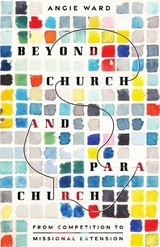
Beyond Church and Parachurch (eBook)
208 Seiten
IVP (Verlag)
978-1-5140-0958-1 (ISBN)
Angie Ward (PhD, Southern Baptist Theological Seminary) is director of the Doctor of Ministry program and associate professor of leadership and ministry at Denver Seminary. She is the author of Uncharted Leadership: 20 Case Studies to Help Ministry Leaders Adapt to Uncertainty and I Am a Leader: When Women Discover the Joy of Their Calling. Angie has over thirty-five years of leadership experience in church, nonprofit, and higher education ministry. A sportswriter in a previous life, Angie loves running, basketball, humor, and movies. She and her pastor-husband live in Denver. They have two grown sons and one very spoiled beagle.
Angie Ward (PhD, Southern Baptist Theological Seminary) is director of the Doctor of Ministry program and associate professor of leadership and ministry at Denver Seminary. She is the author of Uncharted Leadership: 20 Case Studies to Help Ministry Leaders Adapt to Uncertainty and I Am a Leader: When Women Discover the Joy of Their Calling. Angie has over thirty-five years of leadership experience in church, nonprofit, and higher education ministry. A sportswriter in a previous life, Angie loves running, basketball, humor, and movies. She and her pastor-husband live in Denver. They have two grown sons and one very spoiled beagle.
1
Why This Book?
An Introduction and a Road Map
Cynthia is a forty-two-year-old mother of three sons, ages eight to fifteen. Each week she attends Sunday-morning worship services at House of Hope church, a nondenominational congregation that was planted thirty years ago by a group of Christians who left a mainline denominational church when their longtime pastor moved out of state for an assignment to another congregation. Cynthia’s boys attend Sunday school during one of the two morning service times, while her two teenagers return on Sunday evening for middle-school and high-school youth group.
Cynthia is a regular volunteer in the children’s ministry at House of Hope. She also helps lead a kids’ Bible study at her youngest son’s elementary school. All three boys grew up going to Bible Club. The oldest son, now in high school, attends Fellowship of Christian Athletes on Thursday mornings. Every September, he and his middle-school brother spend one Wednesday morning praying for their classmates at See You at the Pole.
On Monday nights, Cynthia attends Bible Study Fellowship (BSF), which is held at another local church. She and her friends from BSF regularly attend an annual women’s conference at the professional sports arena downtown. And whether on her way to Bible Club, BSF, House of Hope church, or to her job as an office manager for a landscaping company, Cynthia listens either to worship music on the local Christian radio station, or a podcast or an audiobook by a well-known Christian speaker or author.
Cynthia is a typical evangelical Protestant Christian in the United States today. You probably know a number of Cynthias, or people quite like her. Perhaps you are a Cynthia.
Or perhaps you are more like Lucas, the senior pastor at House of Hope church, now in his sixth year there and his fourteenth year in church ministry. Although House of Hope is not part of a denomination, it is a member of a national network of churches focused on reaching their communities with the good news of Jesus Christ. Lucas is also a member of a monthly coaching group provided by a different national network.
In addition to weekly worship gatherings and its regular in-house activities, House of Hope runs a teen ministry in a local trailer park as well as a thriving youth soccer ministry, including leagues and coaching, on its ten-acre property. These ministries are staffed primarily by volunteer college students from the nearby university, although most of these students don’t attend House of Hope because they are involved with the student ministry organizations that meet on campus. Some of the full-time staff from these organizations, as well as from the local pregnancy center, attend House of Hope church. Lucas was recently asked to join the board of the pregnancy center, and the church gives some of its income to this ministry.
The House of Hope congregation also sponsors several overseas missionaries through a variety of agencies focusing on various parts of the world. Lucas receives repeated requests for House of Hope to support the college ministries and other organizations around town, which he has learned usually means a desire for regular financial contributions, promotion of their programs, and/or announcements about the volunteer needs in those ministries. Lucas, however, wishes House of Hope had enough volunteers for its own programs, including Sunday school and the nursery.
Then there’s Jasmine, a twenty-something staff worker with ULife, one of the campus ministries at the university. Jasmine came to Christ through her organization’s influence on her own college campus and has a passion for reaching students with the gospel. Jasmine attends a different church in town. She sometimes wishes she could be more involved in her church, but her work with college students means that evenings and weekends are often dedicated to activities on campus, including a weekly large-group worship gathering. Jasmine gives some of her limited income—which she must fundraise for herself as a campus “missionary”—to the church, and some to support her own campus ministry. Can you identify with her?
Welcome to the complex world of Christian life and ministry in the twenty-first century. Cynthia, Lucas, and Jasmine are amalgamations, but they are not anomalies. The snapshots of their lives give us a glimpse into a vast collection of churches and Christian organizations that are both connected to and competitive with one another.
Yes, I said competitive with. Those of us who work in Christian ministry may say or even believe we’re all on the “same team,” but the reality is that all of our organizations have their own agendas, and those agendas often contend for the same people and resources. In the day-to-day struggle for market share, or just for simple survival, precious little time is spent on considering how all of us—churches, Christian organizations, the pastors and leaders of these organizations, and the people in the pews—relate to one another, much less how they should relate. I believe this is because the people of God suffer from a fundamental deficit in ecclesiology—that is, a theological understanding of what the church is, what it should be, and what it should do.
Why does this matter? Lest you think that ecclesiology is just a ten-dollar word, a seminary term, or a purely academic concern, let me make this bold claim: Jesus’ teaching, indeed all of the New Testament, makes the case that our ecclesiology—our understanding of “church”—is central to our very identity.
You see, as followers of Jesus Christ, the Scriptures clearly teach that we are not just individual believers—we are members of Christ’s body, the church (1 Cor. 12:27). In other words, “church” is not just a building we visit, an event we attend, or a group of people we hang out with. It is who we are—a collective identity. Let me say it another way: you and I are the church, the body of Christ.
Read that again, slowly: You. and. I. are. the. church.
WE. ARE.
It doesn’t get more central than that. Church, and our belonging in it, is a state of being, not just a behavior.
And yet we are more inclined to argue over the style of music in a worship gathering, the role of women in ministry, or the events of the end times than to spend time seeking to understand who we are and the significance of this identity for our lives both individually and corporately. Meanwhile, whether or not we are aware of it, this lack of understanding affects our work and our witness. How could it not? An understanding of our identity is critical to everything we as the body of Christ say and do in his name. It affects not only our ministry, but also our unity, and Jesus’ prayerful plea for the church was that it would be marked by unity.
I think we can do better. I think we must do better.
We live in a world in desperate need for the good news of Jesus Christ. There are millions of people far from God and millions more who claim the name of Christ yet live nothing like Christ commanded his followers. Just five minutes scrolling through the day’s headlines—or for that matter, five minutes spent driving around our communities—reminds us of the realities of mental illness, violence, abuse, poverty, disease, death, and broken relationships with God and with one another. Whether close to home or across the globe, the needs are evident and abundant, even overwhelming. Come, Lord Jesus.
Yet we also live in a world, particularly a Western world, where there are more churches and Christian ministries than ever before in history. More efforts than ever, yet statistics and our own experience tell us that much of the world is moving farther from God, not closer.
Even Christians are becoming less “Christian” in terms of both beliefs and behaviors. Evangelicalism is increasingly fracturing. By any measure, the primacy of the Western church is in decline. Individual Christians of all ages are deconstructing their faith and rethinking the nature, purpose, and necessity of the church. Many people stopped attending church during the pandemic and didn’t come back. Christians are disillusioned with abusive church leaders and have given up on organized church. Christian higher education is facing demographic shrinkage, as fewer kids in youth group means fewer students in Christian colleges and seminaries.
As a result, a greater number of organizations are competing for a continuously shrinking pool of human, financial, and material resources. The urgency of unmet needs combined with a scarcity of resources leads to a nagging sense of anxiety that can make pastors and ministry leaders feel defensive and territorial.
It would be easy to blame all sorts of outside factors for this continued decline: secularization, the wrong political leaders, the culture, the media, the entertainment industry—pick your enemy. Yet I think that blame is misguided. You see, after nearly a decade of reading, researching, thinking, serving in, observing, teaching, and talking about this thing called “church,” I am fully convinced that our problem is that the church—and by that I mean the global collection of believers who the Bible says comprises the body of Christ, but in particular the Western, and more specifically, the United States church—does not have a clear sense of what it, what we, should be and do.
In other words, I believe...
| Erscheint lt. Verlag | 13.5.2025 |
|---|---|
| Vorwort | Jerry E. White |
| Verlagsort | Lisle |
| Sprache | englisch |
| Themenwelt | Religion / Theologie ► Christentum ► Kirchengeschichte |
| Schlagworte | Apostolic • Biblical • body of Christ • Christian • congregation • Contemporary • Ecclesiology • evangelical • History • Impact • Kingdom • Laity • laypeople • Leader • ministry • missions • Network • organization • paradigm • Partnership • Pastor • Plant • Protestant • rethink • UNITY • Witness |
| ISBN-10 | 1-5140-0958-7 / 1514009587 |
| ISBN-13 | 978-1-5140-0958-1 / 9781514009581 |
| Informationen gemäß Produktsicherheitsverordnung (GPSR) | |
| Haben Sie eine Frage zum Produkt? |
 EPUB (Wasserzeichen)
DRM: Digitales Wasserzeichen
Dieses eBook enthält ein digitales Wasserzeichen und ist damit für Sie personalisiert. Bei einer missbräuchlichen Weitergabe des eBooks an Dritte ist eine Rückverfolgung an die Quelle möglich.
Dateiformat: EPUB (Electronic Publication)
EPUB ist ein offener Standard für eBooks und eignet sich besonders zur Darstellung von Belletristik und Sachbüchern. Der Fließtext wird dynamisch an die Display- und Schriftgröße angepasst. Auch für mobile Lesegeräte ist EPUB daher gut geeignet.
Systemvoraussetzungen:
PC/Mac: Mit einem PC oder Mac können Sie dieses eBook lesen. Sie benötigen dafür die kostenlose Software Adobe Digital Editions.
eReader: Dieses eBook kann mit (fast) allen eBook-Readern gelesen werden. Mit dem amazon-Kindle ist es aber nicht kompatibel.
Smartphone/Tablet: Egal ob Apple oder Android, dieses eBook können Sie lesen. Sie benötigen dafür eine kostenlose App.
Geräteliste und zusätzliche Hinweise
Buying eBooks from abroad
For tax law reasons we can sell eBooks just within Germany and Switzerland. Regrettably we cannot fulfill eBook-orders from other countries.
aus dem Bereich