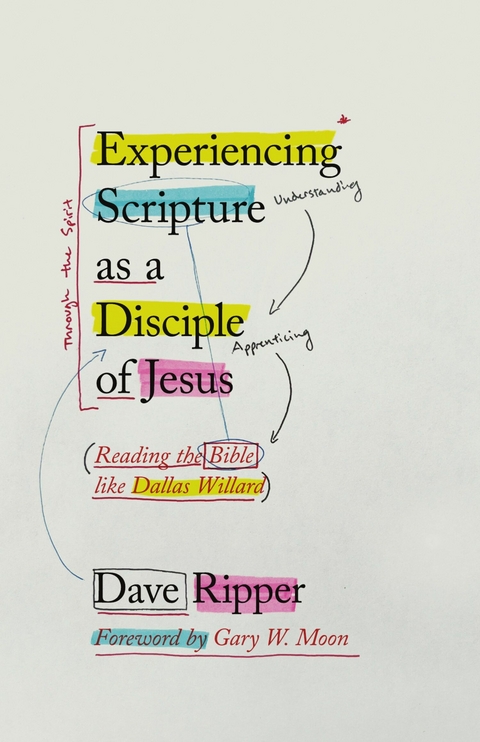
Experiencing Scripture as a Disciple of Jesus (eBook)
208 Seiten
IVP Formatio (Verlag)
978-1-5140-1311-3 (ISBN)
Dave Ripper is the lead pastor of Crossway Christian Church, a multicongregational church in southern New Hampshire, focused on spiritual formation. He earned a doctor of ministry in spiritual direction from Fuller Theological Seminary and The Martin Institute for Christianity and Culture and Dallas Willard Research Center at Westmont College. He is coauthor of The Fellowship of the Suffering and serves as the chaplain for the Boston Bruins. Dave and his wife, Erin, a mental health therapist, have three children. They make their home in the woodlands of New England near Nashua, New Hampshire.
Dave Ripper is the lead pastor of Crossway Christian Church, a multicongregational church in southern New Hampshire, focused on spiritual formation. He earned a doctor of ministry in spiritual direction from Fuller Theological Seminary and The Martin Institute for Christianity and Culture and Dallas Willard Research Center at Westmont College. He is coauthor of The Fellowship of the Suffering and serves as the chaplain for the Boston Bruins. Dave and his wife, Erin, a mental health therapist, have three children. They make their home in the woodlands of New England near Nashua, New Hampshire.
1
Scripture as a Gateway to Eternal Living
We cannot have a relationship with the Bible, but the God of the Bible.
I SHOULD HAVE TAKEN my high school typing class far more seriously.
I thought this about a hundred times as I furiously tried to capture everything Dallas Willard said throughout the weeklong class I took with him in 2010 through Denver Seminary.1 The course was held at The Hideaway Inn and Conference Center in Colorado Springs, in the shadow of what has been called America’s Mountain, Pikes Peak. It was a fitting setting to meet and study under the person who has become the most towering spiritual influence in my life.
In the conference room at The Hideaway, I learned the essential message of Dallas Willard through his profound lectures. While he is often and generally associated with the spiritual disciplines, the scope of his teaching extended greatly beyond this. During our time together, through the use of an old-school transparency projector—a Willard staple—he helped us discover a picture of the gospel Jesus preached. He enabled us to understand what the kingdom of God is really about and its availability here and now. Eventually, he made his way toward the spiritual disciplines and concluded the course by casting a vision for the local church to become a “school for eternal living”—whatever that meant.
He finished his formal teaching with the most freeing words I ever heard as a young pastor: “What God gets out of your life is the person you become.” What God gets out of my life is not my success as a pastor or the size of my ministry. The person I become matters most. That is good news.
Never before or since have I come across a person whose teaching carried so much weight. Every sentence he uttered spoke volumes. Every idea he introduced possessed authority. Every pause pulsated with spiritual power.
Like most students of Dallas Willard, I wasn’t able to come close to understanding all the revolutionary things he said in real time, so I resolved to capture as much as I possibly could for later reflection. Fifteen years later, these are some of the takeaways from Dallas’s teachings that I’ve come to treasure most from my notes:
Joy is “a pervasive sense of well-being.”2 It’s possible for you to be okay even if everything around you isn’t.
Beauty is goodness made sensibly present.3
Does the gospel I preach have a natural tendency to produce disciples or only consumers of religious goods and services?
If you want to do everything Jesus said, don’t try to do everything he said. Instead, train yourself to become the kind of person who would “easily and routinely” do everything he said.4
While I learned the message of Dallas Willard in the conference room, what left an even greater impression on my life was interacting with the man in all the other spaces of The Hideaway. For a person who was once described as “a man from another ‘time zone,’” Dallas was surprisingly down-to-earth.5
He was funny. When talking to my wife, Erin, and me over a meal, he described how he met his wife, Jane, at his college’s library. “I checked her out, but I never checked her back in.”
He was normal. One evening, Dallas watched the college football national championship game with us—even though USC wasn’t playing. Other retreat leaders I had interacted with over the years were almost impossible to connect with outside of the formal sessions. It was a relief and a joy to discover that this philosopher seemed more at home hanging out as our friend than alone as a monk.
He was helpful. Dallas slowly and patiently guided me through some of the confusion I had around spiritual practices and theology. For instance, I posed a “hypothetical” situation to him.
“Dallas, if you’re fasting and your wife cooks you dinner, what do you do? After all, Jesus tells us to fast ‘in secret.’”
“Dave, if you’re fasting and your wife cooks you dinner, you eat. The point of the spiritual disciplines is not to get good at them, as much as they are designed to help you love God and love others more fully. The more loving thing to do is to eat what your wife has prepared.” It wasn’t the answer I was looking for in the presence of my wife, but I’m confident it was the right answer!
And yet Dallas was devout. As the only married couple in the class, my wife and I ended up staying in a suite that shared a wall with the room Dallas was in. Every morning we awoke to the sound of Dallas’s baritone voice singing hymns as part of his morning time with the Lord. Our class followed Dallas’s spiritual practice of fasting on Wednesdays along with him. Somehow being with the man—experiencing his personal presence and his personal spiritual practices—seemed to confirm his message, adding even more gravity to his groundbreaking thought.
Since that course, I spent years first trying to learn what Dallas said about the topics he addressed—especially his unique interpretations of many passages of Scripture. In more recent years, though, as part of my doctoral studies, I have sought to discover how Dallas reached the conclusions he did.
I have been grateful to learn that others have pursued similar ends. In his outstanding academic work The Kingdom Among Us: The Gospel According to Dallas Willard, Michael Stewart Robb shares his email correspondence with Willard, regarding how he arrived at many of the biblical and theological conclusions he came to hold—viewpoints that do not seem to fit squarely in any one Christian tradition. In response to Robb, Willard writes:
Nearly all of my “influences” are from people long dead. I have arrived at my views by studying the Bible philosophically, if you wish, and by reading widely through the ages, and trying to put it all into practice. It is presumptuous to say, but I believe that God has guided my thinking. Certainly nothing I have is really new or “my own.”6
In the next chapter, I will attempt to explain the basics of the philosophical terms and approaches that characterized Willard’s work, like robust metaphysical realism, epistemic realism, and phenomenology. Before then, though, I’d like to use more accessible language to explore how Willard read the Bible philosophically. To do so, we must first build a foundational theological understanding of Willard’s view about the nature of God and what the gospel is. To rightly perceive what the Bible is, we must know the God who lovingly gave it to us. Second, I’ll present a case study of the text Willard arguably quoted the most through his teaching and writing, John 17:3. By building this foundation, we will be prepared to craft the core framework for how Willard read Scripture like a Southern Baptist, a philosopher, and mystic.
WHAT COMES TO MIND WHEN DALLAS THINKS ABOUT GOD
In The Divine Conspiracy, Willard writes that when we think about God, we should conclude that he leads a very interesting life, and that he is pervaded with joy. In fact, he believes God is the “most joyous being in the universe.”7 Because he is abundantly loving and abundantly generous, God is infinitely joyous. What an astonishing way to think about God!
To illustrate this enthralling vision of the nature of God, Willard describes an overwhelming experience of beauty he had off the coast of South Africa. It occurred to him that God sees brilliant scenes of wonder like this all the time. Willard reflects, “It is perhaps strange to say, but suddenly I was extremely happy for God.”8 To deepen his reflections even more, Willard posits, “But he [God] is simply one great inexhaustible and eternal experience of all that is good and true and beautiful and right.”9 This is what we should think of when we think of God’s perfect being—God’s very life. And this life—his life—is the life God desires to share with each one of us.
God desires to share his joyous life with us because, as 1 John states, God is love (4:8, 16). Woven throughout the tapestry of Willard’s works is his belief that the essential nature of God is love.10 Later in The Divine Conspiracy, Willard concludes, “The acid test for any theology is this: Is the God presented one that can be loved, heart, soul, mind, and strength? If the thoughtful, honest answer is ‘Not really,’ then we need to look elsewhere or deeper.”11 Given God’s loving nature, his people are invited to live what Willard described as the with-God life, which is central to his understanding of the gospel.
THE GOSPEL OF THE KINGDOM
To grasp Willard’s understanding of what the Bible is and how it is to be read and applied, we must examine Willard’s subversive perspective on what the gospel is. In The Divine Conspiracy, Willard claims that the Christian message proclaimed today is focused only on how to deal with sin, or what he calls “gospels of sin management.” When surveying the broad spectrum of...
| Erscheint lt. Verlag | 3.6.2025 |
|---|---|
| Vorwort | Gary W. Moon |
| Verlagsort | Lisle |
| Sprache | englisch |
| Themenwelt | Religion / Theologie ► Christentum ► Kirchengeschichte |
| Religion / Theologie ► Christentum ► Moraltheologie / Sozialethik | |
| Schlagworte | Christian • Church • Devotional • evangelical • God • growth • Ignatius • immersive • inductive • Leader • learn • Lectio Divina • Pastor • Practices • Prayer • Quiet time • reflection • Saint • small group • Spiritual Formation • Study • Sunday school • Teacher • Transformation |
| ISBN-10 | 1-5140-1311-8 / 1514013118 |
| ISBN-13 | 978-1-5140-1311-3 / 9781514013113 |
| Informationen gemäß Produktsicherheitsverordnung (GPSR) | |
| Haben Sie eine Frage zum Produkt? |
 EPUB (Wasserzeichen)
DRM: Digitales Wasserzeichen
Dieses eBook enthält ein digitales Wasserzeichen und ist damit für Sie personalisiert. Bei einer missbräuchlichen Weitergabe des eBooks an Dritte ist eine Rückverfolgung an die Quelle möglich.
Dateiformat: EPUB (Electronic Publication)
EPUB ist ein offener Standard für eBooks und eignet sich besonders zur Darstellung von Belletristik und Sachbüchern. Der Fließtext wird dynamisch an die Display- und Schriftgröße angepasst. Auch für mobile Lesegeräte ist EPUB daher gut geeignet.
Systemvoraussetzungen:
PC/Mac: Mit einem PC oder Mac können Sie dieses eBook lesen. Sie benötigen dafür die kostenlose Software Adobe Digital Editions.
eReader: Dieses eBook kann mit (fast) allen eBook-Readern gelesen werden. Mit dem amazon-Kindle ist es aber nicht kompatibel.
Smartphone/Tablet: Egal ob Apple oder Android, dieses eBook können Sie lesen. Sie benötigen dafür eine kostenlose App.
Geräteliste und zusätzliche Hinweise
Buying eBooks from abroad
For tax law reasons we can sell eBooks just within Germany and Switzerland. Regrettably we cannot fulfill eBook-orders from other countries.
aus dem Bereich