


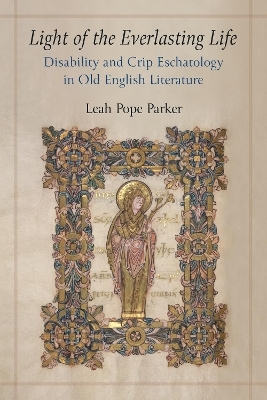
Light of the Everlasting Life
Disability and Crip Eschatology in Old English Literature
Seiten
2025
The University of Michigan Press (Verlag)
978-0-472-07759-5 (ISBN)
The University of Michigan Press (Verlag)
978-0-472-07759-5 (ISBN)
Disability representations and the afterlife in Old English literature
From disability metaphors to narratives structured around bodies presented as aberrant, early medieval English thoughtworlds conveyed the promise of resurrection and the hope of salvation through crip and disabled bodies. Light of the Everlasting Life argues that early medieval Christian eschatology, as manifested in Old English literary texts, was a crip eschatology: a theology of the afterlife that relied upon disabled bodies and concepts related to disability in order to convey promises of resurrection and salvation. In addition to demonstrating how literature manifested theological approaches to the afterlife, Leah Pope Parker articulates the ways of thinking about bodies and disability that were available to ordinary early medieval people, many of whom experienced their bodies in ways that resonate with what we call disability today, but who rarely appear in the historical record.
By analyzing Old English texts, including Alfredian translations, Ælfric’s saints’ lives, and poetry from the Exeter and Vercelli Books, Parker introduces novel ways of characterizing disability’s effects in literature. “Spiritual prosthesis” reveals rhetorical, narrative, and theological reliance upon disability to convey the promise of a Christian afterlife. “Systems of aberrance” emerge as a result, in which bodies marked as deviant—including disabled, monstrous, heroic, saintly, and dead bodies—form a network of embodiments that reinforce the narratives they inhabit and that of Christian salvation history. Locating crip eschatology in early medieval literature, Light of the Everlasting Life rewrites standard histories of disability, of the body, and of medieval Christian eschatology.
From disability metaphors to narratives structured around bodies presented as aberrant, early medieval English thoughtworlds conveyed the promise of resurrection and the hope of salvation through crip and disabled bodies. Light of the Everlasting Life argues that early medieval Christian eschatology, as manifested in Old English literary texts, was a crip eschatology: a theology of the afterlife that relied upon disabled bodies and concepts related to disability in order to convey promises of resurrection and salvation. In addition to demonstrating how literature manifested theological approaches to the afterlife, Leah Pope Parker articulates the ways of thinking about bodies and disability that were available to ordinary early medieval people, many of whom experienced their bodies in ways that resonate with what we call disability today, but who rarely appear in the historical record.
By analyzing Old English texts, including Alfredian translations, Ælfric’s saints’ lives, and poetry from the Exeter and Vercelli Books, Parker introduces novel ways of characterizing disability’s effects in literature. “Spiritual prosthesis” reveals rhetorical, narrative, and theological reliance upon disability to convey the promise of a Christian afterlife. “Systems of aberrance” emerge as a result, in which bodies marked as deviant—including disabled, monstrous, heroic, saintly, and dead bodies—form a network of embodiments that reinforce the narratives they inhabit and that of Christian salvation history. Locating crip eschatology in early medieval literature, Light of the Everlasting Life rewrites standard histories of disability, of the body, and of medieval Christian eschatology.
Leah Pope Parker is Associate Professor of English at the University of Southern Mississippi.
List of Figures
Acknowledgments
Abbreviations
Note on Texts and Translations
Introduction: Crip Eschatology
Part I. Spiritual Prosthesis
1. King Alfred’s Vision: Conceptual Metaphors of Sight and Salvation
2. St. Swithun’s Crutches: Healing Miracle Narratives and the Relics of Disability
3. St. Æthelthryth’s Scar: Marking Crip Eschatology on the Saintly Body
Part II. Systems of Aberrance
4. St. Andrew’s Blood: Cannibalism, Torture, and Conversion
5. Cynewulf’s Wounds: Sinners, Saints, and the Poet’s Eschatological Anxiety
6. The Body of Christ: Seeing and Being Seen in the Apocalypse
Conclusion
Bibliography
| Erscheinungsdatum | 28.08.2025 |
|---|---|
| Reihe/Serie | Corporealities: Discourses of Disability |
| Zusatzinfo | 5 images |
| Verlagsort | Ann Arbor |
| Sprache | englisch |
| Maße | 152 x 229 mm |
| Themenwelt | Literatur ► Klassiker / Moderne Klassiker |
| Geschichte ► Teilgebiete der Geschichte ► Religionsgeschichte | |
| Geisteswissenschaften ► Religion / Theologie ► Christentum | |
| Sozialwissenschaften ► Soziologie | |
| ISBN-10 | 0-472-07759-7 / 0472077597 |
| ISBN-13 | 978-0-472-07759-5 / 9780472077595 |
| Zustand | Neuware |
| Informationen gemäß Produktsicherheitsverordnung (GPSR) | |
| Haben Sie eine Frage zum Produkt? |
Mehr entdecken
aus dem Bereich


aus dem Bereich
von der Antike bis zur Gegenwart
Buch | Softcover (2025)
C.H.Beck (Verlag)
CHF 16,80


