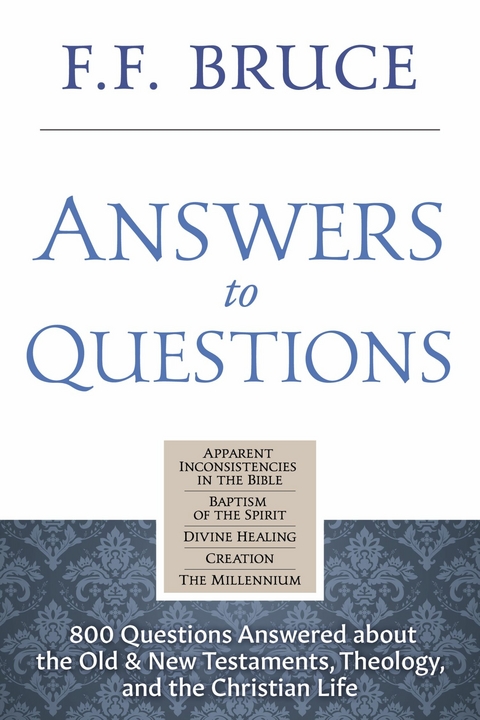
Answers to Questions (eBook)
270 Seiten
Kingsley Books (Verlag)
978-1-912149-58-2 (ISBN)
F.F. Bruce (1910-1990), known worldwide as the 'dean of evangelical scholarship,' was Rylands Professor of Biblical Criticism and Exegesis at the University of Manchester in England. A prolific writer, his commentary The Book of the Acts in the New International Commentary series is considered a classic. Bruce combined an immense contribution to evangelical scholarship with a passion for proclaiming the Bible as God's guide for our lives. He used his great knowledge to explain the Bible simply and clearly.
For more than twenty years F.F. Bruce answered questions submitted by readers of "e;The Harvester,"e; a magazine published by Paternoster Press primarily for members of Brethren assemblies. It was one of the magazine's most popular features. The first half of this book covers questions and answers on the biblical text; the second half covers questions and answers on Christian doctrine and the Christian life. Two indices will help the reader find topics of interest. However, reading through the answers at random will be an experience of delightful discovery of Bruce's comments on issues from singing in worship to eschatology to what it means to be an evangelical. Questions asked to arouse controversy are answered in ways that are pointed, loving, and understanding a demonstration of J.I. Packer's comment that "e;No Christian was ever more free of narrow bigotry, prejudice and eccentricity in the views he held and the way he held them; no man did more to demonstrate how evangelical faith and total academic integrity may walk hand in hand."e; * Some answers were carefully worded because Bruce knew his opinions differed from normal Brethren thought. * Some answers avoided giving specific directions because Professor Bruce preferred to discuss options and let the readers make up their own minds. * Some answers avoided giving advice in specific local situations because it was "e;not the function of this column to usurp the responsibility of the elders of a particular church."e; * Some answers responded to the questioner's hobby horse "e;with a twinkle in his eye,"e; said reviewer Laurence Porter. For instance, a questioner who wanted to censure "e;young sisters"e; who used cosmetics was told that Professor Bruce doubted such censure would be a good idea and he confessed that he himself sometimes used after-shave lotion. F.F. Bruce answered 2,000 questions in the pages of The Harvester over a period of twenty years. The 800 questions and answers in this book were chosen, classified, and indexed by Rev. Clive L. Rawlins.
The Pentateuch
Genesis 1:1. Am I justified in preferring to understand Gen. 1:1 as meaning, “In the beginning God created the ‘space’ and the ‘matter’”?
Hardly. The word translated “heaven” in our common version includes the material of the heavenly bodies as well as the space in which they move; the word translated “earth” denotes our planet as distinct from the rest of the material universe. The two words together comprise the whole created universe of space and time.
Genesis 1:1. What is the “beginning” of Gen. 1:1? Can it be understood as the beginning of God?
No; from first to last, the God of the Bible is revealed as the One who is from everlasting to everlasting and has neither beginning nor end. The “beginning” in which He created heaven and earth was the beginning of time; time (unlike eternity) is something which belongs to the created order. The material universe had a beginning then, and will in due course have an end.
Genesis 1:26. In Gen. 1:26, when God says, “Let us make man”, does the word “us” indicate the Holy Trinity?
It is more probably to be treated as the “plural of majesty,” or a plural denoting God as including within Himself all the powers of deity. See The Names and Titles of God.
Please explain the words “in our image, after our likeness” in Gen. 1:26, and indicate the reason for the repetition.
I find it difficult to distinguish in sense between “image” and “likeness” here and suggest that the repetition is for emphasis (cf. 1 Cor. 11:7, “he is the image and glory of God”). The words appear to denote man as a creature endowed with moral and intellectual responsibility with whom God can have fellowship and in whom He can see His own character reproduced.
Genesis 1:28. Does the word “replenish” in Gen. 1:28 mean that there were people on earth before Adam? Is it the same word as is used to Noah in Gen. 9:1?
The word used in both places is the ordinary Hebrew word meaning “fill”; it is so translated (rightly) in the rsv and neb. Of course, in Gen. 9:1 we know that the idea of replenishing is implied, for there were people on earth before Noah, but the Biblical record is silent on the presence of human beings before Adam (not to put it more categorically), and no such inference can be drawn from the language of Gen. 1:28.
Genesis 2:7. In The Unfolding Drama of Redemption, Vol. 1, p. 55, Dr. W. Graham Scroggie writes with regard to Gen. 2:7, “The body and the spirit (breath . . .) constituted the soul. The soul is the middle term in which body and spirit meet in the unity of personality.” This statement seems to imply that Body plus Spirit equals Soul. Is the writer advocating the dual nature of man? How would you deal with Gen. 2:7?
The phrase translated “living soul” in Gen. 2:7 means “a living person”; i.e., the word “soul” (Heb. nephesh) here does not denote a component part of the living human being, but the whole. (The expression in Gen. 2:7 must not be confused with the formally identical expression used elsewhere with a collective force to denote creatures of the animal world in the narrower sense, as, e.g., in Gen. 2:19, where it is rendered “living creature”.) That is to say, Gen. 2:7 does not teach that Body plus Spirit equals Soul (in the usual restricted sense of the word soul), but that Body plus Spirit equals Person. The man became a living person when God, having fashioned his body, breathed the breath of life into it. The difficulty lies partly in the fact that the Hebrew word nephesh has such a wide range of meaning (See Should the Hebrew word nephesh always be translated “soul”?), and partly in the fact that we tend to read later ideas back into the Old Testament. I doubt whether the familiar distinction between “soul” and “spirit” is clearly expressed in the Bible outside the Pauline writings. In fact, the terms seem at times to be used interchangeably. And even Paul, when he is not dealing explicitly with the soul-spirit tension, can use the terms in a more indefinite sense. The best discussion known to me of this whole subject in so far as it relates to the Old Testament is A. R. Johnson’s The Vitality of the Individual in the Thought of Ancient Israel (Cardiff, 1949).
Genesis 3:1. In his exposition of the Corinthian Epistles, the late Dr. G. Campbell Morgan writes (p. 173), “Again go back to the Garden of Eden, where Satan appeared as a bright and brilliant being. That is the story. The idea of the devil appearing as a snake is, of course, ridiculous. That is not the word at all. It is a shining one. Eve was beguiled by a brilliant appearance.” Is there any support for this statement?
There is none in the Biblical text. The Hebrew word is nahash, which is an ordinary word meaning “serpent”. The same is true of the Greek word ophis, which is used in the Septuagint of Genesis 3 and also in the New Testament references to the serpent, 2 Cor. 11:3 and Rev. 12:9, etc. I am not sure what the source of Dr. Campbell Morgan’s statement was. There is an old tradition, best known to us from Milton (“Paradise Lost,” Book IX), which represents the serpent before the Fall as moving
. . . not with indented wave,
Prone on the ground, as since, but on his rear,
Circular base of rising folds, that towered
Fold above fold a surging maze, his head
Crested aloft, and carbuncle his eyes;
With burnished neck of verdant gold, erect
Amidst his circling spires, that on the grass
Floated redundant: pleasing was his shape,
And lovely, never since of serpent kind
Lovelier . . .
Campbell Morgan’s reference to “the word,” however, suggests that he may have thought of the phrase nahash saraph, used for the fiery serpents of Num. 21:6; the word saraph (“burning”) is also used for the seraphim of Isa. 6. But the serpent of Eden is not described as saraph, and there is nothing in the language of Gen. 3 that justifies the statement which you quote.
Genesis 3:15. Can Gen. 3:15 be properly taken as referring to the suffering and death of our virgin-born Lord, and not rather to the strife and enmity which have marred creation ever since the fall? Surely the serpent had no power to bruise our Lord’s heel, whereas His destroying of the one who had the power of death would be inadequately described as bruising the serpent’s head.
We can interpret Gen. 3:14f., where doom is pronounced on the serpent, on two planes. On the one plane we are to think of the literal serpent, crawling on its belly, eating the dust of the earth with its food, and having its head crushed by man’s heel, which it can bite in retaliation. This natural hostility between human beings and serpents may certainly be regarded as a sample of the strife and enmity which mar creation. But the plenary Christian sense is expressed in Rev. 12:9, where “the old serpent” of Eden is identified with “the devil and Satan, the deceiver of the whole world.” It is true, as you suggest, that men of God have waged spiritual warfare against him throughout the generations, and in the measure in which they have gained the victory over him we may fairly see a fulfilment of Gen. 3:15 on a higher plane. (In the phrase “the seed of the woman” it is Eve and not Mary who if referred to as “the woman”.) But their victory over him is effective only as it is caught up into the decisive victory of Christ. When He said to the men who arrested Him in Gethsemane, “This is your hour, and the power of darkness” (Luke 22:53), His words implied that the prince of darkness now had his moment of opportunity against Him, and this might well be described pictorially as the bruising of His heel by the serpent. But in the process the serpent had his head crushed—no inadequate figure for his being “destroyed” or brought to nought (Heb. 2:14). This does not conflict with our Lord’s claim that He laid down His life of His own accord (John 10:18).
In the history of the exegesis of Gen. 3:15 it is a matter of some interest that while Roman Catholic and Lutheran interpreters have, almost exclusively, taken “the seed of the woman” to refer to Christ alone, Calvinists for the most part have understood the phrase of mankind (or at least redeemed mankind), which is one day to triumph in Christ over the infernal serpent (cf. Rom. 16:20). So John Calvin himself said, “I explain, therefore, the seed to mean the posterity of the woman generally. But since experience teaches that not all the sons of Adam by far arise as conquerors of the devil, we must necessarily come to one head, that we may find to whom the victory belongs.”
Genesis 4:7. In the Septuagint of Gen. 4:7 God is represented as saying to Cain, “If thou offerest rightly...
| Erscheint lt. Verlag | 30.9.2024 |
|---|---|
| Sprache | englisch |
| Themenwelt | Geisteswissenschaften ► Religion / Theologie ► Christentum |
| ISBN-10 | 1-912149-58-3 / 1912149583 |
| ISBN-13 | 978-1-912149-58-2 / 9781912149582 |
| Informationen gemäß Produktsicherheitsverordnung (GPSR) | |
| Haben Sie eine Frage zum Produkt? |
 EPUB (Ohne DRM)
Größe: 5,5 MB
Digital Rights Management: ohne DRM
Dieses eBook enthält kein DRM oder Kopierschutz. Eine Weitergabe an Dritte ist jedoch rechtlich nicht zulässig, weil Sie beim Kauf nur die Rechte an der persönlichen Nutzung erwerben.
Dateiformat: EPUB (Electronic Publication)
EPUB ist ein offener Standard für eBooks und eignet sich besonders zur Darstellung von Belletristik und Sachbüchern. Der Fließtext wird dynamisch an die Display- und Schriftgröße angepasst. Auch für mobile Lesegeräte ist EPUB daher gut geeignet.
Systemvoraussetzungen:
PC/Mac: Mit einem PC oder Mac können Sie dieses eBook lesen. Sie benötigen dafür die kostenlose Software Adobe Digital Editions.
eReader: Dieses eBook kann mit (fast) allen eBook-Readern gelesen werden. Mit dem amazon-Kindle ist es aber nicht kompatibel.
Smartphone/Tablet: Egal ob Apple oder Android, dieses eBook können Sie lesen. Sie benötigen dafür eine kostenlose App.
Geräteliste und zusätzliche Hinweise
Buying eBooks from abroad
For tax law reasons we can sell eBooks just within Germany and Switzerland. Regrettably we cannot fulfill eBook-orders from other countries.
aus dem Bereich