String Figures
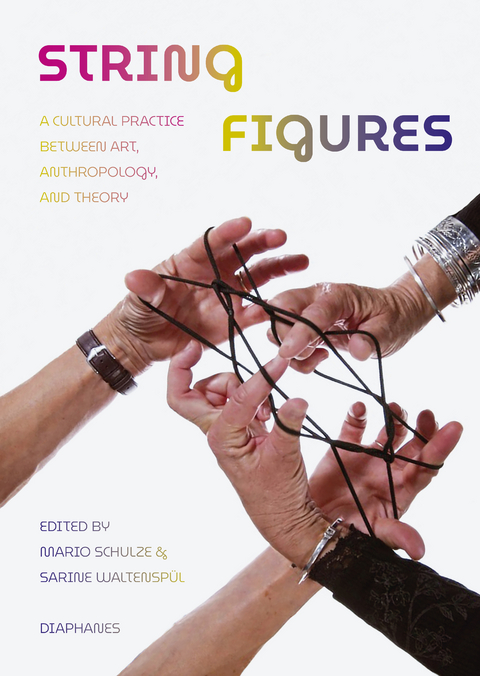
Stretched between eight fingers and two thumbs, sometimes between teeth and toes, lengths of string make shapes. String figures can do many things: they tell stories, they pass the time, they make the unsayable showable, they connect people. Whatever else they may be, they have often been explored by artists, ethnologists and theorists: as an aesthetic practice, as something to collect, as a non-Western way of thinking.
In recent years, string figures have gained prominence in cultural theory. Donna Haraway promotes string figures as a method of thinking and collaboration between both disciplines and species. Rather than the technicist and rigid metaphor of the network, Haraway's string figures provide a playful, process-oriented, embodied, performative (and non-Western) mode of thought in which responsibility and collaboration are foregrounded.
Looking at ways of playing together on the ruins of our history the publication brings together different threads and seeks to weave connections between world regions and disciplines.
Works by Maya Deren, Harry Smith, Mulkun Wirrpanda, Nasser Mufti, Katrien Vermeire, Caroline Monnet, Toby Christian, Maureen Lander, Andy Warhol and contributions by Paul Basu, Seraina Dür and Jonas Gillmann, Mareile Flitsch, Rainer Hatoum, Ines Kleesattel, Robyn McKenzie, Nasser Mufti, Mario Schulze, Rani Singh, Henry Adam Svec, Éric Vandendriessche, Sarine Waltenspül among others; developed by Mario Schulze and Sarine Waltenspül in collaboration with the Museum Tinguely Basel, Switzerland
Sarine Waltenspül Sarine Waltenspül (*1986, Basel-Stadt, Switzerland) is one of the curators of String Figures / Fadenspiele: A Research Exhibition. She is a media scholar and historian of science focusing on the 20th and 21st centuries, who also works as a filmmaker and curator. She studied philosophy, art history and cultural analysis, theory and history in Basel, Zurich and Berlin, earned a doctorate in media studies, worked at the Zurich University of the Arts, was a fellow at MECS/Lüneburg, Collegium Helveticum/ETH, Deutsches Museum Munich and a visiting professor at the University of Basel. She has co-/led various research projects, currently the Visualpedia project. She is the author of Modelle im Film. Eine kleine Kinogeschichte (2024) and co-author with Mario Schulze of Fließend. Die Geschichte eines wissenschaftlichen Films (2025).
Mario Schulze Mario Schulze (*1986, Halle/Saale, Germany) is one of the curators of String Figures/Fadenspiele: A Research Exhibition. He works as a postdoctoral researcher at the Department of Media Studies of the University of Basel, specializing in the history of scientific films and exhibitions from the 1920s to the present. Mario Schulze holds a doctorate in Cultural Analysis from the University of Zurich. Postdoctoral appointments and Fellowships took him to the Humboldt University of Berlin, University of Lucerne, Collegium Helveticum Zurich and the Zurich University of the Arts. He is the author of Wie die Dinge sprechen lernten. Eine Geschichte des Museumsobjektes 1968–2000 (2017) and coauthor with Sarine Waltenspül of Fließend. Die Geschichte eines wissenschaftlichen Films (2025).
7 - 45 An Introduction to String Figures between Art, Anthropology, and Theory (Mario Schulze, Sarine Waltenspül)49 - 67 Recollections of the String Figures of Yirrkala (Robyn McKenzie)69 - 91 Exhibiting Colonial Entanglements (Paul Basu)93 - 122 Who Owns the Films? Who Shows the Films? (Sarine Waltenspül)123 - 135 Ajarorpoq and TseLtse'no (Rainer Hatoum)137 - 150 Ethnomathematics of String Figure-Making Practices (Eric Vandendriessche)151 - 167 Hesitant Hands on Similar Loops (Mareile Flitsch)171 - 189 Shall We Rather Do String Figures Than Think in Networks? (Mario Schulze)191 - 207 From Buffalo Skin to Intertwined Snakes (Rani Singh)209 - 221 The Pliability of Form (Henry Adam Svec)223 - 243 SF: String Figures as Hexenspiele, "Witches' Games" (Ines Kleesattel)245 - 257 For an Aesthetic of Relating (Seraina Dür, Jonas Gillmann)305 - 308 A Reflection on String Figures and That One Time They Went Viral (David Ket'acik Nicolai)309 - 312 Powered by Indigenous Life and Grit (Adam Piron)313 - 316 Strings, Relations, Associations (Diana Guzmán Mirigõ, Andrea Scholz)317 - 320 A Door to the Imagination (Andres Pardey)321 - 324 Members on All Continents (Mark Sherman)325 - 329 The Disappearance of a Female Ethnographer (Ellen Spielmann)333 - 340 Entangling Forms of Knowledge Production (Maria Julia Fernandes Vicentin)341 - 347 Reconfiguring the Encyclopaedia Cinematographica (Moritz Greiner-Petter)349 - 352 Connections in Time and Space (Stephan Claassen)353 - 358 Te whai waewae a Maui (Moya Lawson)359 - 363 Multispecies Obscenity (Nasser Mufti)365 - 371 Cinema and String Figures (Ute Holl)373 - 378 Against Immediacy (Lynton Talbot)
| Erscheinungsdatum | 10.02.2025 |
|---|---|
| Zusatzinfo | 75 farb. Abb., 75 sw. Abb. |
| Verlagsort | Zürich |
| Sprache | englisch |
| Maße | 160 x 225 mm |
| Gewicht | 454 g |
| Themenwelt | Kunst / Musik / Theater ► Kunstgeschichte / Kunststile |
| Geisteswissenschaften ► Archäologie | |
| Geschichte ► Teilgebiete der Geschichte ► Kulturgeschichte | |
| Sozialwissenschaften ► Ethnologie ► Völkerkunde (Naturvölker) | |
| Sozialwissenschaften ► Soziologie | |
| Schlagworte | Ethnologie • Kulturgeschichte • Spiel • Technikgeschichte • Theoriebildung • Wissenschaftstheorie |
| ISBN-10 | 3-0358-0750-7 / 3035807507 |
| ISBN-13 | 978-3-0358-0750-9 / 9783035807509 |
| Zustand | Neuware |
| Informationen gemäß Produktsicherheitsverordnung (GPSR) | |
| Haben Sie eine Frage zum Produkt? |
aus dem Bereich