Sturmartillerie Crewman
Casemate Publishers (Verlag)
978-1-63624-516-4 (ISBN)
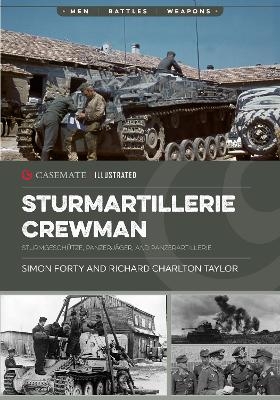
The German procurement process resulted in a wide range of gun-armed armored vehicles—assault guns, tank destroyers and self-propeled artillery—mounting both German and captured guns. Some were developed from existing German chassis; many employed captured enemy vehicles or were built in the factories of the countries they had conquered.
Originally designed as infantry support vehicles, the Sturmgeschütz arm was controlled by the artillery but ended the war having knocked out more enemy tanks than the Panzers. Mainly built on the chassis of the PzKpfw III, particularly after it became obsolete, the StuGs proved durable and effective in infantry support and, when upgunned and even without a turret, as tank killers.
The Germans produced a range of vehicles to fend off enemy armor. They mounted increasingly larger guns on any chassis they could lay their hands on, often captured vehicles—the Marder series on French or Czech chassis. There was also the Jagdpanzer range, better protected with an armored casemate providing overhead armor, based on tank chassis. Heavier Jagdpanzer were produced as the war continued the Hornisse/Nashorn (but without overhead protection), the Ferdinand/Elefant and the Jagdpanther armed with 8.8cm weapons. A few of the massive 12.8cm-armed Jagdtiger appeared before war’s end.
Blitzkrieg showed that the Panzer divisions needed mobile artillery support, so the Germans mounted artillery weapons on tracked chassis: first PzKpfw Is and IIs and then PzKpfw IIIs and 38(t)s. The best known are the Wespe (on the PzKpfw II), the Grille (on the PzKpfw 38(t)), the Hummel (on the Geschützwagen III/IV), and the Sturmpanzer (on the PzKpfw IV).
While some of the crew duties on these vehicles were similar to those of the Panzertruppen, they were completely different vehicles to fight in and fight with: strategically, operationally, tactically and logistically. This fully illustrated book tells the story of the soldiers who crewed these vehicles.
Simon Forty was educated in Dorset and the north of England before reading history at London University’s School of Slavonic and East European Studies. He has been involved in publishing since the mid-1970s, first as editor and latterly as author. Son of author and RAC Tank Museum curator George Forty, he has continued in the family tradition writing mainly on historical and military subjects including books on the Napoleonic Wars and the two world wars. Recently he has produced a range of highly illustrated books on the Normandy battlefields, the Atlantic Wall and the liberation of the Low Countries with co-author Leo Marriott. Richard Charlton Taylor has been schoolteacher, light infantryman and businessman. A collector and trader in World War II militaria, he has worked with Simon Forty on several projects sourcing images and providing detailed military knowledge of weapons, equipment, and tactics.
Introduction
The Soldier
The Units
The Vehicles
Mobility
Tactics and Strategy
Life in the line
Summary
| Erscheinungsdatum | 14.06.2025 |
|---|---|
| Zusatzinfo | 150 photographs |
| Sprache | englisch |
| Maße | 178 x 254 mm |
| Themenwelt | Natur / Technik ► Fahrzeuge / Flugzeuge / Schiffe ► Militärfahrzeuge / -flugzeuge / -schiffe |
| Geschichte ► Allgemeine Geschichte ► 1918 bis 1945 | |
| Geschichte ► Teilgebiete der Geschichte ► Militärgeschichte | |
| ISBN-10 | 1-63624-516-1 / 1636245161 |
| ISBN-13 | 978-1-63624-516-4 / 9781636245164 |
| Zustand | Neuware |
| Informationen gemäß Produktsicherheitsverordnung (GPSR) | |
| Haben Sie eine Frage zum Produkt? |
aus dem Bereich