


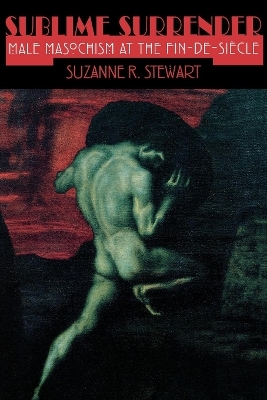
Sublime Surrender
Male Masochism at the Fin-de-siècle
Seiten
1998
Cornell University Press (Verlag)
978-0-8014-3434-1 (ISBN)
Cornell University Press (Verlag)
978-0-8014-3434-1 (ISBN)
When Heinrich Heine left his sick bed in 1848 and stumbled to the Louvre to fall before a statue of the goddess of beauty and lie in the pitying, cold glance she seemed to cast on his prostrate body, he defined a recurring motif of the second half of...
When Heinrich Heine left his sick bed in 1848 and stumbled to the Louvre to fall before a statue of the goddess of beauty and lie in the pitying, cold glance she seemed to cast on his prostrate body, he defined a recurring motif of the second half of the nineteenth century, according to Suzanne R. Stewart. Directing her attention to the voice of the shriveled male body at beauty's feet, she investigates the discourse by and about men that took hold in the German-speaking world between 1870 and 1940 and that articulated masculinity as and through its own marginalization. Male masochism, she suggests, was a rhetorical strategy through which men asserted their cultural and political authority paradoxically by embracing the notion that they were (and always had been) wounded and suffering.
Stewart demonstrates and develops her contentions through close readings of the work of Leopold von Sacher-Masoch, Richard Wagner, and Sigmund Freud, in each case showing that the very act through which men sacrificed themselves to women comprised the essence of the new male subject "deeply penetrated by relations of political and sexual power." Masochistic scenarios, whether in literature, music, the visual arts, or medicalized diagnoses of the fin-de-siècle malaise, stage the male as one who submits, as Stewart explains, "to an aestheticized and eroticized gaze and voice."
When Heinrich Heine left his sick bed in 1848 and stumbled to the Louvre to fall before a statue of the goddess of beauty and lie in the pitying, cold glance she seemed to cast on his prostrate body, he defined a recurring motif of the second half of the nineteenth century, according to Suzanne R. Stewart. Directing her attention to the voice of the shriveled male body at beauty's feet, she investigates the discourse by and about men that took hold in the German-speaking world between 1870 and 1940 and that articulated masculinity as and through its own marginalization. Male masochism, she suggests, was a rhetorical strategy through which men asserted their cultural and political authority paradoxically by embracing the notion that they were (and always had been) wounded and suffering.
Stewart demonstrates and develops her contentions through close readings of the work of Leopold von Sacher-Masoch, Richard Wagner, and Sigmund Freud, in each case showing that the very act through which men sacrificed themselves to women comprised the essence of the new male subject "deeply penetrated by relations of political and sexual power." Masochistic scenarios, whether in literature, music, the visual arts, or medicalized diagnoses of the fin-de-siècle malaise, stage the male as one who submits, as Stewart explains, "to an aestheticized and eroticized gaze and voice."
Suzanne R. Stewart is Assistant Professor of Italian Studies and Comparative Literature at Brown University.
| Erscheint lt. Verlag | 25.6.1998 |
|---|---|
| Reihe/Serie | Cornell Studies in the History of Psychiatry |
| Verlagsort | Ithaca |
| Sprache | englisch |
| Maße | 152 x 229 mm |
| Gewicht | 907 g |
| Themenwelt | Geisteswissenschaften ► Psychologie ► Sozialpsychologie |
| Sozialwissenschaften ► Soziologie ► Gender Studies | |
| ISBN-10 | 0-8014-3434-3 / 0801434343 |
| ISBN-13 | 978-0-8014-3434-1 / 9780801434341 |
| Zustand | Neuware |
| Informationen gemäß Produktsicherheitsverordnung (GPSR) | |
| Haben Sie eine Frage zum Produkt? |
Mehr entdecken
aus dem Bereich



aus dem Bereich
ein Praxismanual zur Unterstützung von Menschen in herausfordernden …
Buch | Hardcover (2023)
Springer Fachmedien Wiesbaden GmbH (Verlag)
CHF 69,95
Buch | Softcover (2025)
Psychiatrie Verlag
CHF 30,80


