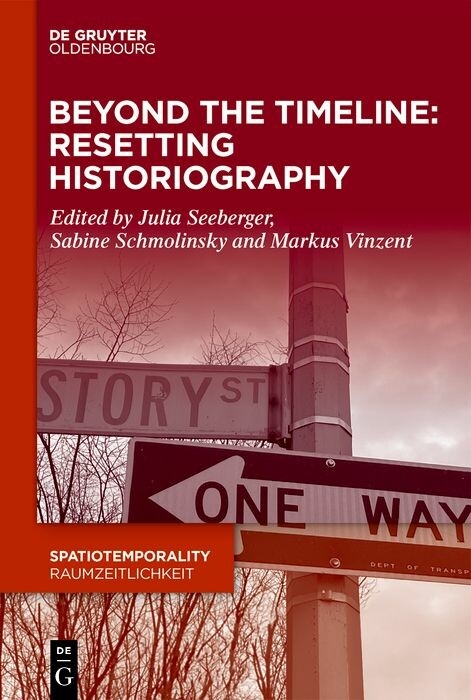
Beyond the Timeline: Resetting Historiography (eBook)
296 Seiten
De Gruyter (Verlag)
978-3-11-116002-3 (ISBN)
Different from literary works (prose, drama etc.) with techniques like montage and contemporary media (film, documentaries, video games, internet) where time-lines are being questioned through flashbacks and flashwords, historiography seems to have resisted such challenges. Most historiographical works (biographies, scholarly studies) still adhere to chronological narratives, even though the boundaries between history and literary fiction have been blurred over the past decades.
Responding to 20th/21st c. attempts like Walter Benjamin's prophetic historian, this volume asks: How to write history without following the chronologically oriented trajectory of time? The interdisciplinary contributions from a broad range of history (medieval, modern, music, sciences), sociology, life sciences, genocide research go back to a symposium that responded to a publication of Markus Vinzent (Writing the History of Early Christianity. From Reception to Retrospection of 2019, Cambridge University Press). The scholars engage with the idea of retrospection as a method of critical historiography.
Writing retrospectively is not simply a matter of presentism, reversing chronology, it disrupts continuities and teleologies and opens creative futures.
| Erscheint lt. Verlag | 21.10.2024 |
|---|---|
| Reihe/Serie | ISSN | SpatioTemporality / RaumZeitlichkeit |
| Sprache | englisch |
| Themenwelt | Geisteswissenschaften ► Geschichte |
| Schlagworte | Geschichtserzählung • medieval historiography • Mittelalterliche Historiographie • Narrating History • Raumzeitlichkeit • retrospection • Retrospektion • Spatio-temporality |
| ISBN-10 | 3-11-116002-5 / 3111160025 |
| ISBN-13 | 978-3-11-116002-3 / 9783111160023 |
| Informationen gemäß Produktsicherheitsverordnung (GPSR) | |
| Haben Sie eine Frage zum Produkt? |
 EPUB (Wasserzeichen)
Größe: 3,2 MB
DRM: Digitales Wasserzeichen
Dieses eBook enthält ein digitales Wasserzeichen und ist damit für Sie personalisiert. Bei einer missbräuchlichen Weitergabe des eBooks an Dritte ist eine Rückverfolgung an die Quelle möglich.
Dateiformat: EPUB (Electronic Publication)
EPUB ist ein offener Standard für eBooks und eignet sich besonders zur Darstellung von Belletristik und Sachbüchern. Der Fließtext wird dynamisch an die Display- und Schriftgröße angepasst. Auch für mobile Lesegeräte ist EPUB daher gut geeignet.
Systemvoraussetzungen:
PC/Mac: Mit einem PC oder Mac können Sie dieses eBook lesen. Sie benötigen dafür die kostenlose Software Adobe Digital Editions.
eReader: Dieses eBook kann mit (fast) allen eBook-Readern gelesen werden. Mit dem amazon-Kindle ist es aber nicht kompatibel.
Smartphone/Tablet: Egal ob Apple oder Android, dieses eBook können Sie lesen. Sie benötigen dafür eine kostenlose App.
Geräteliste und zusätzliche Hinweise
Buying eBooks from abroad
For tax law reasons we can sell eBooks just within Germany and Switzerland. Regrettably we cannot fulfill eBook-orders from other countries.
aus dem Bereich