


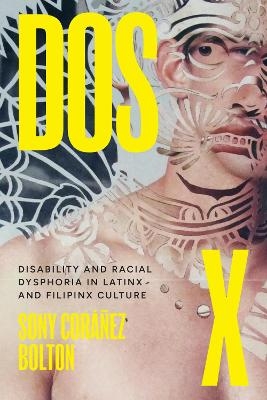
Dos X
Disability and Racial Dysphoria in Latinx and Filipinx Culture
Seiten
2025
University of Texas Press (Verlag)
978-1-4773-3137-8 (ISBN)
University of Texas Press (Verlag)
978-1-4773-3137-8 (ISBN)
Examination of the interconnectedness of brown-racialized people across multiple identities, told through case studies of television, literature, and writing. What does it mean to exist in this liminal state, which Coráñez Bolton dubs the “racial uncanny”? What generative possibilities emerge from the presumed interchangeability of Latinx and Filipinx bodies?
An examination of the interconnectedness of brown-racialized people across multiple identities, told through case studies of television, literature, and writing.
As a Filipinx immigrant to the United States, Sony CorÁÑez Bolton has frequently been mistaken as Mexican. Dos X theorizes such misrecognition. What does it mean to exist in this liminal state, which CorÁÑez Bolton dubs the “racial uncanny”? What generative possibilities emerge from the presumed interchangeability of Latinx and Filipinx bodies-and from the in-betweenness of brownness as such?
Dos X tracks misrecognition through cultural products like the TV series Undone, Brian Ascalon Roley’s American Son, and the nonfiction work of Jose Antonio Vargas. Misrecognition, CorÁÑez Bolton argues, produces moments of uncanniness in which subjects experience dysphoric attachments to identities that aren’t supposed to be theirs. In the context of racial capitalism, racial dysphoria is a disability because it undermines certainty about what one’s body is and therefore what role one is meant to play as a laborer. But racial dysphoria can also be revealing. CorÁÑez Bolton identifies vast potential in this supposed disability, which compels its “sufferers” to confront their shared position within the social, political, and economic organization of capital’s empire, opening new avenues for liberatory solidarity.
An examination of the interconnectedness of brown-racialized people across multiple identities, told through case studies of television, literature, and writing.
As a Filipinx immigrant to the United States, Sony CorÁÑez Bolton has frequently been mistaken as Mexican. Dos X theorizes such misrecognition. What does it mean to exist in this liminal state, which CorÁÑez Bolton dubs the “racial uncanny”? What generative possibilities emerge from the presumed interchangeability of Latinx and Filipinx bodies-and from the in-betweenness of brownness as such?
Dos X tracks misrecognition through cultural products like the TV series Undone, Brian Ascalon Roley’s American Son, and the nonfiction work of Jose Antonio Vargas. Misrecognition, CorÁÑez Bolton argues, produces moments of uncanniness in which subjects experience dysphoric attachments to identities that aren’t supposed to be theirs. In the context of racial capitalism, racial dysphoria is a disability because it undermines certainty about what one’s body is and therefore what role one is meant to play as a laborer. But racial dysphoria can also be revealing. CorÁÑez Bolton identifies vast potential in this supposed disability, which compels its “sufferers” to confront their shared position within the social, political, and economic organization of capital’s empire, opening new avenues for liberatory solidarity.
Sony CorÁÑez Bolton is associate professor of English & Spanish and chair of Latinx and Latin American Studies at Amherst College. He is the author of Crip Colony: Mestizaje, US Imperialism, and the Queer Politics of Disability in the Philippines.
List of Illustrations
Preface: the great bracero
Introduction: Racial Dysphoria
1. Ability as Property: On the Frontier Prosthesis and Colonial Drag
2. Filipinx Spanish: Crip Genres of Anti-Assimilation
3. Filipino Jose, Not Mexican JosÉ: On the Disability Affects of Filipinx Undocumentality and Racial Dysphoria
4. Mad Migrant Imaginary: Asian American and Latinx Disability Politics in Translation
Coda: Basement Archive in the Tropics
Acknowledgments
Notes
Index
| Erscheinungsdatum | 22.05.2025 |
|---|---|
| Reihe/Serie | Latinx: the Future Is Now |
| Zusatzinfo | 6 b&w photos |
| Verlagsort | Austin, TX |
| Sprache | englisch |
| Maße | 152 x 229 mm |
| Gewicht | 286 g |
| Themenwelt | Geschichte ► Teilgebiete der Geschichte ► Kulturgeschichte |
| Sozialwissenschaften ► Ethnologie | |
| Sozialwissenschaften ► Soziologie ► Gender Studies | |
| ISBN-10 | 1-4773-3137-9 / 1477331379 |
| ISBN-13 | 978-1-4773-3137-8 / 9781477331378 |
| Zustand | Neuware |
| Informationen gemäß Produktsicherheitsverordnung (GPSR) | |
| Haben Sie eine Frage zum Produkt? |
Mehr entdecken
aus dem Bereich



aus dem Bereich
Die Revolution des Gemeinen Mannes
Buch | Softcover (2024)
C.H.Beck (Verlag)
CHF 16,80
Eine Geschichte des Geschmacks
Buch | Hardcover (2025)
C.H.Beck (Verlag)
CHF 49,95
vom Mittelalter bis zur Gegenwart
Buch | Softcover (2024)
C.H.Beck (Verlag)
CHF 16,80


