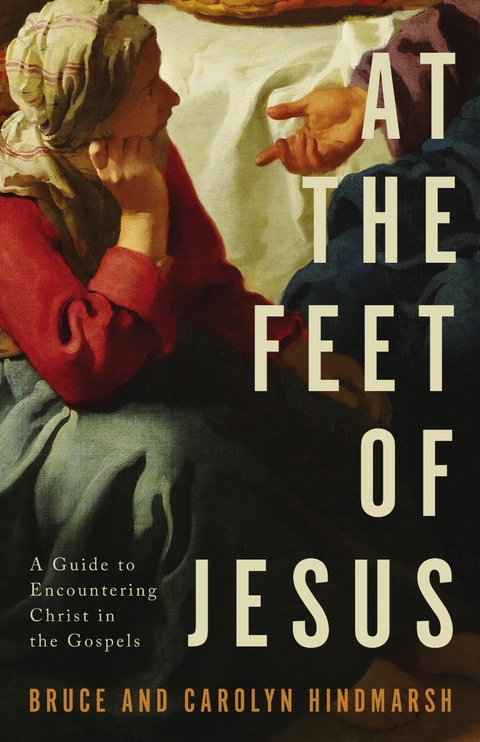
At the Feet of Jesus (eBook)
112 Seiten
IVP (Verlag)
978-1-5140-1054-9 (ISBN)
Bruce Hindmarsh, DPhil (Oxon), is the James M. Houston Professor of Spiritual Theology and professor of the history of Christianity at Regent College in Vancouver. His previous books include The Spirit of Early Evangelicalism and Amazing Grace.
Bruce Hindmarsh, DPhil (Oxon), is the James M. Houston Professor of Spiritual Theology and professor of the history of Christianity at Regent College in Vancouver. His previous books include The Spirit of Early Evangelicalism and Amazing Grace. Carolyn Hindmarsh, DMin (Fuller Seminary) teaches New Testament Greek and spiritual theology at Regent and is a trained spiritual director. Together the couple has led numerous retreats on praying at the feet of Jesus.
Introduction
THE DISCIPLES AT HOME
WHEN WE THINK OF JESUS AND HIS DISCIPLES, we usually think of the twelve who traveled with him in his public ministry and who were uniquely called by him and designated his apostles (Luke 6:13-16). However, we might also think of the three who were his friends and whose home he visited on at least three occasions.
When we first encounter them, we learn that “Martha opened her home to him” (Luke 10:38). We meet Martha and her sister Mary and (later) their brother Lazarus. We might think of Mary, Martha, and Lazarus, therefore, as the domestic disciples. Indeed, Jesus refers to Lazarus as “our friend Lazarus” (John 11:11), and the three are together described as uniquely beloved by him: “Jesus loved Martha and her sister and Lazarus” (John 11:5).
In this small book, we would like to help you, like Martha, to open your home to the Lord Jesus Christ and to consider what it might mean to invite him into this most intimate space. What does it mean to be befriended by Jesus Christ and beloved by him in such an interior way? We are certainly called to follow him in the world as disciples and to share in his public mission. But we are also called to receive him and allow him to enter in and make his home with us.
Jesus is still saying, as he did to the church at Laodicea, “Here I am! I stand at the door and knock. If anyone hears my voice and opens the door, I will come in and eat with that person, and they with me” (Revelation 3:20). Is there any invitation more wonderful or more sacred? How remarkable to have table fellowship with Jesus Christ, to be permitted to be his host, to welcome him, and have him for our guest!
It is at home, behind closed doors, that we dare to voice our greatest hopes and fears, that we experience our deepest joys and sorrows. It is at home that we are known most intimately and fully. In the Gospels, the Lord Jesus chose to visit Martha, Mary, and Lazarus in their ordinary home and to enter fully into their messy lives. On each occasion, his presence made all the difference.
We will consider all three domestic disciples at home in the village of Bethany, but we will focus the spotlight especially on Mary and invite you to follow her in her response to Jesus. By placing yourself there with Mary at the feet of Jesus, you can pray with Mary of Bethany and make her wholehearted response your own.
MAKING A RETREAT
We have designed this book as a prayer retreat. It can be used as a group retreat or as a personal retreat, or can simply be read through as a devotional book, but it is meant above all as an invitation to prayer and to encountering Jesus intimately for yourself. (Suggestions for how to use this book are provided in chapter one.)
It is said of the Spiritual Exercises of Ignatius of Loyola that you do not so much read the Exercises as you make them. So also with this retreat. In this sense, you might think of the chapters that follow like a recipe for a meal. You are meant to make the recipe, and it is in the hands-on sifting, mixing, kneading, baking, and, above all, eating that the beauty of the recipe is experienced. In a way, the recipe should fade away and eventually disappear. There is something much more than the recipe to discover. The words on the page are to be transformed into something felt, handled, touched, and experienced personally.
ENCOUNTERING JESUS
John said of Jesus Christ: “We have seen his glory” (John 1:14). He wrote of a Word “which we have heard, which we have seen with our eyes, which have looked at and our hands have touched” (1 John 1:1). This is meant to be your experience too. The invitation is to a genuine koinonia or fellowship “with the Father and with his Son, Jesus Christ” (1 John 1:3).
Our hope is that this small retreat might help you to deepen your personal response to Jesus. As you follow Mary of Bethany in prayer, you can encounter, with her, the presence of Christ in the midst of your real life and experience today. He comes to you in your home too.
We witness in Jesus Christ the eternal Son of God, begotten of the Father from all eternity. As he “became flesh and made his dwelling among us,” so we are privileged to see in his every word and action the very heart of God (John 1:14). The disciple Philip said, “Lord, show us the Father and that will be enough for us,” and Jesus replied, “Don’t you know me, Philip, even after I have been among you such a long time? Anyone who has seen me has seen the Father” (John 14:8-9).
So, as we follow Jesus throughout the Gospels—as we see him heal Peter’s mother-in-law, teach the multitudes on the mountain, rebuke the religious leaders in the synagogue, cleanse the temple in Jerusalem, and so on—at each and every point we are seeing heaven on earth. The implications of this are profound for us as we read the Gospels and encounter Jesus with the disciples at Bethany.
With every gesture and every utterance, Jesus mediates God to us. Heaven and earth are uniquely joined right here. This invites our close attention.
AN OPENING IN HEAVEN
This is what Nathanael discovered when he first encountered Jesus. Jesus was not only “the one Moses wrote about in the Law, and about whom the prophets also wrote” (John 1:45). He was the new Bethel, or house of God, the place where Jacob’s ladder eternally rests: “You will see ‘heaven open, and the angels of God ascending and descending on’ the Son of Man” (John 1:51; see Genesis 28:12). Here in Jesus Christ, God made flesh, heaven stands open and will remain open forever. Jesus is that opening in heaven even now as we open the Scriptures.
Augustine once described the Scriptures as “the face of God for now,” and he urged us to “gaze intently into it.”1 What did he mean?
You and I were each made to see the face of God, and every Christian heart longs to be able someday to look into the face of love itself. Every human being was created in innocence and purity to walk with God as in a garden. The great promise is that someday we shall be washed, cleansed, and restored by grace; we shall be made fully capable of this. Meanwhile, where do we look to find the face of God turned toward us? Again, “Anyone who has seen me has seen the Father,” says Jesus (John 14:9).
We must look to Jesus. And where do we find him today? Because “the Word was with God, and the Word was God” and because “through him all things were made,” there is nowhere in all creation that God is not speaking, where the Word of God is not articulate (John 1:1-3). “The heavens declare the glory of God” (Psalm 19:1). And God has spoken in the past “at many times and in various ways” (Hebrews 1:1). He continues to speak in nature, in history, in human experience, in all these ways. We should always, everywhere, be listening for what God might be saying to us. All this speech belongs to the one eternal Word who has become human for our sake.2 But all these modes of speech are still only like whispers that have now been gathered into “the full volume of the divine voice in the world” in Jesus Christ.3 To listen to Jesus, we turn to the Scriptures where he is decisively revealed. In the union of the word written and the Word made flesh, we encounter God himself today. Here we may still find Jacob’s ladder joining heaven and earth.
This means we need to pay attention to everything about Jesus. What Jesus is doing in the Gospels he is always doing. Heaven is still open here in Jesus at every moment we encounter him in holy Scripture. The eternal Son of God, the risen and ascended Jesus Christ, is with us now as we read the Gospels today.
If he is the incarnate Word of God, the eternal Son, then he can never be simply past tense.4 He was there in the village of Bethany in the first century. He is here in my room now as I turn the pages of my New Testament.
By the Holy Spirit, the past and present are fused in the burning heat of God’s revelation in Scripture. This is what Jesus promised in the sending of his Spirit: “I will not leave you as orphans; I will come to you” (John 14:18).
JESUS IS PRESENT NOW
This means that as you read about his visit to the home of Martha, Mary, and Lazarus—at the very moment you are reading—Jesus is as present now, as really and truly present to you, as he was to them. These were real events in time and space, a history as real as the moments we live today. Jesus was there and then. But as the eternal Son of God, he is also here and now.
When we speak a word today, the sound of it rings out for a moment and then quickly dies away and all is silent once more. A spoken word is like a word written on the sand. The wind or the waves come over it, and soon enough it disappears. It is not so with the words of Jesus Christ in the Gospels.
These words once spoken have not decayed or faded away. They have no diminishment or half-life. They continue to ring out with the same volume and...
| Erscheint lt. Verlag | 29.4.2025 |
|---|---|
| Verlagsort | Lisle |
| Sprache | englisch |
| Themenwelt | Geisteswissenschaften ► Religion / Theologie ► Christentum |
| Schlagworte | Bethany • Bible study • Contemplation • Devotional • Discernment • experiencing god • Gospels • Group • ignatian • Imagination • Lazarus • Lectio Divina • Martha • Mary • Prayer • Presence • Retreat • Spiritual direction |
| ISBN-10 | 1-5140-1054-2 / 1514010542 |
| ISBN-13 | 978-1-5140-1054-9 / 9781514010549 |
| Informationen gemäß Produktsicherheitsverordnung (GPSR) | |
| Haben Sie eine Frage zum Produkt? |
 EPUB (Wasserzeichen)
DRM: Digitales Wasserzeichen
Dieses eBook enthält ein digitales Wasserzeichen und ist damit für Sie personalisiert. Bei einer missbräuchlichen Weitergabe des eBooks an Dritte ist eine Rückverfolgung an die Quelle möglich.
Dateiformat: EPUB (Electronic Publication)
EPUB ist ein offener Standard für eBooks und eignet sich besonders zur Darstellung von Belletristik und Sachbüchern. Der Fließtext wird dynamisch an die Display- und Schriftgröße angepasst. Auch für mobile Lesegeräte ist EPUB daher gut geeignet.
Systemvoraussetzungen:
PC/Mac: Mit einem PC oder Mac können Sie dieses eBook lesen. Sie benötigen dafür die kostenlose Software Adobe Digital Editions.
eReader: Dieses eBook kann mit (fast) allen eBook-Readern gelesen werden. Mit dem amazon-Kindle ist es aber nicht kompatibel.
Smartphone/Tablet: Egal ob Apple oder Android, dieses eBook können Sie lesen. Sie benötigen dafür eine kostenlose App.
Geräteliste und zusätzliche Hinweise
Buying eBooks from abroad
For tax law reasons we can sell eBooks just within Germany and Switzerland. Regrettably we cannot fulfill eBook-orders from other countries.
aus dem Bereich