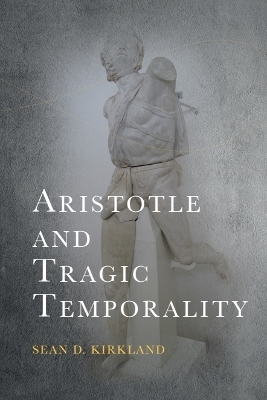
Aristotle and Tragic Temporality
Edinburgh University Press (Verlag)
978-1-3995-3645-5 (ISBN)
Aristotle and Tragic Temporality treats a theme that has drawn scholarly attention for millennia: Aristotle on time and our experience of it. It does so, however, in a wholly unprecedented way, grounding its interpretation in his Poetics and Ethics, rather than the natural philosophy of the Physics. Sean D. Kirkland first takes up Aristotle's discussion of our tragic temporal situatedness—our having to act, think, and live always between a determining past we can never fully master and a projected future we can never fully anticipate. It is this condition that comes powerfully to light for Aristotle on stage in the performance of a tragic drama. The familiar Aristotelian ‘virtue ethics’ then becomes something radically new in the transforming light of the Poetics’ temporality - an outline of how humans can inhabit that irremediably tragic condition, never overcoming or suspending it, and arrive nonetheless at something like happiness and excellence.
Sean D. Kirkland is Professor of Philosophy at DePaul University and serves as the Co-Director of DePaul's Institute for Nature and Culture. He specializes in ancient Greek philosophy, as well as 19th and 20th century continental philosophy. He is the author of Heidegger and the Destruction of Aristotle (Northwestern, 2023) and The Ontology of Socratic Questioning (SUNY, 2012), as well as co-editor of A Companion to Ancient Philosophy (Northwestern, 2018) and The Returns of Antigone (SUNY, 2014).
Acknowledgements
Abbreviations
Aristotle Texts Cited
Introduction: An Ancient Metaphysics of Non-Presence
Chapter I. Modern and Postmodern Philosophies of Time and Temporality
1. Modern Time as Either Objective or Subjective: Descartes, Newton, Kant, Husserl
2. Modern Time Imposed on the Aristotelian Text
3. Post-Modern Temporality: Husserl, Bergson, Heidegger
Chapter II. Aristotle’s Dialectic as Proto-Phenomenological Method
1. Endoxa, Phenomenality, and the Dialectical Path in the Topics
2. Aristotle’s Criticisms of ‘Dialectic’
3. Dialectic and the Natural Path in the Physics
4. Phainomena and Legomena as Starting Points for Dialectic
Chapter III. Staging Tragic Temporality in the Poetics
1. Seeing the Telos at the Moment of Genesis
2. The Birth of Tragedy
3. Tragic Theôria, Between Cognitivist and Non-Cognitivist Approaches
4. Mimêsis, Manthanein, and Human Nature
5. The Mimesis of Praxis as Complete, Whole, and of Some Magnitude
Conclusion
Chapter IV. Living with Tragic Temporality in the Ethics
1. The Rational Foundation of Morality for Kant
2. Pierre Hadot and Ancient Philosophy as a Way of Life
3. Living Between the Past and Future Good
4. On the Intellectualism of Ethics in Plato’s Dialogues
5. The Temporality of Phronêsis
6. Past and Future as Sources of Ethical Judgment
Conclusion: The Phenomenology of Chronos in Physics, Book IV.10-14
Bibliography
Index
| Erscheinungsdatum | 04.02.2025 |
|---|---|
| Reihe/Serie | Cycles |
| Verlagsort | Edinburgh |
| Sprache | englisch |
| Maße | 156 x 234 mm |
| Themenwelt | Geisteswissenschaften ► Philosophie ► Ethik |
| Geisteswissenschaften ► Philosophie ► Philosophie Altertum / Antike | |
| Geisteswissenschaften ► Philosophie ► Philosophie der Neuzeit | |
| ISBN-10 | 1-3995-3645-1 / 1399536451 |
| ISBN-13 | 978-1-3995-3645-5 / 9781399536455 |
| Zustand | Neuware |
| Informationen gemäß Produktsicherheitsverordnung (GPSR) | |
| Haben Sie eine Frage zum Produkt? |
aus dem Bereich