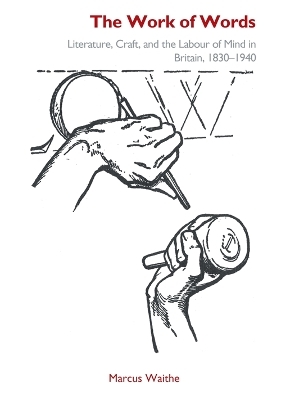
The Work of Words
Edinburgh University Press (Verlag)
978-1-3995-1230-5 (ISBN)
Rather than focus on the well-known ‘dignity of literature’ debate, whereby authors such as Dickens sought to establish authorship as a middle-class profession, The Work of Words considers the alternative path of middle-class writers who re-presented literature as a manual craft. Unlike many works in the field, it extends beyond the mid-Victorian novel as a generic and historical focus, to address its aesthetic and political afterlife right up to the periods of Guild Socialism, modernism and European fascism. Given the tilt of world trade towards China, and more recent supply chain shocks, it is not just writers who are haunted by a lost world of material production, but much of the de-industrialised West. By studying the Victorian attempt to make composition (and related mental processes) palpable, this book takes the long view on questions that still trouble us, and responds to recent concerns, whether as manifested through the revival of craft and workshop culture, or debates about the visibility, weight and worth of the humanities.
Marcus Waithe is University Senior Lecturer; and Fellow in English, Magdalene College, University of Cambridge. His published books include Thinking through Style: Non-Fiction Prose of the Long Nineteenth Century, ed. with Michael Hurley (OUP, 2018), The Labour of Literature in Britain and France: Authorial Work Ethics, ed. with Claire White (Palgrave, 2018) and William Morris’s Utopia of Strangers: Victorian Medievalism and the Ideal of Hospitality (D.S. Brewer, 2006).
Preface
Introduction
I. ANXIOUS VOCATIONS
Chapter 1. Carlyle’s ‘Author Craft’i. Books and Buildingsii. Carlyle’s ‘Craftmanship' iii. The Pen and the Hammer
Chapter 2. Ford Madox Brown Among the Brain-Workersi. Seeming Idlenessii. Idle Observersiii. Disciplines of a Diarist
II. WRITERS AT WORK
Chapter 3. Barrett Browning’s Poetic Vocationi. ‘Song is work’: Barrett Browning’s Poetic Labourii. ‘The writer bodily’: Women and Workiii. Letters, Invalidism, and Poetic Labour
Chapter 4. Participant Observers: Gladstone, Ruskin, and Morrisi. Gladstone’s Odyssean Toolshopii. John Ruskin, Professor of Diggingiii. Morris’s Song-Craft
III. CRAFT CONSCIOUSNESS
Chapter 5. Songs of the Forgei. Harmonious Blacksmithsii. Nail-bearers: Ruskin’s Fors Clavigeraiii. Hopkins’s Poetic Anvil
Chapter 6. Modernism and the Maker i. ‘My mind strikes work’: Olive Schreiner and the Ecstatic Wordii. Gill’s Letter-Craftiii. Rusty Chisels: Pound, Prejudice, and Poetic Apprenticeship
Conclusion: Writing as Working
| Erscheinungsdatum | 13.11.2024 |
|---|---|
| Zusatzinfo | 14 black and white illustrations |
| Verlagsort | Edinburgh |
| Sprache | englisch |
| Maße | 156 x 234 mm |
| Themenwelt | Literatur ► Anthologien |
| Geisteswissenschaften ► Sprach- / Literaturwissenschaft ► Anglistik / Amerikanistik | |
| Geisteswissenschaften ► Sprach- / Literaturwissenschaft ► Literaturwissenschaft | |
| ISBN-10 | 1-3995-1230-7 / 1399512307 |
| ISBN-13 | 978-1-3995-1230-5 / 9781399512305 |
| Zustand | Neuware |
| Informationen gemäß Produktsicherheitsverordnung (GPSR) | |
| Haben Sie eine Frage zum Produkt? |
aus dem Bereich