


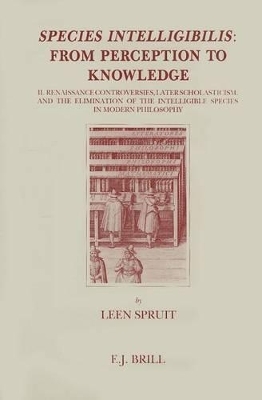
Species intelligibilis: From Perception to Knowledge
2. Renaissance Controversies, Later Scholasticism, and the Elimination of the Intelligible Species in Modern Philosophy
Seiten
1995
Brill (Verlag)
9789004103962 (ISBN)
Brill (Verlag)
9789004103962 (ISBN)
The main purpose of this book is to offer a comprehensive historical analysis of the discussions on a crucial problem for the early modern theory of knowledge: the formal mediation of sensible reality in intellectual knowledge.
Medieval discussions of mental representation were constrained in essential ways by Thomas Aquinas' doctrine of intelligible species. Aquinas' view of a formal mediation of sensible reality in intellectual knowledge was not universally accepted. In particular, after his death, a long series of controversies developed about the necessity of intelligible species. (These were analyzed in the first volume of this study.) The first part of this book deals with Renaissance controversies, discussing Peripatetics, Neoplatonics, and a group of relatively independent authors. In the second part, developments of late Scholasticism, and the elimination of the intelligible species in modern non-Aristotelian philosophy are scrutinized. Particular attention is paid to the possible roots of the seventeenth-century theories of ideas in traditional philosophy.
Medieval discussions of mental representation were constrained in essential ways by Thomas Aquinas' doctrine of intelligible species. Aquinas' view of a formal mediation of sensible reality in intellectual knowledge was not universally accepted. In particular, after his death, a long series of controversies developed about the necessity of intelligible species. (These were analyzed in the first volume of this study.) The first part of this book deals with Renaissance controversies, discussing Peripatetics, Neoplatonics, and a group of relatively independent authors. In the second part, developments of late Scholasticism, and the elimination of the intelligible species in modern non-Aristotelian philosophy are scrutinized. Particular attention is paid to the possible roots of the seventeenth-century theories of ideas in traditional philosophy.
Leen Spruit received his Ph.D. in philosophy (1987) from the University of Amsterdam. He has been research fellow at the Universities of Amsterdam and Utrecht. His main interests are in the history of Medieval and early modern epistemology. He currently lives in Rome.
| Erscheint lt. Verlag | 1.7.1995 |
|---|---|
| Reihe/Serie | Species Intelligibilis: From Perception to Knowledge ; BD 2 | 1.20 |
| Verlagsort | Leiden |
| Sprache | englisch |
| Maße | 155 x 235 mm |
| Gewicht | 1031 g |
| Einbandart | Leinen |
| Themenwelt | Geisteswissenschaften ► Philosophie ► Erkenntnistheorie / Wissenschaftstheorie |
| Geisteswissenschaften ► Philosophie ► Philosophie des Mittelalters | |
| Sozialwissenschaften | |
| ISBN-13 | 9789004103962 / 9789004103962 |
| Zustand | Neuware |
| Informationen gemäß Produktsicherheitsverordnung (GPSR) | |
| Haben Sie eine Frage zum Produkt? |
Mehr entdecken
aus dem Bereich

aus dem Bereich
Buch | Softcover (2023)
Reclam, Philipp (Verlag)
CHF 9,80
die Evolution des Geistes
Buch | Softcover (2025)
Suhrkamp (Verlag)
CHF 41,95


