


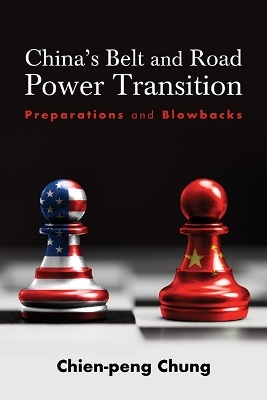
China's Belt and Road Power Transition
Preparations and Blowbacks
Seiten
2025
State University of New York Press (Verlag)
979-8-8558-0092-0 (ISBN)
State University of New York Press (Verlag)
979-8-8558-0092-0 (ISBN)
Details the Belt and Road global infrastructure development initiative as the most important instrument for China's leadership under Xi Jinping to create an alternative global economic and geopolitical order to challenge the United States.
In the opening decades of the twenty-first century the Chinese Communist Party (CCP) leadership under Xi Jinping has created a worldwide Sino-centric network, the Belt and Road Initiative (BRI), to challenge American dominance in world affairs. Encompassing economic, financial, political, and strategic relations, the CCP's belief is that the funds, construction projects, and promises offered by the BRI will generate a widespread perception of the inexorability, legitimacy, and thus acceptability of a Chinese world order. Consisting initially of a land-based "Silk Road Economic Belt," an oceangoing "Maritime Silk Road," and the China-Pakistan Economic Corridor, the BRI has expanded to involve more than 140 countries and includes a Health Silk Road, Digital Silk Road, and Polar Silk Road, but it has also experienced serious challenges. Using power transition theory, Chien-peng Chung carefully investigates and evaluates the enterprise's benefits and shortcomings, concluding that it is still too early to consider the BRI a success.
In the opening decades of the twenty-first century the Chinese Communist Party (CCP) leadership under Xi Jinping has created a worldwide Sino-centric network, the Belt and Road Initiative (BRI), to challenge American dominance in world affairs. Encompassing economic, financial, political, and strategic relations, the CCP's belief is that the funds, construction projects, and promises offered by the BRI will generate a widespread perception of the inexorability, legitimacy, and thus acceptability of a Chinese world order. Consisting initially of a land-based "Silk Road Economic Belt," an oceangoing "Maritime Silk Road," and the China-Pakistan Economic Corridor, the BRI has expanded to involve more than 140 countries and includes a Health Silk Road, Digital Silk Road, and Polar Silk Road, but it has also experienced serious challenges. Using power transition theory, Chien-peng Chung carefully investigates and evaluates the enterprise's benefits and shortcomings, concluding that it is still too early to consider the BRI a success.
Chien-peng Chung is Professor of Political Science at Lingnan University, Hong Kong.
List of Abbreviations
Preface
Introduction: The Greatest Roadshow on Earth
1. Introducing China's Belt-and-Road Initiative
2. The Silk Road Economic Belt: Bringing Together China's Eurasian Forums
3. Reimagining the 21st Century Maritime Silk Road
4. China's "Health Silk Road" Diplomacy
5. China's Evolving Belt-and-Road Initiative
6. Blowback to the Belt-and-Road Initiative Power Transition
Conclusion
Notes
References
Index
| Erscheinungsdatum | 03.01.2025 |
|---|---|
| Reihe/Serie | SUNY series, James N. Rosenau series in Global Politics |
| Zusatzinfo | 1 Maps |
| Verlagsort | Albany, NY |
| Sprache | englisch |
| Maße | 152 x 229 mm |
| Gewicht | 454 g |
| Themenwelt | Geisteswissenschaften ► Geschichte ► Regional- / Ländergeschichte |
| Sozialwissenschaften ► Politik / Verwaltung ► Europäische / Internationale Politik | |
| Wirtschaft ► Volkswirtschaftslehre ► Wirtschaftspolitik | |
| ISBN-13 | 979-8-8558-0092-0 / 9798855800920 |
| Zustand | Neuware |
| Informationen gemäß Produktsicherheitsverordnung (GPSR) | |
| Haben Sie eine Frage zum Produkt? |
Mehr entdecken
aus dem Bereich


aus dem Bereich
die Geschichte meiner Urgroßmutter
Buch | Hardcover (2025)
C.H.Beck (Verlag)
CHF 32,15
Träume und Macht : eine Biografie
Buch | Hardcover (2025)
C.H.Beck (Verlag)
CHF 61,60


