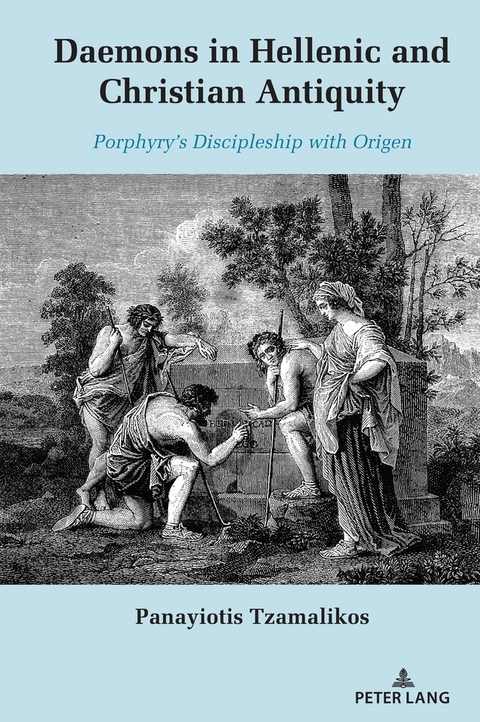
Daemons in Hellenic and Christian Antiquity
Peter Lang Publishing Inc (Verlag)
978-1-63667-405-6 (ISBN)
By critical comparative study of Origen’s Contra Celsum and Porphyry’s De Abstinentia, author Panayiotis Tzamalikos establishes beyond doubt that Porphyry’s conception of daemons took its cue overwhelmingly from his predecessor’s theories on the subject. Porphyry adopted Origen’s ideas (and, at crucial points, his vocabulary) on daemons, at times very closely, thereby setting his daemonology apart from that of other Greek schools, while also he employed terminology interweaving Greek and Christian language. Throughout this inquiry, the author also builds further evidence that there was only one Origen, and that the modern invention of ‘two Origens’ (one ‘Platonist’, the other ‘Christian’) is untenable.
This book is set to revolutionise understanding of the relationship between Greek philosophy and Christianity in Late Antiquity.
Panayiotis Tzamalikos, MSc, MPhil, PhD, is Professor of Philosophy at the Aristotle University of Thessaloniki. His books include The Concept of Time in Origen (1991 –his Phd at the University of Glasgow, 1987); Origen: Cosmology and Ontology of Time (2007); Origen: Philosophy of History and Eschatology (2007); A Newly Discovered Greek Father – Cassian the Sabaite eclipsed by John Cassian of Marseilles (2012); The Real Cassian Revisited – Monastic Life, Greek Paideia, and Origenism in the Sixth Century (2012); An Ancient Commentary on the Book of Revelation – A critical edition of the Scholia in Apocalypsin (2013); Anaxagoras, Origen, and Neoplatonism – The Legacy of Anaxagoras to Classical and Late Antiquity (2 vols. 2016); Origen: New Fragments from the Commentary on Matthew (2020); Origen and Hellenism – The Interplay Between Greek and Christian Ideas in Late Antiquity (2022); Guilty of Genius – Origen and the Theory of Transmigration (2022); The Wisdom of Solomon and the Byzantine Reception of Origen (2023).
CONTENTS
INTRODUCTION
Tensions in Late Antiquity
Origen and the Greeks
The figment ‘Christian Platonism’
The ‘mind that comes from without’ (θύραθεν νοῦς)
Tentative statements for mental exercise’ (γυμνασία).
Rufinus’ translation
Greeks on Philology, Philosophy, and Theology
CHAPTER 1: What is a daemon?
CHAPTER 2: Greeks on daemons
CHAPTER 3: Angels and daemons
The need for a systematic theory
Names and correlative activity
Angels as surrogates of divinity
Daemons and angels
CHAPTER 4: Origen and Porphyry: a tender relationship
Porphyry and ‘certain Platonists’
Symmetric and asymmetric bodies
Wickedness as irrationality
Rationality and human conduct
The rational soul and passions
CHAPTER 5: Wrestling against daemons
CHAPTER 6: Names and correlative activity
CHAPTER 7: Philosophical affinities
CONCLUSION
| Erscheinungsdatum | 22.08.2024 |
|---|---|
| Sprache | englisch |
| Maße | 152 x 229 mm |
| Gewicht | 1147 g |
| Themenwelt | Geisteswissenschaften ► Philosophie ► Philosophie Altertum / Antike |
| Religion / Theologie ► Christentum ► Bibelausgaben / Bibelkommentare | |
| Religion / Theologie ► Christentum ► Kirchengeschichte | |
| Geisteswissenschaften ► Sprach- / Literaturwissenschaft ► Anglistik / Amerikanistik | |
| Geisteswissenschaften ► Sprach- / Literaturwissenschaft ► Literaturwissenschaft | |
| ISBN-10 | 1-63667-405-4 / 1636674054 |
| ISBN-13 | 978-1-63667-405-6 / 9781636674056 |
| Zustand | Neuware |
| Informationen gemäß Produktsicherheitsverordnung (GPSR) | |
| Haben Sie eine Frage zum Produkt? |
aus dem Bereich